


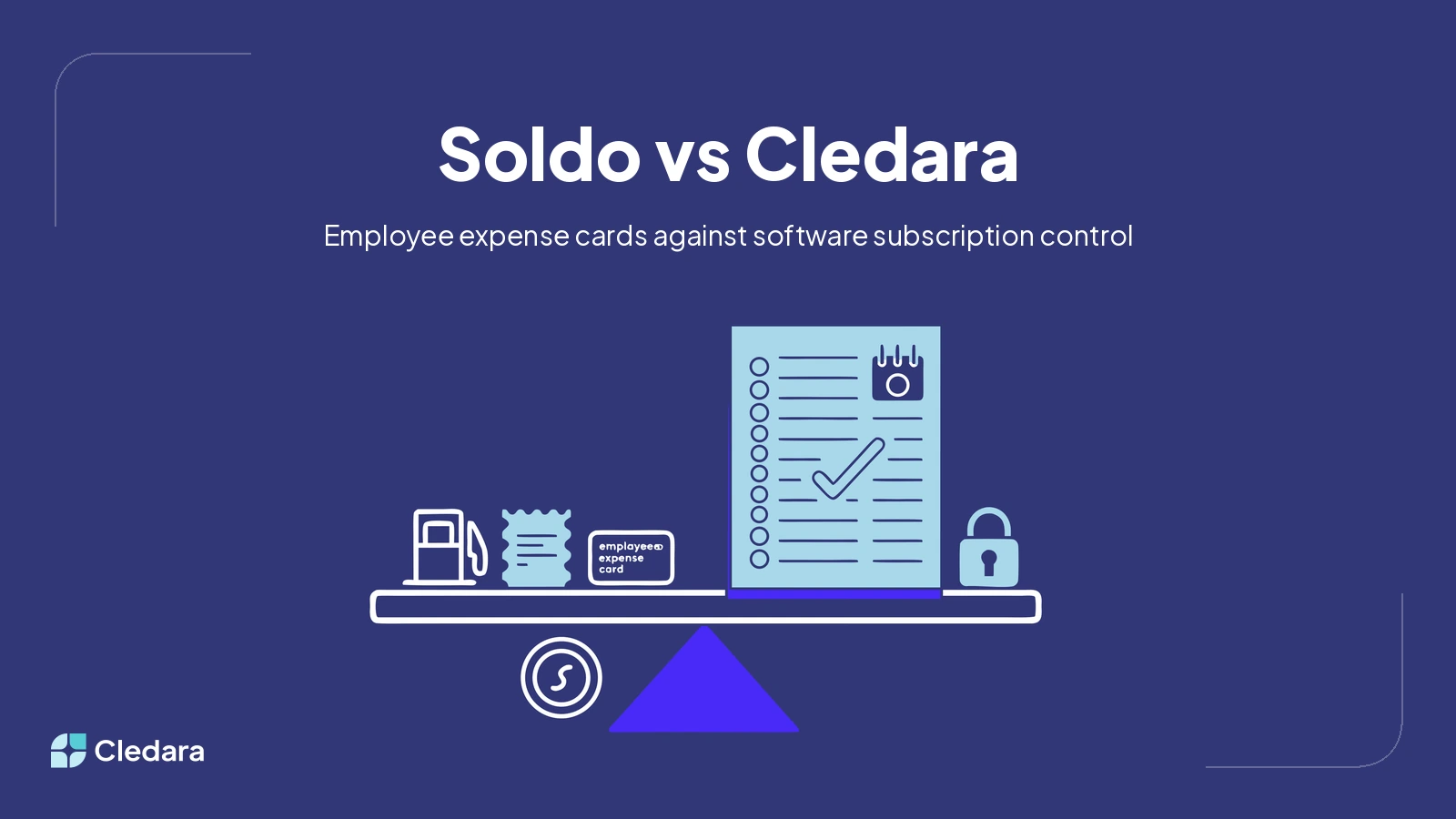

When you're evaluating spend management tools for your organization, the choice between Soldo and Cledara often comes down to a fundamental question: are you trying to control physical employee spending (meals, travel, supplies) or manage your growing software subscription costs?
Both platforms offer virtual cards, real-time visibility, and receipt capture. But they're built for different problems. Soldo is a European corporate card platform designed for general employee spending across 30+ countries. Cledara is a specialist SaaS subscription management platform that tackles software renewals, duplicate detection, and vendor management.
This guide walks through the key differences, helping you pick the right tool for your spend category.
| Feature | Soldo | Cledara |
|---|---|---|
| Primary Use Case | Employee cards for travel, meals, supplies | SaaS subscription and software spend |
| Virtual Cards | Yes, with spending limits | Yes, one per subscription |
| Physical Cards | Yes, across 30+ countries | No |
| Subscription Renewal Tracking | No | Yes, core feature |
| Duplicate Detection | No | Yes, flags redundant tools |
| Receipt Capture | Yes, automatic | Yes, from invoices |
| Real-time Spend Visibility | Yes, with analytics | Yes, with AI insights |
| Benchmarking | No | Yes, against peer spending |
| Spending Limits by User | Yes, granular controls | Per-subscription controls |
| Multi-Currency Support | Yes, 30+ countries | Yes, USD, GBP, EUR |
| G2 Rating | 4.5/5 (188 reviews) | 4.6/5 (248 reviews) |
| Best For | Teams with high employee spending | Teams with 20+ SaaS subscriptions |
Soldo: Built for Physical Spending
Soldo started with a simple insight: corporate card programs are built for a pre-cloud era, when most business spending was offline. The platform offers physical cards issued to employees across 30+ countries, alongside virtual cards with customizable spending limits.
The strength of Soldo is its breadth. You can assign cards to teams, departments, or cost centers. Set per-card spending limits. Capture receipts automatically. Block merchants or geographies. For a team where employees regularly buy travel tickets, meals, or office supplies, Soldo handles this smoothly.
Soldo integrates with major accounting systems like Xero, QuickBooks, and NetSuite. That matters when your controller needs transaction data flowing into the GL without manual entry.
The downside: Soldo has zero awareness of software subscriptions. It doesn't track when your annual Salesforce license renews, whether you're paying for redundant tools, or how your software spend compares to similar companies. Those gaps don't hurt if you're managing office expenses. They're painful if you're drowning in SaaS bills.
Cledara: Purpose-Built for Software Spend
Cledara solves a different problem entirely. Modern companies spend 20% to 40% of their tech budget on SaaS tools, yet most organizations can't answer basic questions: What subscriptions do we have? Which ones renew next month? Are we paying for two competing tools?
Cledara's core features address those gaps directly. Renewal tracking sends alerts weeks before your Slack or Figma license comes due. Duplicate detection flags similar tools (like multiple VPN services) so you can consolidate. Each subscription gets its own virtual card; you can pause, control, or cancel without manual payment updates. AI-powered spend insights highlight spikes and trends. Benchmarking shows how your SaaS spend stacks against peer companies.
Cledara also handles multi-currency (USD, GBP, EUR), so teams spanning Europe and North America can manage subscriptions in their native currency without fx drama.
The trade-off: Cledara doesn't issue physical cards. There's no way to hand a Cledara card to an employee for a business dinner or taxi ride. It's designed entirely for SaaS and digital vendor payments.
Card Acceptance and Reliability
One recurring theme in Soldo reviews is merchant acceptance. Some reviewers report that Soldo cards are declined or blocked unexpectedly, especially with tech vendors. Google and Meta, for instance, are known to reject Soldo cards as payment methods for ad accounts. Decline reasons are sometimes unclear, adding friction to the support process.
Cledara avoids this entirely because it doesn't rely on card acceptance. Subscriptions are billed directly to your payment method (Stripe, for example), then Cledara issues a virtual card for that subscription. The vendor doesn't see Cledara at all; they see your connected bank account. That eliminates the merchant acceptance problem altogether.
Pricing and Setup Costs
Soldo's base pricing is reasonable for small teams, but reviewers frequently flag that adding extra cards or features gets expensive quickly. G2 comments mention that issuance fees, card upgrade charges, and additional integrations stack up. The initial setup also takes time; some reviewers report multi-week onboarding and configuration.
Cledara's pricing scales with the number of subscriptions you manage, not the number of employees or cards. For teams with 20 to 200 SaaS tools, this is typically much cheaper than Soldo's per-card model. There's less to configure up front; Cledara auto-discovers many of your existing subscriptions by analyzing your invoice inbox.
Global vs. European Focus
Soldo is strongest in Europe and the UK, with 25,000+ organizations across 30+ countries. Physical card issuance is its main differentiator, and that's easiest to deliver in regions with established banking partnerships. If your team is mostly in the UK or EU, Soldo's card network is polished. If you're in Asia or South America, coverage is thinner.
Cledara is designed for global SaaS teams from day one. Most subscriptions (Slack, Figma, HubSpot) operate globally with no regional boundaries. Currency support (USD, GBP, EUR) covers the major zones. There's less friction in multi-region deployments.
What G2 Reviewers Say About Soldo
Strengths: Reviewers praise Soldo for ease of card issuance, spending limit controls, and receipt capture. Teams managing high employee spending say the platform saves time on expense reporting. Multi-currency support is appreciated by distributed teams.
Pain Points: Complaints cluster around three areas. First, pricing: extra cards and features add up. Second, card reliability: unexpected declines, especially with tech vendors, cause friction. Third, clarity: when a card is blocked, understanding the reason requires support tickets. Some reviewers also note setup complexity and initial configuration time.
Choose Soldo If / Choose Cledara If
Choose Soldo if:
- You have a team that regularly spends on travel, meals, and office supplies
- You're based primarily in Europe or the UK
- You want a single platform for physical and virtual cards with spending controls
- You need accounting integration (Xero, QuickBooks) for transaction posting
- Your merchant network (suppliers, vendors) accepts card payments reliably
Choose Cledara if:
- You're managing 20 or more SaaS subscriptions and need visibility into renewal dates
- You want to identify and eliminate duplicate tools and overlapping licenses
- Your biggest budget leak is software spending, not travel or office expenses
- You're a global team working across multiple currencies
- You want AI-powered insights and peer benchmarking on software spend
The Verdict
Soldo and Cledara are not competitors in the traditional sense. They solve adjacent problems with different tools. Soldo is a corporate card platform; Cledara is a SaaS subscription manager. A large organization might use both: Cledara to manage software spend and Soldo to manage employee cards for travel and meals.
The real choice is about your biggest pain point. If you're worried about employees overspending on business meals and trips, or if you need card controls across a distributed team, Soldo excels. If you're losing track of your software bills, missing renewal deadlines, or suspecting you're paying for duplicate tools, Cledara is purpose-built to solve that.
For most modern tech teams, software spend is the larger and more complex category. Cledara's focus on renewals, duplicates, and SaaS-specific insights tends to deliver faster ROI. But for teams with high physical spending, Soldo's card capabilities are hard to beat.


