



Zoom vs Google Meet vs Microsoft Teams: The Video Conferencing Spend Data (2026)
If you ask people "what's the best video conferencing tool," you'll get different answers depending on whether they're engineers, sales people, or compliance officers. But if you look at actual spending patterns, the answer is more clear: it's all of them, and companies are paying for redundancy whether they intend to or not.
The Adoption Landscape
Zoom maintains the strongest adoption: 37.3% of companies in Cledara's data use Zoom as a primary or secondary video platform. But it's not a monopoly. Google Meet is at 31%, and Teams is at 34%. (Many companies use multiple platforms, so these add to more than 100%.)
The interesting part is the spending breakdown:
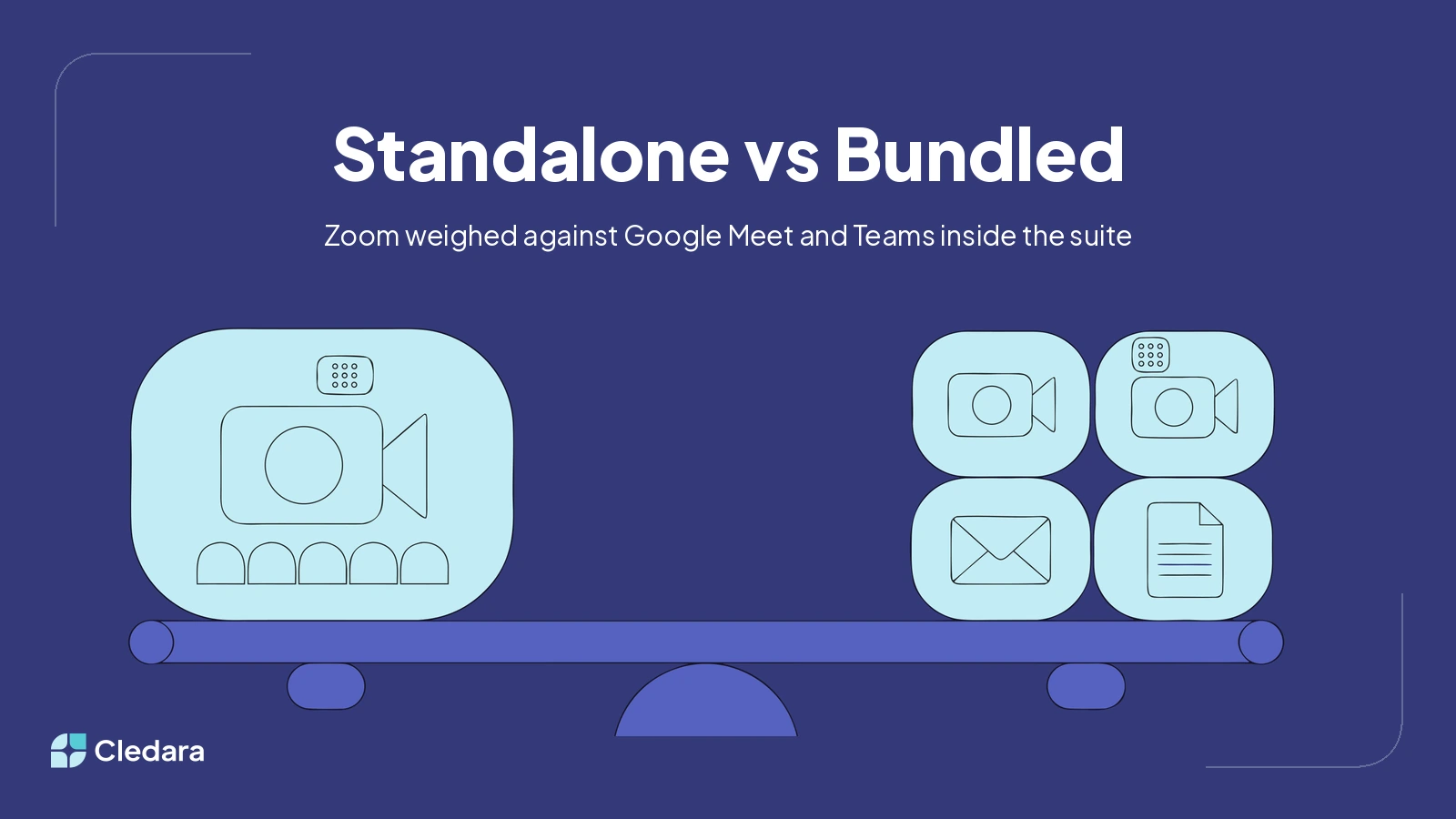
Zoom spend is the highest for a standalone video tool. Google Meet's spend is low because it's mostly free (bundled with Google Workspace). Teams spend is highest, but that's a false equivalence—Teams is part of a larger bundle, and most of that spend isn't video conferencing; it's email, Office, and cloud storage.
Why Zoom Is Still Winning (On the Video Conferencing Front)
Zoom's advantage is specialization. Zoom does video conferencing better than the alternatives. It has better reliability, cleaner UI, superior gallery view, better recording, and integrations with basically everything. The $8,391 average spend reflects heavy users—people who hold multiple calls per day.
Zoom's pricing is also simple. Pro is $199/year per user (or $16/month). Business is $199/month for 10-300 users. Enterprise negotiates. You know what you're paying for: video conferencing.
The killer feature, though, is network effects. If everyone you meet with expects to dial into Zoom, other tools become friction. Your company might be on Teams, but you still add Zoom because clients, partners, and external stakeholders use Zoom. It's the default video platform in a way that's hard to dislodge.
Google Meet Is Winning on Accessibility
Google Meet's low average spend masks its reach. It's bundled free with Google Workspace, so the marginal cost of a new user is zero. If you're already paying for Workspace (Gmail, Drive, Docs), Meet is just there.
This is why adoption is high but spend is low. 31% of companies use it, but most of them aren't paying for Meet specifically; they're paying for Workspace, and Meet comes with it.
For internal-only meetings (all-hands, team stand-ups, one-on-ones), Google Meet is increasingly sufficient. It's free, it's simple, and it's good enough for 80% of use cases.
Teams Is the Bundled Default
Teams adoption is high (34% of companies) because Microsoft 365 adoption is ubiquitous. But here's the paradox: most people prefer not using Teams for video if they can avoid it. Teams calls work, but they're clunky. The UI is optimized for messaging more than video. Gallery view is fine, but not as polished as Zoom.
Yet companies keep paying for Teams because it's part of the Microsoft 365 contract, which is non-negotiable for most organizations (Outlook, Excel, Word are deal-breakers). Teams comes along for the ride.
The $10,798 average spend isn't because Teams is expensive for video—it's because Microsoft 365 is expensive overall, and video is one feature of many.
The Redundancy Problem
Here's what the data reveals: 41% of companies pay for both Zoom and Teams. Many pay for Zoom, Teams, and Google Meet. This is pure redundancy, and it's expensive.
Why do they do it? Because video conferencing tool choice isn't made centrally anymore. Teams is forced (because Microsoft 365 is mandatory). Zoom is added because engineers, product teams, and external partners demand it. Google Meet gets added because some team is already on Google Workspace.
Consolidation doesn't happen because the cost of removing a tool is organizational friction, not money. Telling your company "we're eliminating Zoom" requires getting everyone to be fine with Teams. Good luck with that.
What's Changing
Two things are worth watching in 2026-2027:
1. AI-Enhanced Video - Teams is investing heavily in AI features (noise suppression, background blur, speaker attribution). Zoom is doing the same. Google Meet is catching up. This could be a differentiator for teams that care about call quality and post-call summaries.
2. Embedded Video - Video conferencing is becoming an embedded feature rather than a standalone tool. Slack added huddles (lightweight calls). Linear and Figma are adding video comments. Airtable has integrations. The future might be less "pick a video tool" and more "video is available everywhere."
For now, Zoom is the specialist, Google Meet is the freebie, and Teams is the bundled feature nobody chose but everyone has. All three are here to stay because switching costs are real and organizational preferences are sticky.
The winner isn't decided by technical superiority. It's decided by lock-in, network effects, and organizational inertia.


