


The most expensive software in your company is on a card finance has never seen
Here's a funny thing about engineering software spend. The tools that cost the most and grow the fastest (the AI models, the coding assistants, the cloud bill) are almost never bought through the process finance designed. They're bought by the CTO, on the CTO's card, at eleven at night, because a model needed an API key and the team needed it then.
Nobody did anything wrong. The CTO is the right person to decide which tools engineering uses, and waiting a week for a purchase order would have been silly. But it means the biggest and least predictable line in the software budget starts life outside the system, and finance meets it for the first time as a card statement at month end. True story: one finance lead told us recently that their CTO personally logs in to every provider to download the invoices, and that she had no idea how long it took him. I'll let you guess how he feels about that job.
Key takeaways
- Engineering is the second most diverse buyer in the company: Cledara tracks over 1,100 distinct engineering tools, and engineering's share of software spend on the platform rose from 15.5% to 17% in the past year.
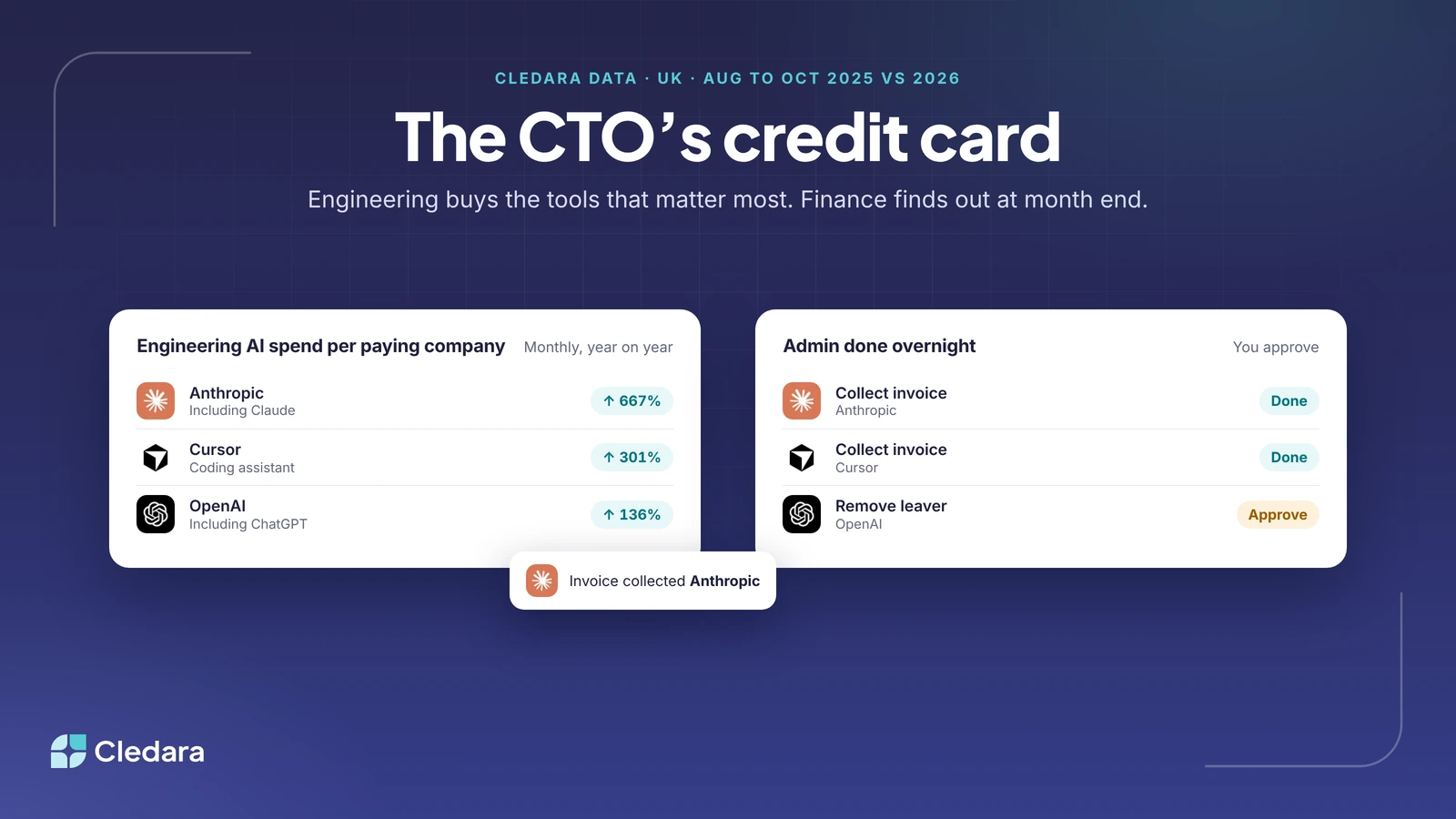
- The fastest-growing engineering tools bill on usage: spend per paying UK company rose 667% on Anthropic (including Claude), 301% on Cursor and 136% on OpenAI (including ChatGPT) year on year.
- Most of this is bought on one person's card or a single corporate card, so finance sees it late and sees it as a lump.
- The fix is to make the right way the easy way: a card per tool, an owner per tool, a budget per AI key, and an agent that does the invoice chasing.
- CTOs are better at tool choice than finance will ever be. Let them choose; take the admin off them.
How engineering ended up buying software on a credit card
Twenty years ago engineering didn't buy software, it built it. The tools engineers used came from IT or were free. Then came the cloud, and with it a generation of developer tools you could start using with an email address and a card: hosting, monitoring, CI, error tracking, a code host. Each one was cheap to start and expensive to stop, and each one was picked by the people who'd use it.
That was a good thing. Engineering teams got the best tools in the world without a procurement cycle, and the companies that let them move fast generally won. But it also set a pattern: engineering tools are bought by engineers, paid on whichever card is to hand, and explained to finance afterwards.
AI has turned the pattern up to eleven. Cledara data shows Cursor is now the fifth most-adopted software tool in our rankings, across every category rather than just engineering. OpenRouter climbed 136 places in the adoption rankings in a year, Lovable climbed 60, and Vercel 12. These are tools that didn't exist, or barely existed, a couple of years ago, and most of them bill partly on usage. The invoice follows the tokens.
What it costs when engineering software spend runs through one card
The CTO doesn't mind buying the tools. What everyone minds is what comes after.
- Finance chases the CTO for invoices. The invoice is behind a login only the CTO has. Month-end waits, VAT goes unreclaimed, and someone very expensive spends their evening downloading PDFs.
- The budget is a surprise. Usage-based tools don't send a renewal quote. They send a bigger bill. One prospect running a large Claude workload told us the token spend was a black box: they could see the total, but not which project or which developer drove it.
- One card means one point of failure. When the card expires or the CTO leaves, the cloud account, the model API and the CI pipeline all fail on the same morning.
- Nobody knows who has what. Seats on coding assistants get added for contractors and never removed. Leavers keep API keys. The owner of each tool is "engineering", which means nobody.
- Finance builds a shadow process. A spreadsheet of engineering tools, maintained by hand, that is wrong within a month.
Our shadow IT research puts unmanaged software at 35% to 40% of total SaaS spend for the median company. In our experience a large share of that sits in engineering, for the simple reason that engineering buys the most tools.
The hidden cost is what the CTO isn't doing
The wasted seats and the late VAT add up, but I think the real cost is that two of the most valuable people in the company are doing admin for each other. The CTO is downloading invoices and answering "what's this £4,000 to Anthropic?" The head of finance is reverse-engineering an engineering budget from card statements.
Every hour the CTO spends on billing portals is an hour not spent on the product. Every hour finance spends reconstructing engineering spend is an hour not spent on the forecast. And the relationship between the two suffers, because the only time they talk about software is when something has gone wrong. Finance becomes the battlefield IT manager, and nobody signed up for that.
What the companies getting this right look like
The future I'd bet on is one where engineering keeps choosing its tools and stops doing their admin, and finance sees every engineering subscription the day it starts rather than the month after. Here's the pattern, from the companies in our data who already work this way.
| What they do | What it replaces |
| A virtual card per tool, with its own limit, instead of the CTO's card | One card holding the cloud account, the model API and the CI pipeline |
| A named owner per tool, usually the engineering lead who picked it | "Engineering" as the owner, which means nobody |
| A budget on every AI key, tracked daily, with a warning before it runs over | A surprise at month end |
| Invoices collected from the vendor's billing page automatically | The CTO downloading PDFs on a Sunday |
| Seats and API keys removed when someone leaves, from every tool | Leavers with access and seats still billing |
| A request route that takes minutes | A request route that takes a week, so people go round it |
The common thread is that none of it slows engineering down. The CTO still picks the tool. The difference is that the tool arrives with a card, an owner and a budget already attached, so finance doesn't need to ask any questions later.
Why this is only possible now
Most of that table was a pain to run until recently. A card per tool used to mean a drawer of plastic. A budget on an AI key meant someone checking a dashboard every morning. And collecting invoices from forty billing portals meant exactly what it sounds like.
Two things changed. Virtual cards made a card per subscription free and instant. And agents made it possible to sign in to a vendor's billing page, download the invoice, match it to the payment and remove a leaver's seat without a human doing any of it. That second part is new. It's why Cledara Agent exists, and it's why finance can now offer engineering a deal that works for both sides: you choose, we'll handle the admin, and you'll never be asked for an invoice again.
How to get engineering software spend under control without slowing engineering down
If you're the head of finance reading this, here's the order I'd do it in. It's a few weeks of work, most of it done once.
- List every engineering tool from payments, not memory. Twelve months of card and bank data, plus whatever the AI providers' billing pages show. Cledara does this from the payments themselves and from the logins its browser extension sees.
- Agree the deal with the CTO. Engineering keeps choosing tools. In return, every tool gets its own card, an owner and a budget. Frame it as taking work off them, because it is.
- Move the AI keys first. Connect OpenAI, Anthropic and Cursor so usage is tracked every day against a budget you set, and the owner and finance are warned before it runs over. This is where the surprises come from, so start there.
- Give each tool its own virtual card. Move the cloud account, the model APIs and the CI tools off the CTO's card, one at a time, with a limit per card.
- Switch on invoice collection and leaver removal. Cledara Agent collects the invoices from each billing page overnight and removes leavers from every tool they had, with you approving each change or setting a standing approval for routine work.
- Review monthly, together. A 20-minute look at engineering spend with the CTO, with the data already in front of you, replaces the month-end interrogation.
This will seem obvious soon
Not that long ago, plenty of finance teams typed bank statements into the accounts by hand. Then bank feeds arrived and within a few years nobody could remember doing it any other way. I think engineering software admin is at the same point. In a couple of years the idea that a CTO downloaded invoices from twenty billing portals, or that finance found out about a £50,000 AI bill from a card statement, will sound like typing in bank statements.
The companies that get there first will have CTOs who spend their time on the product, finance teams who see engineering spend the day it starts, and a relationship between the two that isn't built on chasing. That's a better way to run a company, and it's available now.
If you're a CTO who recognised yourself in the first paragraph, send this to your head of finance. If you're the head of finance, send it to your CTO. Then have the conversation, and let the agent do the admin.
Cheers,
Brad