


Does Cledara pay for itself?
When a finance lead first hears how Cledara works, there are two questions. The first is "what does it cost?", and the answer to that lives on our pricing page, so I won't repeat it here (it changes, and blog posts don't). The second is "will it pay for itself?", and a surprising number of people ask it in a slightly suspicious tone. One finance director told our team the model sounded too good to be true. Fair enough. So here's the Cledara ROI maths, laid out plainly, with the numbers we're confident in and the ones that depend on you.
Key takeaways
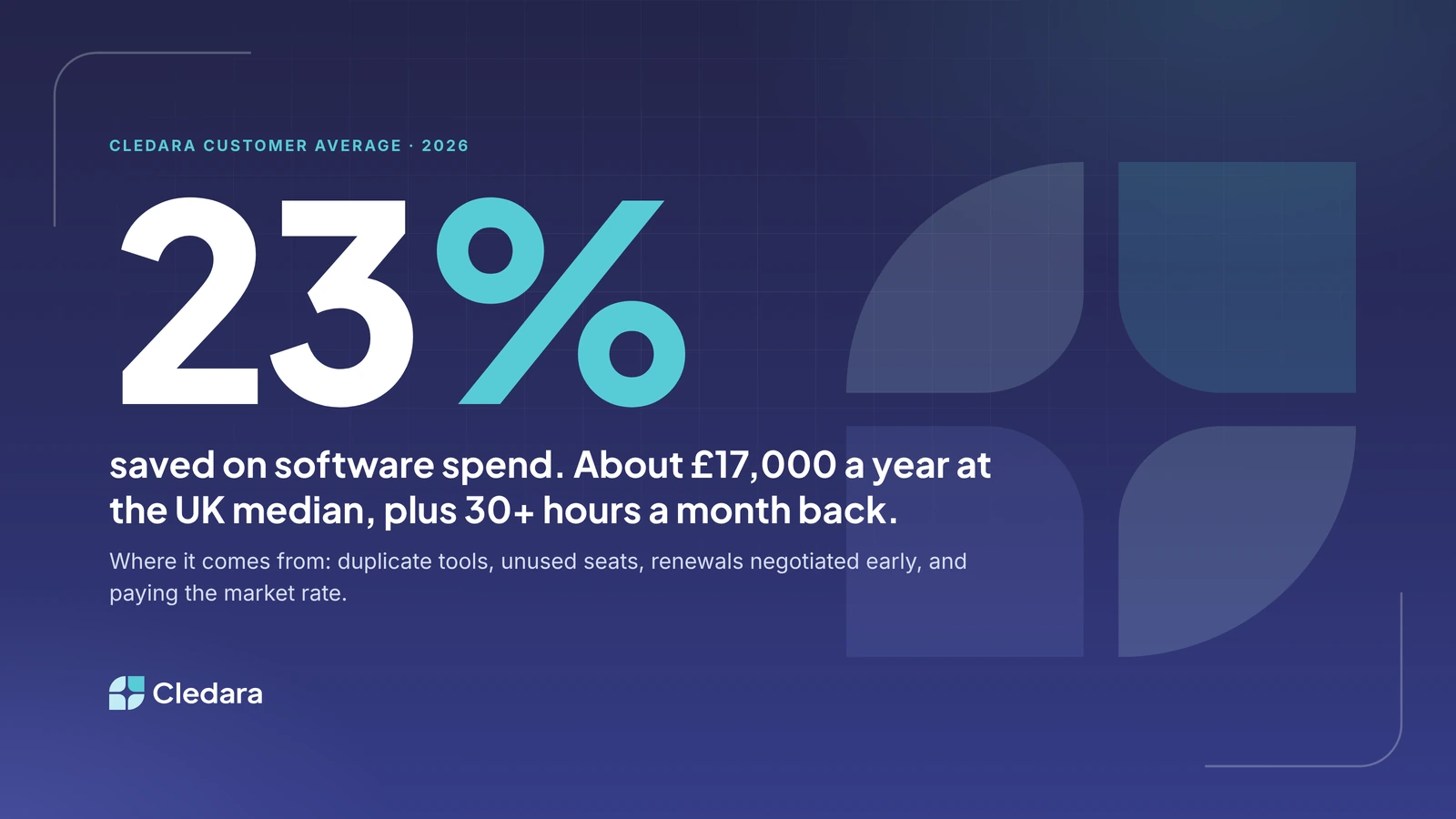
- The Cledara ROI starts with 23% saved on software spend, the Cledara customer average. That's about £17,000 a year at the UK median software bill.
- A typical customer gets 30+ hours a month back from invoice chasing, reconciliation and access admin. Over a year that's more than two months of one person's time.
- The savings come from four places: duplicate tools, unused seats, renewals negotiated early, and paying the market rate.
- Cashback on software and cloud spend reduces the net cost further for new Premium and Pro customers in their first year, but it's the smallest of the three numbers.
- You can run the numbers for your own company in about 20 minutes with the free benchmarks at data.cledara.com.
Where the 23% saving actually comes from
The 23% is the average saving across Cledara customers, and I think it's more believable once you see that it's four smaller numbers rather than one big one.
- Duplicate tools. Two teams buy two e-signature tools. Three people have personal AI subscriptions when the company has a team plan. Once every subscription sits in one list with an owner, the duplicates are obvious. Demet Durmuscelebi, Group Financial Controller at IMMO Capital, put it simply: "We've been able to cancel 10% of our software applications just thanks to Cledara flagging for duplicates."
- Unused seats. Seats bought for a project that ended, or for people who have since left. Cledara shows who used each tool and when, and Cledara Agent can take back paid seats nobody uses, so the saving happens without anyone having to remember.
- Renewals handled early. Across Cledara's customers, companies that start a renewal conversation 90 days out save about 49% on that renewal, against 19% for those who start later. Renewal alerts make the 90-day start the default rather than the exception.
- Paying the market rate. The Spend Optimisation module benchmarks what you pay against similar companies and flags price increases. Vendors raise renewal prices by 8 to 12% a year on average, and most companies accept it because they don't know what anyone else pays. Now you do.
None of those four is exotic. The saving comes from doing all of them, every month, without a project. That's the difference between a one-off clean-up and a system.
The Cledara ROI maths on a typical company
Let's use real medians rather than a flattering example. Cledara data for the year to October 2026, across 978 companies, puts the median company at 32 paid software tools, with the middle half between 16 and 48. Median annual software spend is £75,043 in the UK, €64,290 in Europe and $161,726 in the US. Here's what the two big numbers look like at those medians.
| | UK median | Europe median | US median |
| Annual software spend (Cledara data, year to Oct 2026) | £75,043 | €64,290 | $161,726 |
| 23% saving (customer average) | £17,260 | €14,787 | $37,197 |
| Hours back a month (typical customer) | 30+ | 30+ | 30+ |
| Hours back a year | 360+ | 360+ | 360+ |
Put the first row of savings next to the plan price on the pricing page for your region and you have your answer. For most companies at or above the median, the saving covers the plan several times over before you count a single hour.
Note: the 23% is an average, and averages hide a range. A company that has never audited its software tends to find more. One customer found £30,000 a year in unused subscriptions in the first three months. Another went from 92 tools to 54 after removing duplicates. A company that already runs a tight ship will find less, and should expect to.
The hours are the bigger number
The saving is the easy part to explain. The hours are where most finance teams feel it. A typical customer gets 30+ hours a month back (that figure is modelled on a company with about 70 tools), and it comes from three places people hate.
- Chasing invoices. Jenny Liu, Head of Finance at Marshmallow: "We used to waste 1-2 full days a month on just chasing and matching invoices. Now it's all automated and it's really helped with team culture not having to chase people every month."
- Reconciliation. Nathan Humphreys, Finance Manager at Jiminny: "The invoice matching is so good. I took a week off, came back and all of the payments and invoices were correctly matched. Next time I'll take two."
- Access admin. Setting up new starters in the tools their team uses and removing leavers from every tool they had. With Cledara Agent, you approve and it does the rest.
How you value an hour is up to you. If you put a fully loaded cost of £35 an hour on a finance operations role (purely illustrative; use your own number), 360 hours is about £12,600 a year. But I'd argue the real value is what those hours get spent on instead. Every hour finance spends collecting invoices from vendors' billing pages is an hour not spent on the forecast, the board pack or the fundraising model. That's the work people were hired to do.
Cashback, briefly
New Premium and Pro customers earn 1% cashback on software and cloud hosting spend through Cledara for their first year. On the UK median spend above, that's about £750. It's real money and it lowers the net cost, but I'd put it third on the list, well behind the 23% and the hours. The terms differ by region, so check the pricing page for yours rather than taking my word for it.
If anyone tells you Cledara pays for itself because of cashback, they've got the order wrong. It pays for itself because the software admin stops being done by hand.
What the Cledara ROI maths leaves out
A few things don't fit neatly in a table but are worth putting in your own version of it.
- Surprise auto-renewals that no longer happen. Every annual contract has a notice period, and missing one costs a full year.
- VAT you can reclaim because the invoice was actually collected. A payment without an invoice is a payment you can't fully recover the tax on.
- Payments that don't bounce. A single declined payment on hosting or an ad platform can cost more in an afternoon than a year of software management.
- Audit and compliance time. One list of every vendor, with owner, certification and invoices attached, is most of what an ISO 27001 or SOC 2 auditor asks for.
- Leavers who no longer have access to your data. Hard to price, easy to regret.
How to work out your own Cledara ROI
- Export a year of software payments from your accounting system or card statements and add them up. Include anything reimbursed through expenses. That's your annual software spend.
- Count the distinct tools. If it's more than you expected, you're in good company; 32 is the median.
- Take 23% of the spend as a starting estimate of savings. Adjust it down if you've audited in the last year, up if you never have.
- Estimate the hours. Count invoices collected by hand each month (about three minutes each is a fair rule of thumb), plus time spent on reconciliation and on joiners and leavers.
- Check a few of your biggest tools against the free benchmarks at data.cledara.com to see whether you're paying the market rate.
Then compare the total with the plan price on the pricing page. If the maths doesn't work for your company, I'd rather you knew that now. For most finance teams managing more than a couple of dozen tools, it works comfortably.
Why this will seem obvious
Not that long ago, plenty of finance teams typed bank statements into the accounts by hand. Then bank feeds arrived, and within a few years nobody could remember why they'd ever done it the old way. Software subscription management is at the same point. The admin around 30 or 50 or 100 tools was always a job. It just wasn't anyone's job, so it was done badly and expensively by whoever was nearest.
The 23% and the 30 hours are the Cledara ROI in plain numbers, and they're what it costs to keep doing it the old way. The plan price is what it costs to stop. I'll let you do the maths.
Cheers,
Brad