


Why a missing software invoice is really a missing VAT claim
Every software payment that goes out without an invoice behind it costs you twice. Once when you pay it, and again at the end of the quarter when you can't reclaim the VAT on it because there's nothing to show HMRC.
Most finance teams know this in theory. In practice, software is the category where invoices go missing most, because the invoice lives behind a login that belongs to whoever bought the tool. One UK finance team told us that in a single quarter they'd made 146 software payments with no invoice attached. Another was working through a backlog, prioritising the vendors that charge UK VAT first, because that was where the money was. Both were doing the right thing. Both were also doing it by hand.
This post is about how to reclaim VAT on software subscriptions, why so much of it goes unclaimed, and what a sensible fix looks like. (It's general guidance rather than tax advice, so run your own numbers past your accountant.)
Key takeaways
- To reclaim VAT on software subscriptions, HMRC expects you to hold a valid VAT invoice, or a simplified invoice where the charge is £250 or less including VAT. A card statement line on its own doesn't count.
- Software is where invoices go missing most: they sit in vendor billing portals, in the inboxes of the people who bought the tool, and in the accounts of people who have since left.
- Overseas SaaS vendors that aren't UK VAT registered fall under the reverse charge, so there's no VAT to reclaim on the invoice itself, but you still need the invoice as evidence.
- Late claims for input tax can be made on a later return, within four years of the due date of the return the claim belonged to. A backlog exercise can recover real money.
- The lasting fix is to collect every software invoice automatically, match it to the payment and code the VAT once, so month-end starts with the evidence already in place.
How to reclaim VAT on software subscriptions: the rules in plain English
HMRC's starting point is simple: a claim to deduct input tax must be supported by documentary evidence, and the first thing on its list of acceptable evidence is a full VAT invoice. That's set out in HMRC's internal guidance at VIT31000, which also accepts a less detailed invoice where the tax-inclusive value is £250 or less.
What a full VAT invoice has to show is listed in VAT Notice 700/21: a unique sequential number, the time of supply, the supplier's name, address and VAT registration number, your name and address, a description of the service, and the net amount, VAT rate and VAT in sterling. For a charge of £250 or less including VAT, a simplified invoice will do, which covers a lot of monthly SaaS plans. The same notice says you must generally keep VAT records for six years.
Two consequences follow for software. First, the invoice has to exist and be in your possession; the fact that the vendor would have issued one if asked isn't evidence. Second, the invoice should be addressed to the business. A receipt in an employee's personal name for a tool they put on their own card and expensed is the sort of thing HMRC can question, so it's worth getting subscriptions onto company payment methods and company billing details.
Where software invoices go to hide
The reason it's hard to reclaim VAT on software subscriptions is structural. Most SaaS vendors don't post or email an invoice to accounts payable. They put it in a billing section of the product, and they email a copy, if at all, to the admin email on the account. That admin is rarely finance.
| Where the invoice is | Why finance never sees it | How to get it back |
| The vendor's billing page | Only the account admin can log in, and finance often has access to only a fraction of the tools | Give finance or an agent a seat with billing access, or collect the invoice from the billing page automatically |
| The buyer's inbox | The receipt goes to whoever signed up, who files it or ignores it | Connect the inboxes of tool owners for automatic invoice capture, or set up a forwarding address |
| A leaver's account | The admin left; their mailbox was closed; the subscription kept billing | Reassign ownership at offboarding and change the billing email before the mailbox goes |
| A personal card, expensed | The receipt is in the employee's name, often without a VAT number | Move the tool to a company virtual card with company billing details |
| Usage-based billing | Several invoices a month that nobody expects, so nobody looks for them | Track the vendor's usage daily and collect every invoice, not just the first |
How small a fraction? One finance team we work with counted: of roughly 90 applications, finance held admin access to about 10% of them. The rest were owned by people in product, marketing and engineering who had no reason to think about VAT. That's the normal shape of a modern company, and it's why the invoice problem doesn't fix itself.
Overseas vendors, the reverse charge and what still needs collecting
A lot of software is bought from vendors outside the UK, and this is where the VAT treatment changes. If a US or EU vendor isn't UK VAT registered, the supply to a UK business customer usually falls under the reverse charge. HMRC's own example at VATPOSS14300 is B2B web hosting from a US supplier: you account for the output tax as if you'd supplied the service yourself, then reclaim it as input tax subject to the normal rules. For a fully taxable business that nets to nil, but it still has to go on the return, and you still need the invoice as evidence of what you bought and from whom.
The vendors that matter most for reclaim are the ones that do charge UK VAT. Many of the large global SaaS companies are UK VAT registered and add 20% to UK customers' invoices; you'll see a GB VAT number on the document. Those are the invoices worth chasing first, and they're the ones that team we mentioned prioritised in their backlog. A quick way to triage: sort your software payments by vendor, mark which vendors show a GB VAT number on their invoices, and start there.
A worked example: what the missing invoices cost
Let's put numbers on what it costs to reclaim VAT on software subscriptions late or never. Across Cledara's customers, the average company pays for about 35 software tools. Say 12 of yours charge UK VAT, and together they come to £10,000 a month including VAT. At 20%, that's about £1,667 of input VAT a month sitting on those invoices.
- If every invoice is collected and coded, you reclaim the full £1,667 a month, or about £20,000 a year.
- Now assume a third of those invoices never make it into the accounts, which is easy to do when nobody owns collection. That's £555 a month going unclaimed.
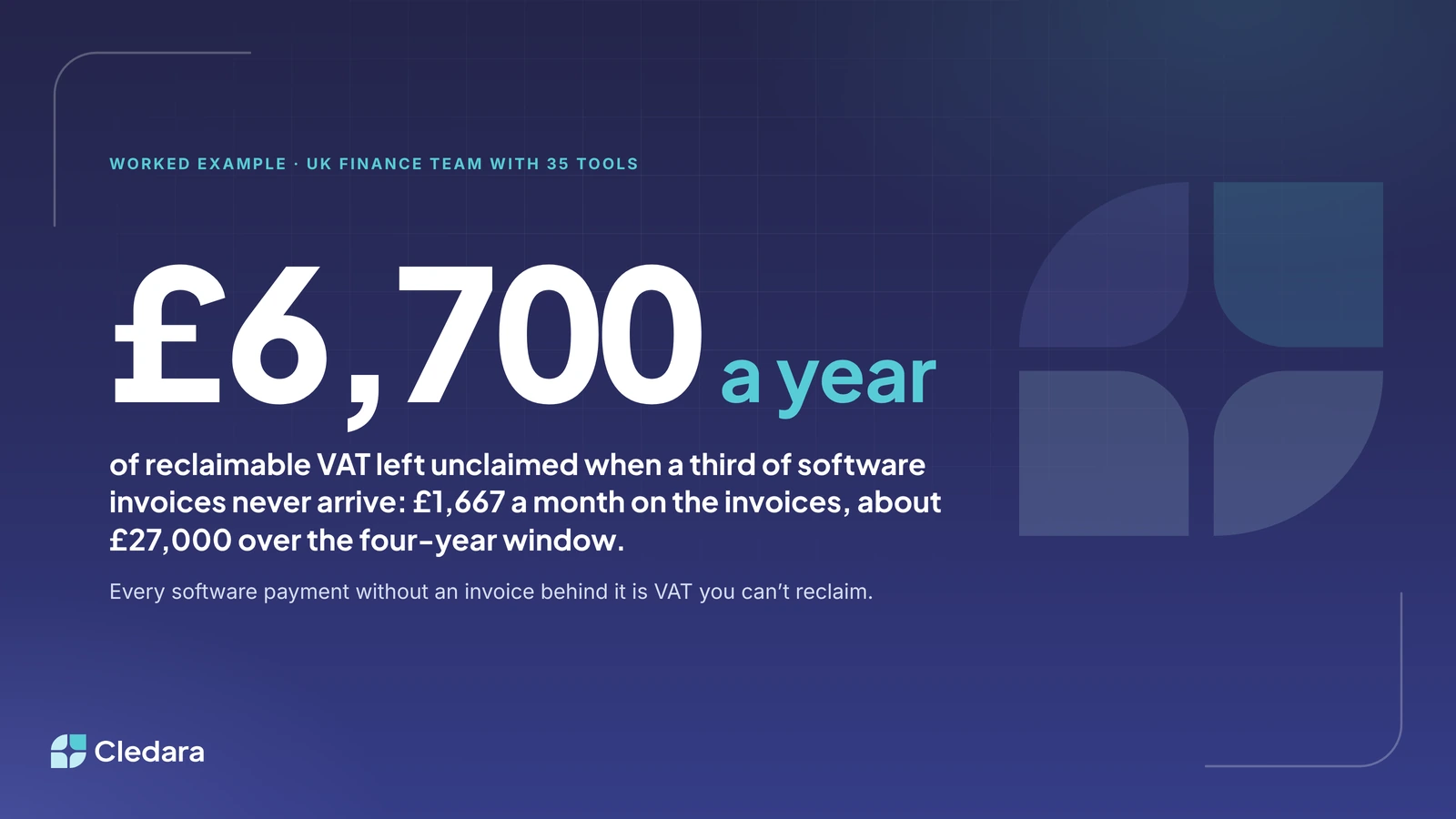
- Over a year that's about £6,700 of VAT you were entitled to and didn't get back, on top of the time spent chasing the invoices you did find.
- Over the four-year claim window, a company that never fixed this has left something in the region of £27,000 with HMRC.
Call it £6,700 a year of reclaimable VAT left unclaimed when a third of software invoices never arrive: £1,667 a month on the invoices, about £27,000 over the four-year window. Your numbers will differ, but the shape won't.
The time cost is the part finance leads feel first. Jenny Liu, Head of Finance at Marshmallow, described it to us this way: "We used to waste 1-2 full days a month on just chasing and matching invoices." At roughly three minutes per manual upload, which is what one finance team timed it at, a hundred missing invoices a quarter is five hours of someone's time before you've reclaimed a penny.
The four-year backlog is worth going back for
Here's the good news. If you couldn't claim input tax in a period because you didn't hold the invoice, HMRC's VAT Notice 700/45 says you can claim it on a later return, as long as the claim falls within the time limit in section 4.7: four years from the due date of the return for the period in which the claim should have been made.
That makes a one-off backlog exercise to reclaim VAT on software subscriptions worth doing. A sensible version looks like this:
- List every software payment from the last four years and mark the ones with no invoice attached.
- Sort by vendor and flag the vendors that charge UK VAT; park the reverse-charge vendors for a second pass.
- For each flagged vendor, download the historic invoices from the billing portal (most keep them indefinitely) or ask the vendor for copies addressed to the business.
- Check each invoice against the Notice 700/21 list, especially the VAT number and your company name.
- Post the late claims on the next return, and keep the invoices for six years.
One finance team we spoke to did exactly this, got the VAT-eligible invoices back first, and consciously decided the remaining low-value, non-VAT invoices could wait. That's a reasonable call. The point is that the decision was theirs, because they finally had the list.
How to stop the invoices going missing again
A backlog exercise fixes the past. The future needs the invoices to arrive on their own, which is the problem Cledara was built around.
Every software subscription gets its own virtual card and sits in one list with its owner, cost and renewal date, so there's never a payment that nobody can explain. Invoices are collected three ways: automatically from Gmail or Microsoft 365 inboxes, through a forwarding address, and, for the invoices that are never emailed at all, by Cledara Agent, which signs in to the vendor's billing page overnight, downloads the invoice and matches it to the payment. The VAT is extracted from the invoice and can be reviewed before it syncs, and each payment goes to Xero, QuickBooks or NetSuite with its invoice and codes attached. Month-end starts with the evidence in place rather than a list of people to chase.
The agent only works in the tools you connect and only does the jobs you switch on, and sign-in details sit encrypted in a vault that the AI never sees. It's the only SaaS management agent verified by Cloudflare. You can read more on the Cledara Agent page.
The future: VAT reclaim becomes a by-product of paying the bill
Not that long ago, plenty of finance teams typed bank statements into the accounts by hand. Then bank feeds arrived and nobody looked back. Chasing software invoices across 35 vendor portals is the same kind of job, and it's about to feel just as old-fashioned.
Every software payment without an invoice behind it is VAT you can't reclaim. When every invoice arrives on its own, reclaiming VAT on software subscriptions stops being a quarterly project and becomes a by-product of paying the bill. The money was always yours. The only thing standing between you and it was a login you didn't have.