


Why every company needs an AI tool approval checklist now
Here's a funny thing about AI tools. Nobody procures them. They just turn up. Someone in marketing tries a new writing assistant on a Tuesday, pops it on a personal card, and by Friday half the team has a login. That's why an AI tool approval checklist matters more than almost any other policy document a growing company writes this year: AI-native tools now take 27% of the software spend that runs through Cledara, up from about 3% two years ago, and UK AI-native spend from August to October 2026 was 25% higher than in the three months before.
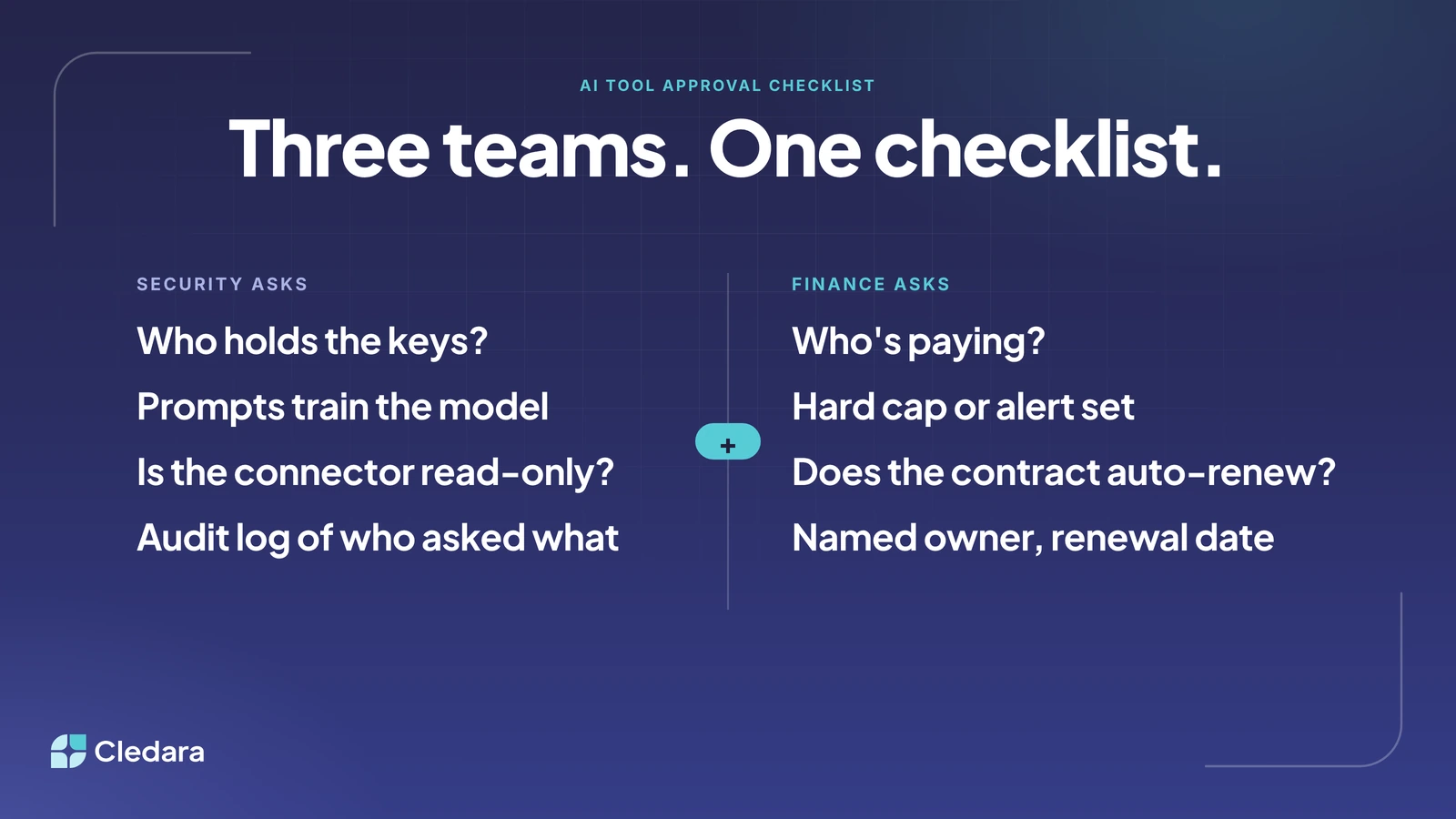
Most companies still review these tools with a process built for one big procurement a year. Security asks its questions, then compliance, then finance asks who's paying. Three teams, in sequence, each waiting for the last. That's how a tool that costs less than a team lunch takes six weeks to approve. This post is the checklist we'd hand to all three teams at once (three teams, one checklist), plus a one-page template you can copy.
Key takeaways
- Security, compliance and finance review different things, and doing it in sequence is what turns a two-day decision into a six-week one.
- One AI tool approval checklist, filled in once by the requester, lets all three teams review in parallel.
- Ten items cover it: data handling, model training, access controls, SSO, retention, certifications, sub-processors, cost caps, exit terms, and an owner with a renewal date.
- Finance's rows (cost caps, owner, renewal date) are the ones a platform can enforce automatically, so they shouldn't hold up the review.
- Finance and IT are among the lowest AI adopters in Cledara's data (16% each), so the reviewing teams need a short checklist, not a long one.
- The template at the end is a table you can paste into a doc or a ticket today.
What should security and compliance teams review before approving an AI analytics tool?
Before approving an AI analytics tool, security and compliance teams should check where the data goes, whether your prompts and uploads train the vendor's model, who can see which results, how long data is kept, and which third parties sit behind the vendor. Those five questions cover most of the risk in a tool that reads your numbers and writes back answers, and they map to the first seven rows of the AI tool approval checklist below.
An analytics tool is a special case because it's usually connected to something that matters: the warehouse, the CRM, the accounts. So the review is less about the AI and more about the plumbing. Is the connector read-only? Can the vendor's staff see query results? Does the tool keep a copy of the data it queried?
Tip: ask for the vendor's data flow diagram before the security questionnaire. If they can't draw where a prompt goes, the questionnaire won't be worth much either. The wider risk picture is in AI security risks in your SaaS stack; this post is the practical half.
The AI tool approval checklist: ten things to check
The AI tool approval checklist below has ten items. The requester answers what they can, the vendor fills in the gaps, and each reviewing team only looks at its own rows.
1. Data handling and residency
- ✓ Which categories of data will go into the tool (customer, employee, financial, source code), and where is it processed and stored?
- ✓ Is data encrypted in transit and at rest, and who holds the keys?
2. Whether prompts train the model
- ✓ Are prompts, uploads and outputs used to train the vendor's models by default, and can you opt out at account level?
- ✓ Is the opt-out in the contract rather than a settings page, and does it cover any third-party model the vendor calls?
3. Access and role controls
- ✓ Can admins limit what each role sees, by business unit, entity or region, and does the tool inherit permissions from the systems it connects to?
- ✓ Is there an audit log of who asked what, and can you export it?
4. SSO
- ✓ Does it support SSO with your identity provider, on which plan, and can password logins be switched off?
- ✓ Is there SCIM or an equivalent for removing people automatically when they leave?
5. Retention and deletion
- ✓ How long are prompts, outputs and uploaded files kept, and can you shorten it?
- ✓ How quickly is data deleted after you cancel, and will the vendor confirm it in writing?
6. Certifications
- ✓ SOC 2 Type II report (the report, not the badge) or ISO 27001 certificate with its scope statement.
- ✓ A GDPR data processing agreement (DPA) you can actually sign, with standard contractual clauses if data leaves the UK or EEA.
7. Sub-processors
- ✓ A published list of sub-processors, including the model providers.
- ✓ Notice before a new sub-processor is added, and a right to object.
8. Cost caps and usage billing
- ✓ Flat seat price, usage billing or both, and is the overage rate in the contract?
- ✓ Can you set a hard cap on monthly spend, or at least an alert?
9. Exit terms and data export
- ✓ Can you export your data (and your prompt history) in a usable format?
- ✓ What's the notice period, and does the contract auto-renew?
10. Owner and renewal date
- ✓ One named person owns the tool, its budget and its renewal.
- ✓ The renewal date is written down somewhere all three teams can see.
Who checks what: the AI tool approval checklist by team
Approvals drag because nobody has agreed which team owns which question. The table below splits the AI tool approval checklist three ways so the reviews can run at the same time.
Note: "Nothing to check" is the most useful cell in that table. Most of the time saved comes from teams skipping rows that aren't theirs.
What compliance certifications should an AI vendor hold?
At minimum, an AI vendor should hold a SOC 2 Type II report or an ISO 27001 certificate, and be able to sign a GDPR DPA with a published sub-processor list. For AI specifically, ISO/IEC 42001 is the one to ask about: it's the first certifiable international standard built for AI management systems, with third-party audits across the whole AI lifecycle, from design through to ongoing monitoring.
Honestly, most AI vendors don't have ISO 42001 yet. A FinTech Global piece from August 2026 notes that more than half the vendors promoting AI in Gartner's Magic Quadrant lack it, and expects it to follow SOC 2's path: a differentiator now, a contractual requirement later. So treat its absence as a question, not a veto, and treat SOC 2 and ISO 42001 as complementary.
Important: a badge on a website is not a certification. Ask for the SOC 2 report under NDA and the ISO certificate with its scope, because the scope line tells you whether the AI product is even covered.
How do other IT organisations structure internal governance reviews for platforms integrated with marketing and enterprise systems?
Most IT teams we talk to structure governance reviews for integrated platforms in tiers: a light review for standalone tools with no company data, a standard review for tools that connect to a marketing or enterprise system, and a full review for anything touching customer, employee or financial records. The tier is decided by the integration, not the price.
That matters for marketing in particular. In Cledara's October 2026 data, marketing is the second-highest AI adopter of any team at 38%, behind only data and AI teams at 55%. Product is at 31%, sales at 26% and engineering at 23%. IT and finance are both at 16%. So the teams writing the governance review are among the lowest users of the tools they're reviewing, and marketing's AI tools are usually plugged straight into the CRM and the website.
- The requester fills in the one-page checklist (below) and names the systems the tool will connect to.
- The connection list sets the tier. Read-only access to a marketing tool is standard; write access to the CRM or the finance system is full.
- Security, compliance and finance review their own rows in parallel, against a deadline.
- Approval creates the record: owner, budget, cap, renewal date. No record, no tool.
- A new integration added later re-opens the review at the right tier.
If you want the policy that sits above this, our AI procurement policy template is the wrapper, and the AI tool approval checklist is the form inside it.
The one-page AI tool approval checklist template
Here's the AI tool approval checklist as a single table you can copy into a doc, a ticket or a form. One row per item, one reviewer per row, and a column for the evidence.
How to use it:
- Paste the table into wherever requests already live (a form, a ticket, a Slack workflow).
- The requester fills in row 0 and anything they know, then sends the rest to the vendor in one email.
- Each reviewer ticks only their rows, against a deadline agreed up front.
- When all rows are green, create the subscription record (owner, budget, cap, renewal date) and store the evidence links against it.
- Re-run rows 2, 6 and 7 at renewal, because those are the ones vendors change.
Where the AI tool approval checklist is heading
I think the future of this is a much shorter checklist plus a platform that enforces the cost and ownership rows automatically. The security and compliance questions genuinely need a human. The finance ones don't. Whether a tool has a cap, an owner and a renewal date shouldn't be something a person checks; the system shouldn't let you skip it.
That's what we do at Cledara. Every software and AI tool sits on one list with its owner, users, cost and renewal date. Connect OpenAI, Anthropic or Cursor and it tracks usage every day against the budget you set, as a soft cap that warns finance and the owner before spend runs over, or a hard cap that stops it at the limit. Approvals route to the manager, finance or IT based on your rules, and the Software Compliance module tags each vendor with its ISO 27001 and SOC 2 status. The options for that side of the job are side by side in AI spend management tools, and the benchmarks behind this post are free at data.cledara.com.
We're a regulated company ourselves, so we run this review for every AI tool we buy. Fair enough, it's not the fun part of adopting AI. But three teams looking at one page at the same time is a lot less work than three documents one after another. Not that long ago, plenty of companies approved software with a signature on a purchase order and nothing else. Then subscriptions arrived and the purchase order stopped meaning much. I think the sequential review is going the same way.
If you'd like to see how the ownership and cost rows can look after themselves, book a demo and we'll show you.
Cheers,
Brad