


How to make the business case for Cledara to your CEO
A pattern we see a lot: the person who runs software at a company sees the demo, likes it, and then says "now I have to sell it to the CEO". Sometimes there's a fundraise in the way. Sometimes it's a founder who still thinks of software as a few cards in a drawer. Either way, the business case for software subscription management lands on the desk of someone who's never had to chase an invoice in their life.
This post is for the person doing the selling. It gives you the one-page structure, the numbers to collect, the objections you'll hear, and an email you can send as it is. It's written about Cledara because that's what I know, but most of it works for making the case for any finance tool.
Key takeaways
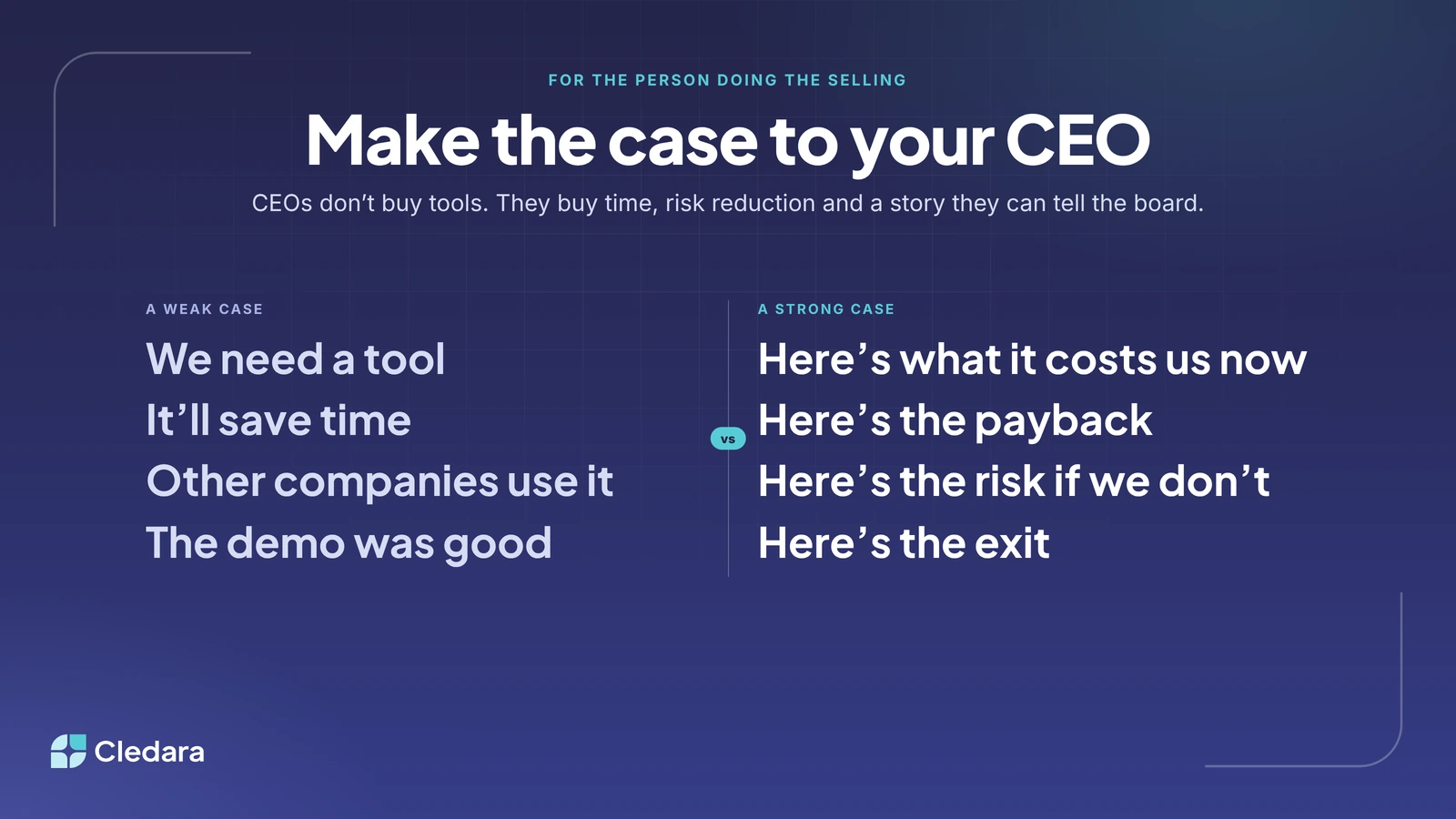
- CEOs don't buy tools. They buy time, risk reduction and a story they can tell the board. Frame the case in those three.
- A strong business case fits on one page: the problem in numbers, the cost of doing nothing, what changes, the payback, the risk and exit, and a clear ask.
- You can collect every number you need in an afternoon: tool count, payments a year, annual renewals, leavers in the last 12 months and the hours you spend.
- Cledara customers save 23% of software spend on average and get 30+ hours a month back. Put your own numbers next to those.
- Answer the "we're too small" and "can't we use a spreadsheet" objections before they're asked.
- Send a short email, with the one-pager attached and a specific ask. The template is below.
What a CEO actually cares about in a business case
Most internal pitches fail because they describe the tool. "It gives us visibility." "It automates invoices." Those are true, and the CEO doesn't care, because they're not the one doing the admin. What they care about is narrower and easier to hit:
- Time. Whose time, how much of it, and what that person would do instead. A finance hire spending two days a month on invoices is a finance hire not doing finance.
- Risk. The contract that auto-renews for another year. The leaver who still has access to customer data. The investor who asks for the software list in diligence and gets a spreadsheet from March.
- The board story. "We doubled headcount without growing the finance team" is a line a CEO wants to say. "We bought a subscriptions tool" isn't.
So the business case for software subscription management is really a business case about people and risk, with the tool as the mechanism. Here's the difference in practice.
The one-page business case, section by section
Keep it to one page. CEOs read one page; they skim three. These six sections, in this order, with a number in every one:
- The problem in numbers. How many tools we pay for, how many payments a year, how many people buy software, how many annual contracts. Across Cledara's customers the median company pays for 32 software tools, and about 81% of UK software spend goes out monthly, so even a modest stack is a couple of hundred payments a year.
- The cost of doing nothing. Hours a month on invoices, reconciliation and chasing. Seats still paid for leavers. Renewals that fired without a decision. Be specific and be fair; a CEO can smell an inflated number.
- What changes. One list of every tool with an owner and renewal date. Invoices collected and matched before month-end. New starters and leavers handled in every tool. AI spend tracked daily against a budget. Four lines, no feature tour.
- The payback. Cledara customers save 23% of software spend on average, and a typical customer gets 30+ hours a month back. Apply those to your own numbers and show the maths. Point to the pricing page for the cost rather than burying it in the deck.
- Risk and exit. SOC 2 Type II. No long implementation. Monthly billing is available, so the exit is a decision rather than a project. CEOs say yes faster when they know how to say no later.
- The ask. One sentence. "Approve the Premium plan from January and I'll own the set-up." Not "thoughts?"
Finding the numbers in an afternoon
You don't need a perfect dataset. You need defensible estimates, and you can get them from the bank feed and the accounting system in a few hours:
- Export 12 months of card and bank transactions and filter for recurring software vendors. Count the distinct vendors. That's your tool count.
- Count the transactions. That's roughly your invoices a year, and every one needed finding, matching and coding.
- Mark the annual payments. Those are your renewals, and the ones where a missed notice period costs a year.
- Ask HR how many people left in the last 12 months. Then ask how many of them were removed from every tool on their last day. (The gap is usually the most persuasive number in the whole document.)
- Time yourself for one month-end. How long on invoices and reconciliation? Multiply by twelve.
Add one line on AI. Across Cledara's customers, AI-native tools took about 23% of software spend in October 2026, up from about 4% two years earlier, and much of it is billed on usage. If your engineering team has an API key with a card behind it, your CEO will want to know what's watching it. (The live trend is at data.cledara.com if you want a chart for the page.)
The objections you'll hear, and the answers
You'll get some version of these. Better to put the answers in the one-pager than to be surprised in the meeting.
A real example of the time number
If you want a line from a customer rather than from me, this one is already public:
We used to waste 1-2 full days a month on just chasing and matching invoices. Now it's all automated and it's really helped with team culture not having to chase people every month.
That's Jenny Liu, Head of Finance at Marshmallow. Notice what she leads with: the chasing, and what it did to the team. That's your pitch too.
The email to your CEO (copy and edit)
Keep it short. The one-pager carries the detail; the email carries the ask. Replace the square brackets with your numbers.
Subject: Software admin: a proposal (one page attached)
Hi [name],
Quick one. We now pay for [number] software tools, which is about [number] payments and invoices a year, plus [number] annual contracts that renew whether or not anyone's looked at them. Most of the admin lands on me, and it's roughly [number] hours a month that I'd rather spend on [the thing you're actually hired to do].
I've looked at Cledara. It puts every tool on one list with an owner and a renewal date, collects and matches the invoices (including the ones nobody emails us), handles new starters and leavers in each tool, and tracks our AI spend against a budget every day. Their customers save 23% of software spend on average and get 30+ hours a month back. On our numbers that's roughly [your estimate].
It's SOC 2 Type II, set-up takes days rather than months, and we can bill monthly, so if it doesn't earn its keep we stop. The one-pager attached has the detail and the pricing.
My ask: approve it from [month] and I'll own the set-up. Happy to walk you through it in 15 minutes if that's easier.
Thanks,
[you]
After the yes
Once you have approval, move fast, because the goodwill is highest on the day it's granted. Set-up is days, not months, and every plan includes set-up help. Start with the tools that cause the most chasing, connect the accounting system, and put the renewal calendar in front of the CEO within the first month. The first "we would have missed this" moment does more for the relationship than any slide.
And then do the thing the business case promised: spend the hours on finance. That's the whole point. The companies that come out of the next few years well won't be the ones with the most tools. They'll be the ones where the admin got done by machines and the people did the thinking.
Cheers,
Brad