


What the data says about SaaS renewal price increases
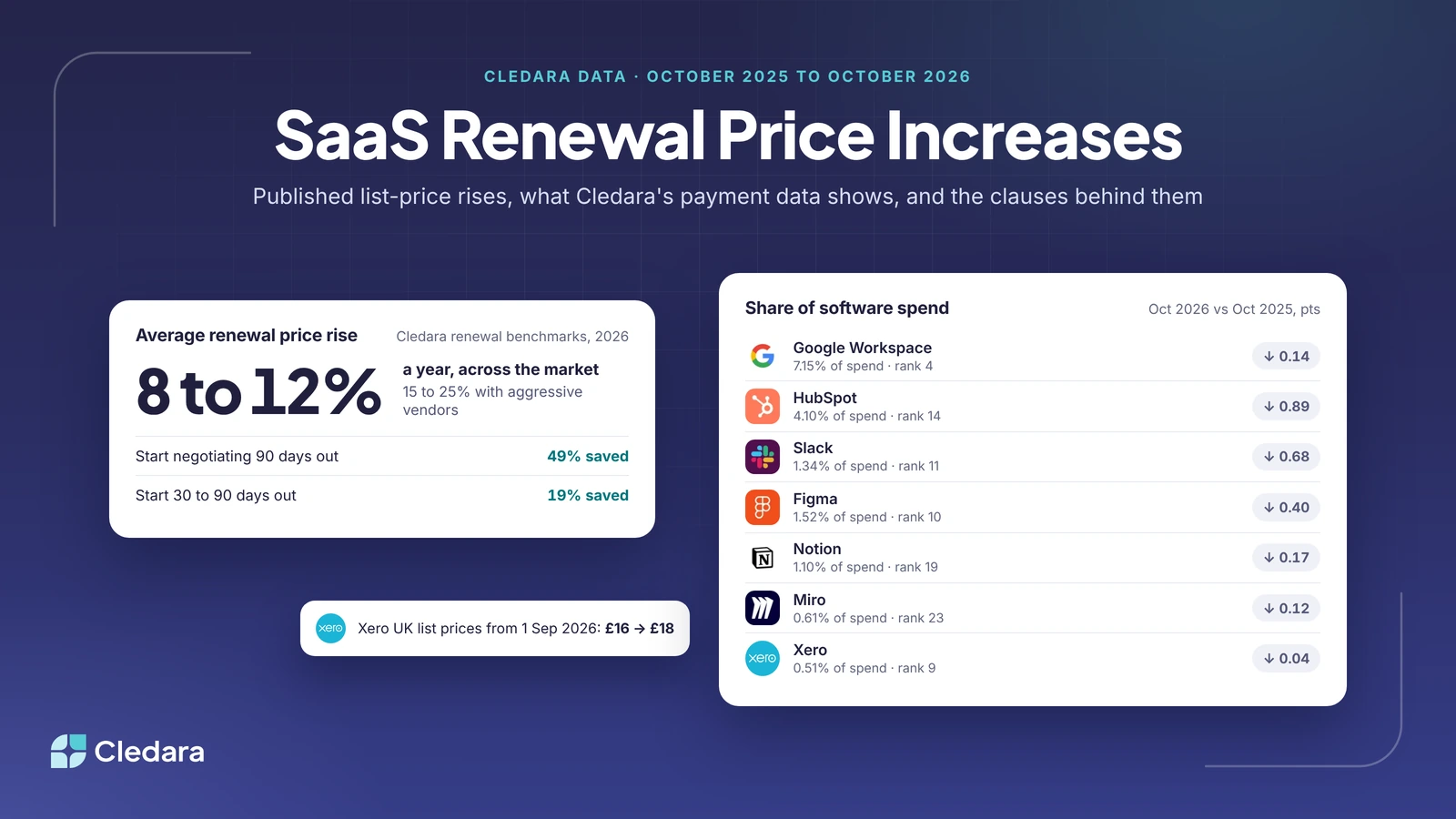
Here is a pattern that took me a while to see. Almost every software tool a company pays for costs more at renewal than it did the year before, and almost none of the companies paying could tell you by how much. SaaS renewal price increases average 8 to 12% a year, 15 to 25% where the vendor pushes hard, and they are written into the contract long before the invoice arrives (our renewal benchmarks).
This post puts the published list-price changes of 14 widely used vendors next to Cledara's own payment data for the same tools, then goes through the clauses that make SaaS renewal price increases possible, quoted from each vendor's public terms. No opinions about any vendor. Just numbers and clauses.
Key takeaways
- SaaS renewal price increases average 8 to 12% a year, and 15 to 25% with the most aggressive vendors (Cledara renewal benchmarks, 2026).
- Published list-price rises since 2022 run from about 5% (Salesforce, HubSpot's migration uplift) to 317% (Canva Teams' old five-person plan).
- Cledara's data tracks share of spend and rank, not per-seat price. Of the 14 vendors below, only Microsoft 365 grew its share of software spend across Cledara customers from October 2025 to October 2026.
- Salesforce, HubSpot, Zoom, Atlassian, Google Workspace and BambooHR all auto-renew by default. Notice periods to stop it run from 15 days (Google Workspace) to 30 days (Zoom, Salesforce) and 60 days (BambooHR).
- Most terms move you to the then-current list price at renewal with 30 days' notice, and seats can go up mid-term but not down.
- Companies that start negotiating 90 days before renewal save 49% on average, against 19% for those who start 30 to 90 days out.
Which SaaS vendors raise prices at renewal, and by how much?
The vendors with the largest published list-price rises in the last four years are Canva (Teams), Microsoft 365 (frontline and business plans), Google Workspace and Xero. The table ranks each vendor by the biggest percentage change it has announced publicly, with the date and the source. Where no percentage was published, the row says so.
Note: Zoom, Notion, Miro, Asana, Loom and QuickBooks appear in the data table below but are not ranked here, because I could not find an official announcement with a before-and-after price for them.
What Cledara's payment data shows for the same vendors
Cledara's data does not record a vendor's price per seat. It records what companies actually pay, so the metric below is each vendor's share of all software spend across Cledara customers, and its popularity rank (by number of paying companies). A falling share is not a price cut: AI-native tools now take 27% of software spend on Cledara, up from about 3% two years ago, so most established vendors gave up share even as list prices rose.
Source: data.cledara.com vendor trajectories, October 2025 and October 2026, all regions. Microsoft 365 is the only one of the 14 to grow its share of spend, from 6.14% to 6.38%. Google Workspace is still the biggest single line at 7.15%, down from 7.29%. The free benchmarks show the same figures by category and by company.
How much do SaaS prices rise at renewal?
SaaS prices rise 8 to 12% a year at renewal on average, and 15 to 25% with aggressive vendors, based on Cledara's renewal benchmarks. The published changes above sit in the same band for most plans (Slack 9%, Salesforce 6%, Xero 5 to 13%, Google Workspace 17 to 22%). The outliers come from plan restructures rather than a simple uplift: Microsoft's frontline plans (25 to 33%) and Canva's old Teams plan (317%).
That last point matters. The biggest SaaS renewal price increases usually arrive as a new packaging model (seat types, tiers, AI bundled in) rather than a line that says "your price is going up". HubSpot's seat migration, Figma's seat structure and Google's Gemini bundling all changed what customers pay without one headline percentage. So ask at renewal: has the unit I am buying changed?
Tip: record the unit price, the unit, the renewal date and the notice deadline against every tool in your software list. Our post on managing subscriptions when prices rise covers how.
SaaS renewal price increases live in the contract: the clauses to check
The mechanism behind SaaS renewal price increases is a short set of clauses that appear, in near-identical wording, across most vendors' public terms. Here is each one, what it means, and what to ask for.
Which CRM has the worst contract terms and cancellation policy?
There is no honest ranking of "worst", because CRM terms differ in kind rather than degree. The useful question is which clauses in your CRM contract carry the cost. From the public terms: Salesforce auto-renews for one-year terms with 30 days' notice, re-prices renewals where volume falls, and says quantities cannot be decreased during a term. HubSpot auto-renews unless switched off, may raise fees to the then-current list price with 30 days' notice, and allows no downgrade mid-term.
So for a CRM contract, check four things before you sign or renew:
- The renewal term length and the notice deadline, written as a date in your calendar.
- Whether the renewal price is capped, or defaults to list price.
- Whether cutting seats at renewal resets your per-seat discount.
- Whether the unit has changed (editions, seat types, bundled AI) since you signed.
Our guide to benchmarking SaaS pricing before renewal shows how to put a market price next to the quote.
How do HR software vendors adjust renewal pricing when employee counts grow during a multi-year contract?
HR software is usually priced per employee a month, so growth is billed as it happens and shrinkage is not. BambooHR's public terms are a clear example: fees cover "all non-terminated employees in the Service", with a minimum employee count in the order form. If headcount rises you are "billed based on your actual counts for such period"; if it falls below the minimum, that "will not reduce the fees owed". The rate is fixed for the term, but BambooHR "may change the price of your subscription for the next renewal term" with 60 days' notice.
For a multi-year HR contract, three numbers decide the renewal: the per-employee rate (fixed for the term, so negotiate a cap on the next one), the employee minimum (set it at today's headcount, not next year's plan) and the notice period (60 days is long; put it in the calendar). If headcount is growing, ask for tiered pricing that steps down at each band, and a minimum reviewed at each anniversary.
What should a SaaS licensing agreement include?
A SaaS licensing agreement should state the unit, the price, the term, the renewal mechanism and the exit, each as a number or a date rather than a reference to "then-current" anything. This is the checklist I would want on every order form:
- ✓ The unit you are buying (seat, employee, workspace, usage) and its price, with the edition or seat type named.
- ✓ Term length and renewal date, plus a vendor reminder 60 to 90 days before it.
- ✓ A cap on SaaS renewal price increases (a fixed percentage or CPI), and price protection across every year of a multi-year term.
- ✓ A notice period for non-renewal of 30 days or less, by email.
- ✓ A true-down right at each anniversary, and per-unit pricing held within an agreed volume band.
- ✓ Minimum commitments at or below current headcount, reviewed annually.
- ✓ Data export and a defined wind-down period on exit.
Important: the public terms quoted here are defaults. Every one can be changed on an order form, and vendors expect you to ask. The ones who do not ask pay list.
Price rises are a policy, not an accident
Here is the thing I keep coming back to. Vendors are not sneaking SaaS renewal price increases past anyone. They publish them, with dates. Microsoft announced its July 2026 rise in December 2025. Xero gave UK customers the September 2026 prices in advance. Atlassian posted the October 2026 date on a public page. The increase is a policy with a calendar.
The companies that come out ahead treat it the same way. They know the renewal date, the notice deadline and the market price for every tool, and they open the conversation 90 days out, when a 49% saving is on the table rather than 19%. That is not heroic procurement. It is a list, kept up to date, with the dates in it.
That is what Cledara is for. Every software and AI tool in one list with its owner, cost and renewal date; alerts before each renewal; and the Spend Optimisation module, which benchmarks what you pay against similar companies, flags price increases and unused seats, and drafts the negotiation. Cledara Agent takes back the seats nobody uses once you approve, so the number you walk into the renewal with is the number you need. Plans are on the pricing page.
If you have a renewal in the next 90 days, book a demo and we will show you what similar companies pay before you reply to the quote.
Cheers,
Brad