


What is AI spend management, and why is it different from SaaS spend?
AI spend management is the practice of tracking, budgeting and controlling what a company pays for AI tools and AI usage, and software subscription management platforms such as Cledara do it alongside the rest of the software list. It matters now because AI is the first budget line that grows by usage rather than by seats.
Here's the thing I keep noticing. The teams that use AI the most are almost never the teams that control the bill. Data, marketing and engineering are the heavy users. Finance and IT, who sign off the budget, sit near the bottom of the adoption table. That gap is the whole problem.
So this guide goes team by team, then band by band from seed stage to 1,000 people, using Cledara's data from more than 1,000 companies in 32 countries (explore it at data.cledara.com).
Key takeaways
- 27% of software spend on Cledara now goes to AI-native tools, up from about 3% two years ago. UK AI-native spend in August to October 2026 was 25% higher than the three months before.
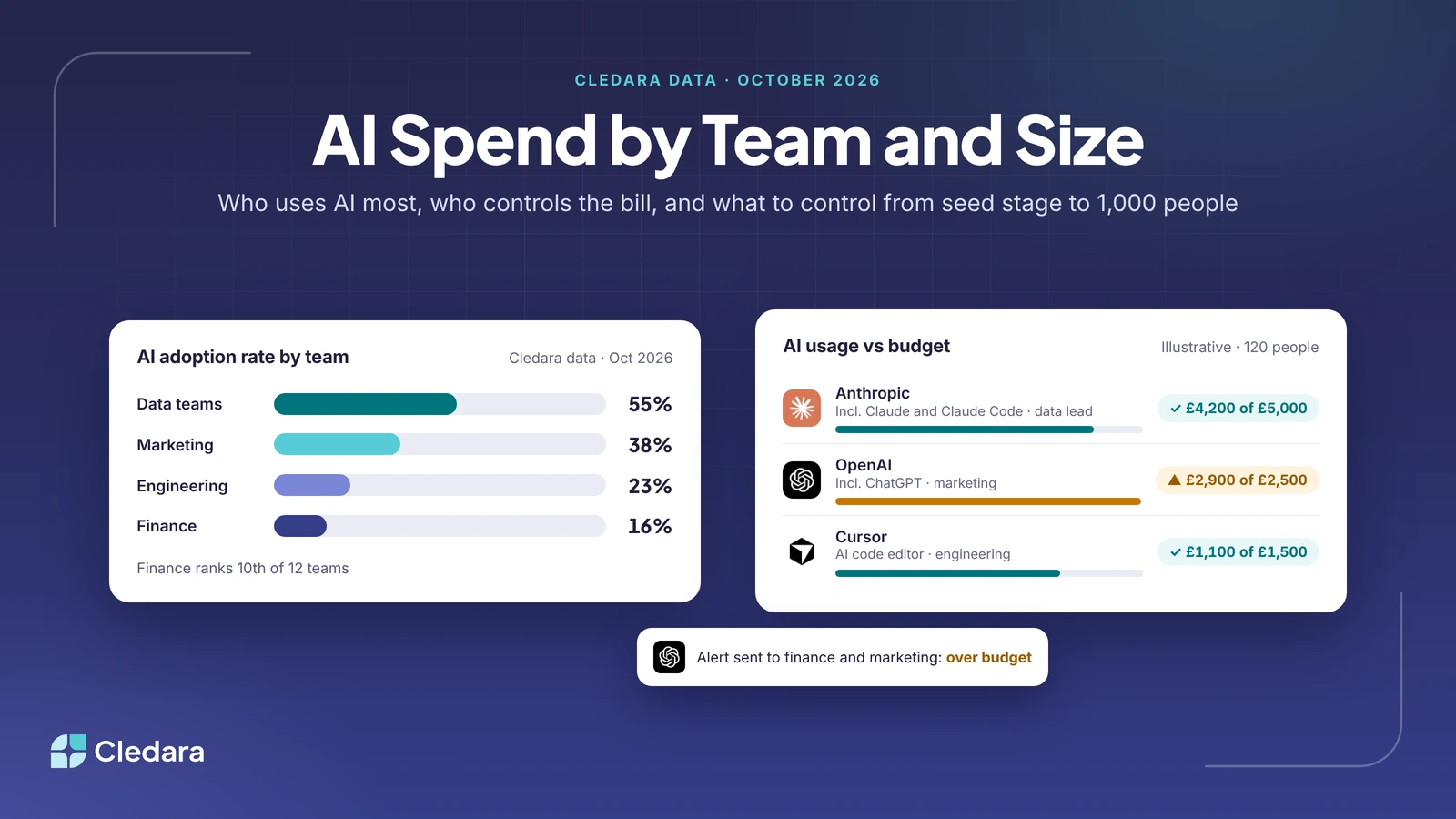
- AI adoption by team (Cledara data, October 2026): data and AI 55%, marketing 38%, engineering 23%, IT 16%, finance 16%, HR 7%. Finance ranks tenth of twelve.
- AI spend grows by usage, not seats, so you need daily usage tracked against a budget, not just renewal dates.
- Among UK companies with 51 or more tools, the top three software vendors by spend in August to October 2026 were Anthropic, OpenAI and Cursor.
- At seed stage, a card per tool and a budget is enough. By 120 people you need owners, approvals and usage data. By 500 or more, HR-linked leavers and multi-entity reporting.
AI spend management by team: who uses AI most, and who controls the bill
Across Cledara customers, the teams with the highest AI adoption are data and AI (55%), marketing (38%) and cross-functional teams (35%). Finance and IT both sit at 16%, and HR at 7%. So the people approving AI budgets are, on average, among the lightest users of the tools they approve.
That's not a criticism of finance. It's the shape of the job. The total used to be predictable: a seat costs the same in June as in March. AI broke that. An engineer who wires an API key into a new feature can double a vendor's bill in a month, and nobody knows until the invoice turns up.
Note: adoption rate measures the breadth of AI tools in each team's software stack on Cledara, not how much is spent on them.
So AI spend management can't be a finance-only activity. Finance owns the budget, but the usage lives in engineering, data and marketing, so each team needs its own view and finance needs the total. Our AI spend benchmarks for 2026 go deeper by team and vendor.
What is the best AI spend management software for engineering teams?
For engineering teams, the best AI spend management software connects to the AI providers directly (OpenAI, Anthropic, Cursor) and tracks usage every day against a budget, rather than waiting for the monthly invoice. Engineering AI spend is mostly usage-based, so a tool that only sees the card payment sees it a month too late.
Engineering's adoption rate looks modest (23%, seventh of twelve teams) but its spend is anything but. Cursor is the top engineering product on Cledara and the fifth most popular software product overall, and engineering's share of all software spend rose from 16.4% in May 2026 to 17.0% in October 2026.
- ✓ A budget per provider, ideally per API key, with usage tracked daily: a soft cap that warns early, or a hard cap where the work can tolerate it.
- ✓ One owner per key. The person who created it gets the alert.
- ✓ A virtual card per AI tool, so a runaway bill can be frozen in one click.
- ✓ Coding-tool seats reviewed against who used them last month.
- ✓ Invoices collected from the provider's billing page automatically. Engineers won't do it.
What is the best AI spend management software for IT teams?
For IT teams, the best AI spend management software shows which AI tools people actually use, including the ones nobody approved, and ties access to the HR system so leavers are removed from every AI tool they had. For IT the money matters, but the access matters more.
IT's own AI adoption is 16%, but that's not where the IT problem is. The problem is the 38% in marketing and the 55% in data, much of it signed up to with a work email and a personal card. Shadow IT was bad. Shadow AI is worse, because the tool holds your data (see our post on AI tool sprawl).
- ✓ Discovery of AI tools in use, not just the approved list. Cledara Engage, our browser extension, shows which of 8,000+ tools people use and collects only the username and a timestamp.
- ✓ An approval flow before the card is issued, with the vendor's ISO 27001 and SOC 2 tags on the request.
- ✓ Leavers linked to the HR system (BambooHR, HiBob, Personio, Workday, Gusto), so someone who leaves is removed from every AI tool they had.
- ✓ One list of who has access to what, shared with finance, so the access review and the spend review are the same review.
What are the best AI spend management platforms for CFOs and finance teams?
For CFOs, the best AI spend management platforms put AI tools on the same list as every other software subscription, with an owner, a budget, a renewal date and the invoice, and warn before a usage-based bill runs over. Finance doesn't need a separate AI dashboard. It needs AI to stop being the exception.
Finance ranks tenth of twelve teams for AI adoption, at 16%. I think that's fine, honestly. A CFO doesn't need to be the heaviest user of Anthropic to run the budget well. They need the AI line to behave like every other line: forecastable, owned and explainable to the board. The hard part is the forecast. Seat-based SaaS is 40 seats at a known price. AI is 40 people doing an unknown amount of work. The fix is a budget per tool with usage tracked daily, so the variance shows up on day 10 rather than at month-end (our guide on how to track and control AI spend covers the set-up).
- ✓ One list of every software and AI tool with owner, users, cost, renewal date and card.
- ✓ A budget per AI tool, tracked daily, with alerts to finance and the owner before it's blown.
- ✓ Invoices collected automatically and synced to Xero, QuickBooks, NetSuite or Tripletex.
- ✓ Duplicate detection. Two teams with separate Anthropic accounts means paying twice and negotiating from a weaker position.
Key takeaway: give engineering, data and marketing their own budgets and alerts, and give finance the total.
AI spend management for marketing and data teams
For marketing teams
Marketing has the second-highest AI adoption of any team at 38%, bought one tool at a time: a writing assistant here, an image generator there, a video tool on someone's personal card. Spend per tool is small, the number of tools is large, and the duplication is real. The control that matters is a card per tool with a limit, and a monthly look at which ones anyone still uses.
For data and AI teams
Data and AI teams are the heaviest users at 55%, and their spend is the most usage-based of all: model APIs, inference and training. Set a budget per project, give each API key an owner, and let the platform warn at 80% and stop at 100% where the work can tolerate it. In September 2026, 44% of the software tools appearing on Cledara for the first time were AI tools.
AI spend management by company size: from seed stage to 1,000 people
What matters in AI spend management changes with company size. At seed stage it's a card per tool and a budget. By 120 people it's owners, approvals and usage data. By 500 or more it's HR-linked leavers and multi-entity reporting.
Cledara's data doesn't segment by headcount, but it does segment by stack size (the number of software tools a company pays for), which is a proxy for maturity rather than headcount. The pattern in August to October 2026 was clear: the more tools a company runs, the higher the AI vendors sit in its spend list.
Best AI-powered spend management platforms for a seed-stage startup
For a seed-stage startup, the best AI-powered spend management platform is the simplest one that gives every AI tool its own virtual card and budget, and collects the invoices. You don't need approval workflows at 12 people. You need to know what you're paying Anthropic and OpenAI this month, and to have the invoice when the accountant asks. Virtual cards are free on every Cledara plan (see pricing).
Best AI-powered spend management platforms for a 120-person company
At 120 people, the best AI-powered spend management platform adds owners, approvals and daily usage tracking to the card-per-tool basics. This is the size where every team has its own AI tools, the first duplicate Anthropic or OpenAI accounts appear, and an engineer's API key can quietly become a top-ten vendor. If you're writing the rules down for the first time, start with our AI procurement policy template.
Best AI-powered spend management platforms for a large multinational
For a large multinational, the best AI-powered spend management platform handles several entities and currencies, enforces policy at the moment of purchase, and connects joiners and leavers to the HR system so access and spend move together. At this size AI vendors are among the biggest software lines, so the admin behind them is real work. Cledara Agent does that admin: invoices, joiners, unused seats and leavers across 8,000+ SaaS and AI tools, with your approval.
What features should I look for in an AI-powered spend management platform?
Look for an AI-powered spend management platform that tracks usage daily against a budget, gives every AI tool an owner and a card of its own, collects the invoices, and connects to the HR system. Those four cover most of what goes wrong with AI spend.
- ✓ Direct connections to AI providers (OpenAI, Anthropic, Cursor) with usage tracked every day against the budget you set
- ✓ Soft caps that warn before a bill runs over, and hard caps where the work can tolerate a stop
- ✓ A virtual card per subscription with its own limit, and cancelling by freezing the card
- ✓ One list of every software and AI tool with owner, users, cost, renewal date and card
- ✓ Discovery of AI tools in use that nobody approved
- ✓ Approvals routed to the manager, finance or IT, with actions in Slack
- ✓ Invoices collected automatically, including from billing pages that never email them, and synced to the accounting system
- ✓ Leavers tied to the HR system, so they lose their AI seats and keys
- ✓ Benchmarks against what similar companies pay, and duplicate detection across teams
Here's how that looks for a company of around 120 people (illustrative figures): Anthropic at £4,200 against a £5,000 monthly budget, owned by the data lead; OpenAI at £2,900 against a £2,500 budget, so the alert has already gone to finance and marketing; Cursor at £1,100 against £1,500, held by engineering. Three tools, three owners, one list.
Which AI spend management platforms are worth comparing before choosing one?
Before choosing an AI spend management platform, compare four kinds of tool: the AI providers' own billing dashboards, a card or expense tool, a SaaS management platform, and a software subscription management platform such as Cledara that combines payments, subscriptions and usage in one place.
- The AI providers' own dashboards. OpenAI, Anthropic and Cursor each show usage and let you set limits. They don't talk to each other, don't know who left and don't produce your Xero entries.
- Cards and expense tools. They see the transaction, but not the subscription, the renewal date, the usage inside the tool or who has access.
- SaaS management platforms. Good at discovery and access, usually built for IT. Most don't hold the payment, so they can't cap or cancel.
- Software subscription management with built-in payments. This is the Cledara approach: a card per tool, one list with an owner each, daily usage against a budget, invoices collected and synced, and Cledara Agent doing the admin inside the tools. Customers save 23% on software spend on average and get 30+ hours a month back.
There's a longer comparison of AI spend management tools on the blog. The short version: pick the tool that matches where the usage lives, not just where the budget lives.
Where AI spend management goes next
I'm optimistic about all of this. AI is the first software budget line that grows with how much work it does for you, and that's a good problem to have. The companies that handle it well won't lock it down. They'll give each team a budget it can see and have the admin done in the background. Give it a couple of years and budgeting by seat will look as odd as typing bank statements into the accounts by hand.
If you'd like to see how Cledara does AI spend management for your team and your size, book a demo and we'll show you on your own numbers.
Cheers,
Brad