


Is Cledara worth it for a small team with 15 tools?
The most common reason a conversation with our sales team ends is some version of "we're only 15 tools, it's not a pain point yet". Fair enough. I'd rather someone said that than bought something they didn't need. But I think the question of whether software subscription management for small teams is worth it gets answered on the wrong evidence, so here's my answer, with the numbers we have.
The short answer: at 15 tools, a spreadsheet can work, right up until it doesn't. The trick is knowing which side of that line you're on, and what it costs to cross it late.
Key takeaways
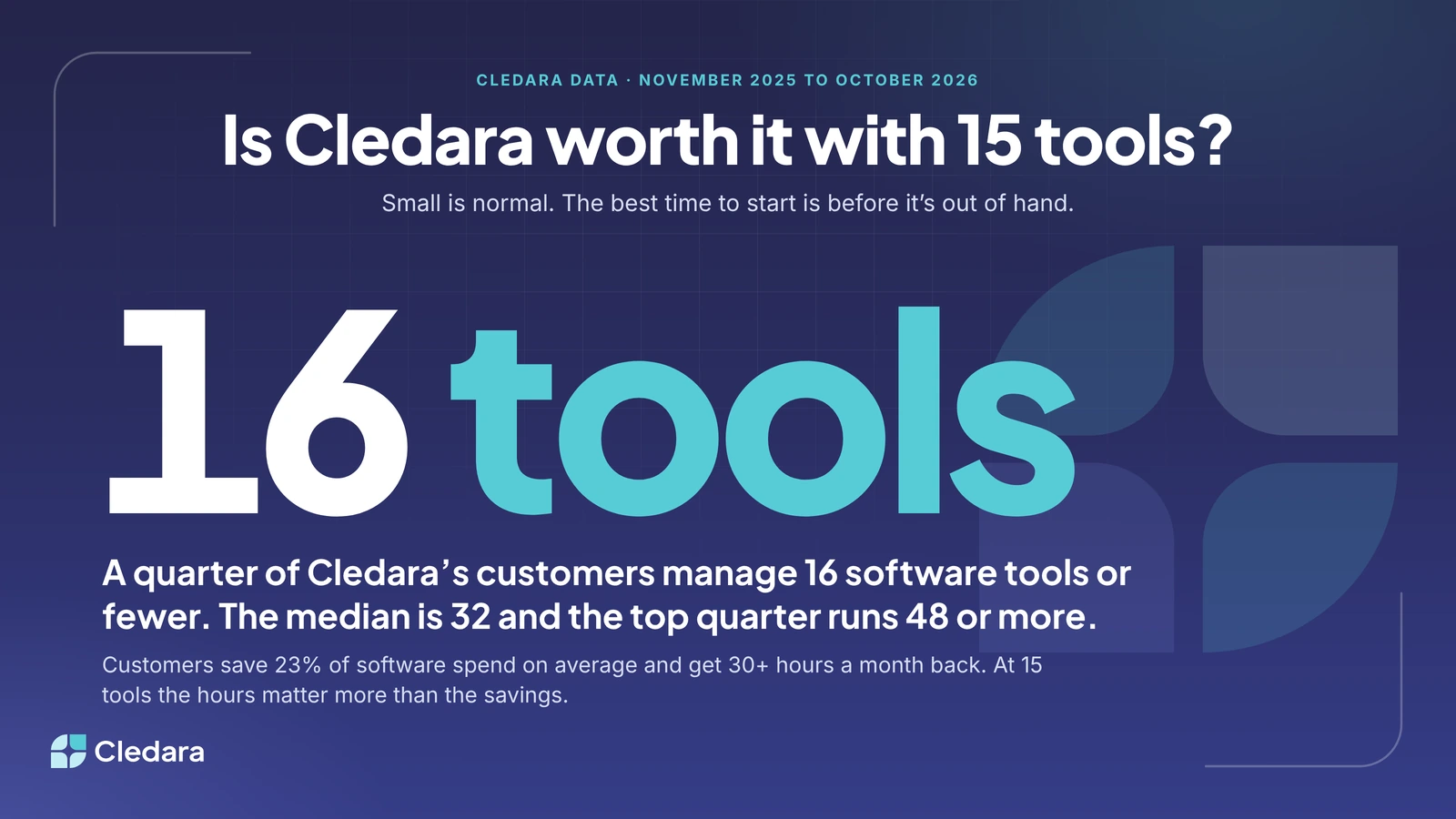
- A quarter of Cledara's customers manage 16 software tools or fewer. Small is normal here, and the median is 32.
- Fifteen monthly tools is roughly 180 payments and 180 invoices a year. The admin is bigger than the tool count suggests.
- Annual contracts are about 15% of software spend by value across UK companies on Cledara, and that 15% is where the surprise renewals live.
- A spreadsheet is enough when one person buys everything, nobody has left recently and there's no auditor or investor asking questions. That describes fewer companies than it used to.
- The best time to start is before it's out of hand. Clean-ups are expensive; discipline from the start is cheap.
- Customers save 23% of software spend on average and get 30+ hours a month back. At 15 tools the hours matter more than the savings.
How small is "too small" for software subscription management?
Smaller than most people think. Across Cledara's customers over the last twelve months (software vendors only, November 2025 to October 2026), the median company pays for 32 software tools. A quarter of them manage 16 or fewer. The top quarter runs 48 or more.
So a 15-tool company sits right at the edge of the bottom quarter of our customer base. It's not an outlier. Plenty of companies started with us at that size and grew into the median.
Companies in that smaller band, between 6 and 20 distinct software vendors, average 13 tools each on Cledara. Their payments are also smaller: the average software payment in that group is around £290 in the UK. That's the profile of a company paying for Google Workspace, Slack, a CRM, an accounting system, a few engineering tools and an AI subscription or two. Sound familiar?
What 15 software tools actually cost you in a year
Tool count is a bad measure of admin. Payments and invoices are better ones. Most software bills monthly: across Cledara's UK customers, about 81% of software spend goes out on monthly subscriptions, about 15% on annual ones, and the rest quarterly or weekly.
So 15 tools, mostly monthly, is roughly 180 card payments a year, each one needing an invoice in the accounts, a VAT check and a code. Call it three minutes an invoice if you have the login and the invoice is where you expect it. Call it fifteen if you don't. Here's a rough, illustrative year for a 15-tool company. Your numbers will differ, but the shape won't.
None of these is dramatic on its own. That's exactly why they get ignored. The cost of 15 tools is a few hundred small tasks spread across the year, usually done by the one person who'd rather be doing finance.
When a spreadsheet is enough
I'll be fair to the spreadsheet. It's free, everyone knows how it works and it's done the job at thousands of companies. If all of these are true, keep it for now:
- One person buys every tool, pays for it and gets the invoice. No team buys anything on their own card.
- Nobody has joined or left in the last six months, so access hasn't drifted.
- Your annual contracts are few enough that you know the renewal dates from memory.
- No investor, auditor or new finance hire is about to ask for the full list.
- Your AI spend is a fixed seat or two, not a usage bill that moves.
The catch is that this list gets shorter every quarter at a growing company. The founder stops being the only buyer. Someone leaves. An investor asks for the list during diligence. And AI changes the shape of the bill: across Cledara's customers, AI-native tools took about 23% of software spend in October 2026, much of it billed on usage rather than per seat. (We publish that trend live at data.cledara.com.) A spreadsheet is fine at recording a fixed monthly fee. It's hopeless at a bill that changes every day.
Why before it's out of hand is the cheapest time to start
Every finance leader I've met who cleaned up their software retroactively says the same thing: they wish they'd started 18 months earlier. The clean-up is a project. It means chasing people for logins, finding out which tools are duplicated, working out who owns what and telling colleagues their favourite tool is being cancelled. It's a big job, and it lands at exactly the moment the company can least afford the distraction.
Starting at 15 tools is the opposite. There's nothing to untangle. You put every subscription on its own virtual card, give each one an owner and a renewal date, and connect the accounting system. New tools arrive into a process that already exists, instead of into a spreadsheet nobody updates. The discipline costs almost nothing while things are small, and it stops the chaos from happening at all.
That's why we'd rather talk to a 15-tool company than a 150-tool one in a mess. The second conversation is more dramatic. The first one is more useful.
What Cledara does for a small team
For a team at this size, the value is mostly the admin disappearing, in this order:
- One list of every tool. Built from every payment, with the owner, the users, the cost and the renewal date. Adding a subscription takes about two minutes.
- Invoices arrive by themselves. Email capture picks up the ones that are emailed, and Cledara Agent signs in to collect the ones that never are, then matches each to its payment and syncs it to Xero or QuickBooks.
- Renewals become a decision. Every renewal date in one place, with an alert before it fires, so an annual contract never renews without someone choosing to let it.
- Joiners and leavers get handled. Cledara suggests a new starter's tools from what their team already uses, and lists everything a leaver had so it can be removed in one go.
- AI spend stays in view. Cledara connects to providers such as OpenAI and Anthropic and tracks usage every day against the budget you set, warning you before it runs over.
None of that needs an IT team, a procurement function or an implementation project. Set-up takes days, and every plan includes set-up help. The pricing page has the plans; the Basic plan was designed for exactly this size of company.
Does the maths work at 15 tools?
I'll let you do most of it, but here's the frame. Customers save 23% of their software spend on average. At a small company the savings are smaller in pounds, obviously. A quarter of our UK customers spend less than about £32,000 a year on software (the median is about £75,000), and at that level a few unused seats and one unwanted renewal is the whole saving right there.
The bigger number for a small team is time. A typical customer gets 30+ hours a month back, mostly from invoices, reconciliation and chasing. At 15 tools it won't be 30, but even a few hours a month is a meaningful share of a one-person finance function. And it's the dull hours, which are the ones you most want to give to a machine.
Then there's the thing you can't put a number on: when the investor or the auditor asks for the list, you send a link. That's worth having before you need it.
So, is it worth it?
If every item on the spreadsheet list above is true for you, probably not yet, and I'd say so. If two or three have stopped being true, you're already past the point where this is a "nice to have". The companies that handle software well in five years' time won't be the ones who did a heroic clean-up. They'll be the ones who never let it get messy in the first place, because the admin was done for them from the start.
Start small. Start before it's out of hand. That's the whole argument.
Cheers,
Brad