


Why offboarding software licences lands on finance's desk
Here's a pattern I see in almost every growing company. Someone leaves. HR closes the file, IT turns off their email, and everyone moves on. Six months later, finance is still paying for their Slack seat, their Figma seat, their Notion seat and whatever AI tool they signed up for on the company card in their second week.
Nobody did anything wrong. The person who knew which tools the leaver used was the leaver. And offboarding software licences has never had a clear owner, so it quietly became a finance problem: finance is the team that sees the invoice, and finance is the team that ends up paying for seats nobody sits in.
Key takeaways
- Across Cledara's customers, the average company pays for about 35 software tools (median 32), so a leaver typically holds seats in dozens of tools, not two or three.
- 48% of former employees still have access to company SaaS months after leaving, according to a June 2026 survey of 1,000 enterprise CIOs and CISOs by CloudEagle.
- Offboarding software licences is a finance problem because the cost shows up on the invoice, while the knowledge of who used what sits with team leads, IT and the leaver themselves.
- The fix is a leaver checklist that finance owns alongside IT: HR system as the trigger, one list of who has access, no subscriptions tied to a person's card, seats reclaimed on day one and a monthly seats-versus-headcount check.
- Done well, offboarding becomes a budget event (a seat freed to give to the next hire) rather than a security scare.
How many software seats does one leaver actually hold?
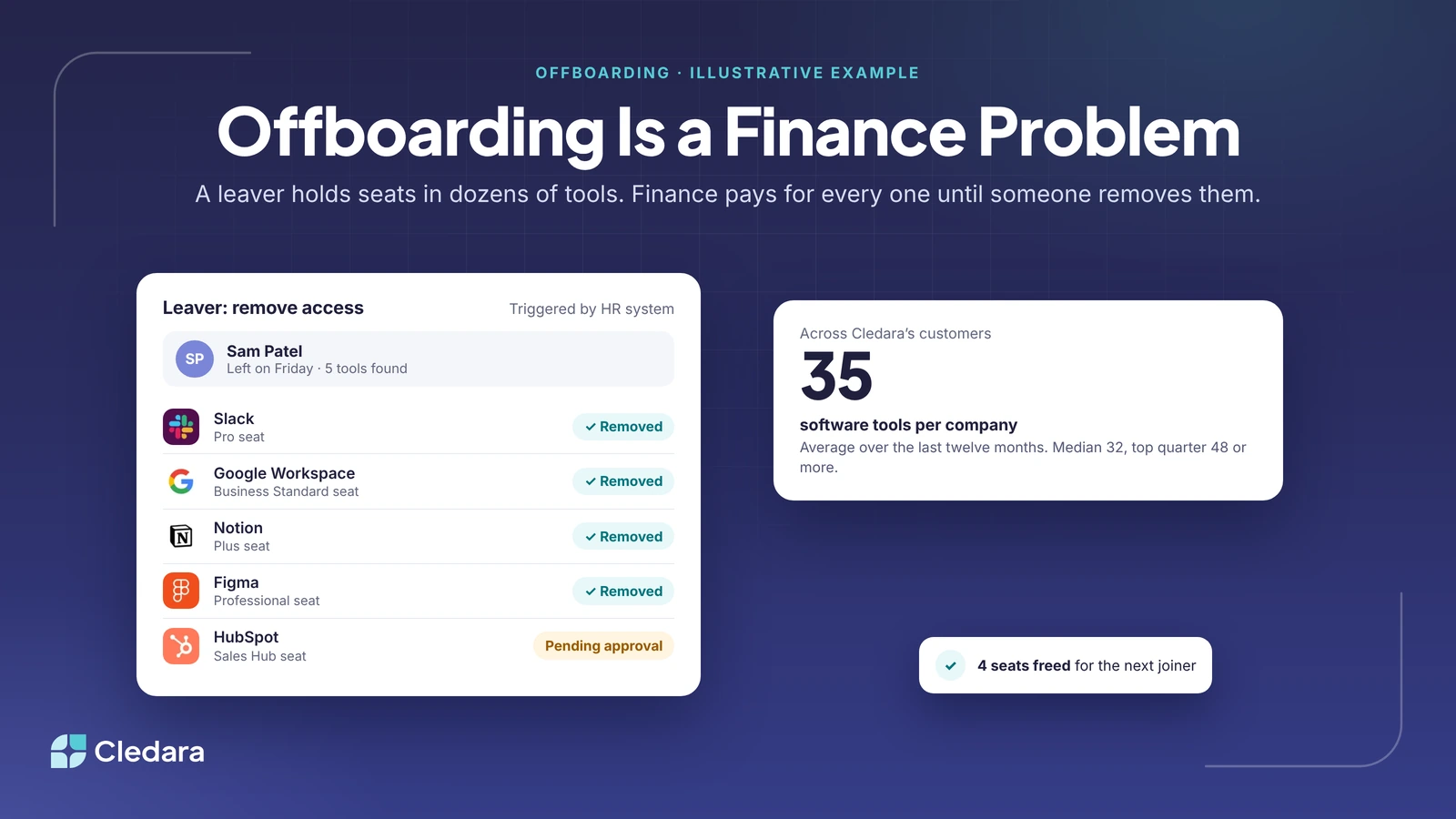
Offboarding software licences starts with knowing how many there are, and it's more than you think. Cledara data shows the average company on the platform paid for about 35 software tools over the last twelve months, with a median of 32 and the top quarter of companies paying for 48 or more. A typical employee won't use all of them, but a product manager or a marketer will easily touch fifteen.
The ops leads we talk to describe the same thing in different words. One told us that when people leave, their Slack and Google seats "don't consistently get deprovisioned" and the company only finds out when the next invoice lands. Another called onboarding and offboarding across tools the job nobody wants, because it means logging in to every system one at a time.
That's the structural issue. Software used to be bought by IT, so IT knew what everyone had. Now anyone can buy a tool with a card and an email address, which means the list of what a person uses lives in a dozen heads and a few spreadsheets.
What leavers cost: seats, data and surprise renewals
The obvious cost is the seat. Per-seat tools bill for the people on the account, not the people in the building, so a leaver keeps costing money until someone removes them. On an annual plan, that can mean paying for an empty seat for eleven months.
The less obvious cost is risk. A 2023 DoControl report found that 31% of companies had former employees access company assets in SaaS applications after they left. By 2026 the picture hadn't improved: CloudEagle's survey of 1,000 enterprise CIOs and CISOs found 48% of former employees still had SaaS access months after leaving. A paid seat and a live login are the same thing from the vendor's point of view (and from an auditor's).
Then there's the renewal problem. Seat counts set at renewal tend to include everyone who had a seat, including the people who left in month three. You end up committing for another year to a number that was wrong on the day you signed it.
| Where leavers' seats hide | Typical billing | Who usually notices | How long it goes unnoticed |
| Collaboration tools (Slack, Google Workspace, Notion) | Per seat, monthly or annual | Finance, on the invoice | Until the next seat-count review |
| Design and engineering tools (Figma, GitHub, Cursor) | Per seat, managed by the team lead | The team lead, if asked | Often until renewal |
| AI tools (OpenAI, Anthropic) | Personal login on a company card, sometimes usage based | Nobody, unless usage is tracked daily | Indefinitely |
| Sales and support tools (HubSpot, Zendesk) | Seat tiers with minimum commitments | Finance, at renewal | Until the contract term ends |
| Tools on the leaver's own card | Reimbursed through expenses | Nobody, once expenses stop | The subscription usually lapses when the card is cancelled, taking the data with it |
That last row cuts both ways. If a subscription was tied to the leaver's personal card or an individual company card, it doesn't just keep costing money; it can stop working the day their card is cancelled. One finance lead told us that was exactly why they moved away from cards tied to individuals: "if someone leaves, the tool goes down."
Why nobody owns offboarding software licences
Offboarding sits between three teams, and each one has a reasonable excuse.
- HR owns the leaver process, but their checklist ends at the laptop and the email account.
- IT owns identity, but only for the tools behind single sign-on. Most of the long tail of SaaS was bought by a team lead and never went near IT.
- Finance sees every payment, but a line that says "Figma, 24 seats" doesn't tell you which 24 people, or that two of them left in the spring.
So the knowledge, the authority and the cost sit in three different places. Everyone assumes someone else has it. The invoice is the only thing that ties them together, which is why I think finance has to take the lead. You don't need to become the IT team to do it. You just need the list.
The five-step checklist for offboarding software licences
The companies that get this right treat offboarding as a budget event with a fixed sequence, triggered by HR and finished by finance. Here's the version I'd start with.
- Make the HR system the trigger. The leaving date goes into BambooHR, HiBob, Personio or whatever you use, and that date starts the clock. Nobody should have to remember to tell finance.
- Keep one list of who has access to what. Not a spreadsheet someone updates when they remember. A live list, per tool, of the people on the account. If you can't produce this list for a given leaver in five minutes, step one can't do its job.
- Never tie a subscription to a person's card. Each tool should have its own card with its own limit, so the payment survives the person. This is the single change that stops "the tool went down when she left" from ever happening.
- Remove access and reclaim the seat on day one. Not at the end of the month. If the seat is on an annual plan, note the freed seat so it goes to the next joiner instead of a new purchase.
- Reconcile seats against headcount every month. Paid seats per tool versus people who should have them. The gap is your waste, and it's usually bigger than anyone expected the first time you run it.
The whole thing takes about an hour per leaver if you do it by hand across 35 tools. Which is why most companies don't, and why it needs to be automated.
What this looks like when software does the admin
In practice, steps one to five are a lot of logging in. The HR system says Sam has left; someone opens Slack, then Figma, then Notion, then GitHub, finds Sam, removes Sam, checks whether the seat can be downgraded, and moves on to the next one. Multiply by every leaver and it's a part-time job.
Offboarding software licences is one of the four jobs we built Cledara Agent to do. The HR integration tells Cledara someone has left, Cledara lists everything they had access to, you approve once, and the agent signs in to each tool and removes them. Say the HR system records that Sam Patel left on Friday. Cledara shows the 5 tools found against her name, you approve, and by Monday morning 4 seats are freed for the next joiner, with the HubSpot removal pending approval from the sales lead because that seat sits in a tier with a minimum commitment. It also takes back paid seats nobody is using, and sets up new joiners in the tools their team already uses, so the freed seat goes straight to the next person. It only works in the tools you connect and only does the jobs you switch on, and each change waits for your approval unless you've set a standing approval for routine work like removing leavers. Sign-in details sit encrypted in a vault that the AI never sees, and it's the only SaaS management agent verified by Cloudflare.
Even without the agent, a single list of every tool with its owner, users, cost and renewal date does most of the heavy lifting, because it turns "who had what?" from a detective job into a filter. You can see how that list works on the Cledara onboarding and offboarding page and in our guide to SaaS renewal management, which covers the seat-count conversation at renewal.
The future: offboarding as a budget line you control
I think the companies that win over the next few years will be the ones where headcount in finance and operations doesn't grow in a straight line with the rest of the business. Offboarding software licences is a good test of that. Done by hand, every leaver costs an hour of someone's time and a few months of wasted seats. Done properly, a leaver becomes a line in a report: seats freed, cost saved, access removed, done overnight.
Not that long ago, plenty of finance teams typed bank statements into the accounts by hand. Then bank feeds arrived and nobody looked back. Chasing a leaver's logins across 35 tools is the same kind of job. It's about to feel just as old-fashioned. Fund the next hire, not a leaver's Figma seat.