


What a SaaS auto-renewal clause actually does
Most software contracts contain a sentence nobody reads until it's too late. It says something like: "This agreement shall automatically renew for successive terms equal to the initial term unless either party gives written notice of non-renewal at least 90 days before the end of the then-current term."
That's a SaaS auto-renewal clause. Read it quickly and it sounds like admin. Read it slowly and you'll notice it does three things at once: it decides how long you're committed next time, it sets a deadline for getting out that's weeks or months before the date you'd naturally remember, and it defines what counts as "notice". Miss any one of them and you've bought another year. A finance lead building a procurement function put it to us plainly: "You might get tied into an extra year with a contract and you wouldn't quite like to."
Key takeaways
- A SaaS auto-renewal clause has three moving parts: the renewal term, the notice window and the form of notice. The trap is usually in the second one.
- Notice windows are counted back from the end of the term, so a 90-day window on a 31 March renewal means your real deadline is 31 December, the quietest week of the year.
- Evergreen clauses often renew for a term "equal to the initial term", so a three-year deal can renew for three more years with one missed email.
- Business contracts get none of the protection consumers do. The UK's new subscription rules under the DMCC Act, expected in spring 2027, are written for consumer contracts.
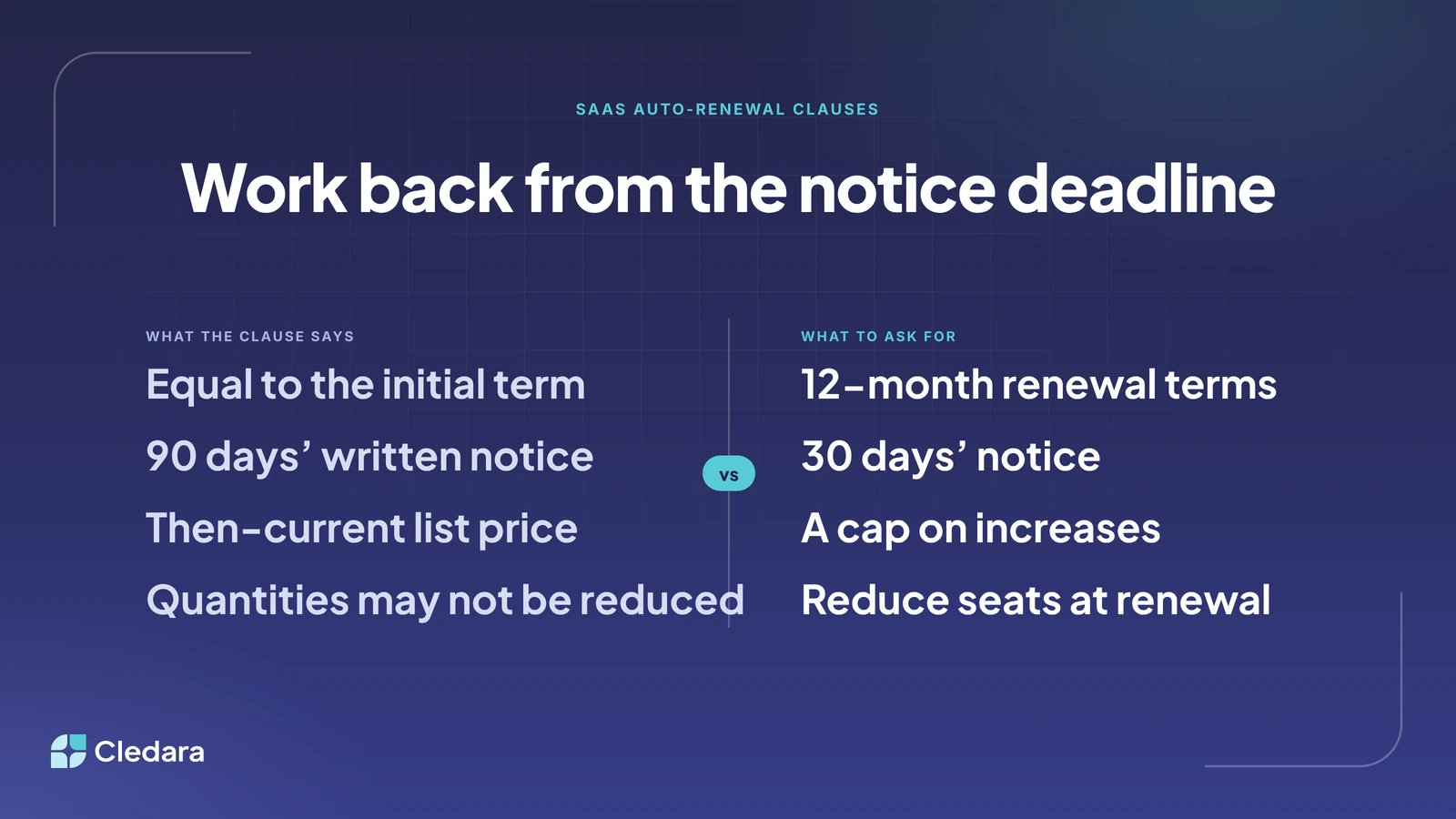
- Work back from the notice deadline rather than the renewal date. A 90-day calendar that starts at the notice deadline gives you the review, the decision and the written notice before the clause can bite.
- Cledara data shows annual billing is 13% of UK software subscription spend, 17% in Europe and 22% in the US, and those annual contracts are where the clauses live.
How we ended up with auto-renewal as the default
Auto-renewal wasn't always the norm. When software was a licence you installed, a contract ending meant the software kept working and you simply stopped paying for support. Subscriptions changed that: if a subscription lapses, the tool goes dark, and vendors learned that customers would rather renew quietly than risk an outage. So auto-renewal became a convenience, and the notice window became the small print.
It's worth being fair about this. For most tools, auto-renewal is what you want. Nobody wants Slack to switch off on a Tuesday because a renewal email went to someone who left in June. Renewal itself is fine. The trouble is that the clause quietly moves the decision point to a date nobody has written down.
The clauses also got longer as deals got bigger. A monthly plan paid on a card rolls over with little ceremony. An annual contract signed with a sales rep arrives with a renewal term, a notice period and, increasingly, a price uplift. Cledara data shows 83% of UK software subscription spend is still billed monthly (78% in Europe, 73% in the US), so the auto-renewal clause is mostly a problem of your largest and most expensive tools. Which is precisely where it hurts most.
The three traps inside a SaaS auto-renewal clause
Here's what to look for in a SaaS auto-renewal clause, in the order the traps tend to catch people.
1. The notice window is counted backwards from a date you don't celebrate
A 60 or 90-day notice period sounds generous until you realise it's measured back from the end of the term. If the contract runs to 31 March, a 90-day window means your last day to give notice is 31 December. Your calendar reminder, if you set one at all, is probably sitting on the renewal date itself, three months too late.
Longer windows are becoming more common on larger contracts, and the window is often expressed as "not less than" a number of days, so a notice that lands one day late is simply ignored.
2. The renewal term copies the original term
"Successive terms equal to the initial term" is the sentence to find. If you signed for 36 months to get a discount, the clause renews you for 36 months. There's nothing illegal about it; it's just that the discount is long forgotten by year four and the commitment isn't.
The companion trap is the seat count. Renewals typically roll forward the number of seats or the minimum commitment in the original order form, including the seats for people who have since left. If you haven't trimmed the seat count before the notice deadline, you've committed to paying for them again.
3. The price moves and the form of notice is strict
Many clauses allow the vendor to raise prices at renewal, either by a fixed percentage or "in line with the then-current list price". Our own benchmarks, published in our guide to SaaS renewal management, put the average renewal uplift at 8 to 12% a year, with aggressive vendors at 15 to 25%.
Then there's the form. "Written notice" can mean an email to a named address, a letter to a registered office or a form inside the product's admin console. A reply to your account manager saying "we're not renewing" may not count, and some vendors will tell you so only after the deadline has passed.
| Clause wording | What it really means | What to ask for instead |
| "Renews for successive terms equal to the initial term" | A 3-year deal renews for 3 more years | 12-month renewal terms, whatever the initial term |
| "Not less than 90 days' written notice prior to the end of the then-current term" | Your deadline is three months before the date you remember | 30 days' notice, and a vendor reminder at least 60 days before the deadline |
| "Fees for any renewal term shall be at the then-current list price" | The discount you negotiated disappears | A cap on increases, fixed or tied to inflation |
| "Quantities may not be reduced during the term" | Leavers' seats roll into the next term | The right to reduce seats at renewal, with no minimum above current usage |
| "Notice must be sent to the address specified in the order form" | An email to your rep may not count | Notice by email to named addresses, with confirmation of receipt |
Why business contracts don't get the protection consumers do
If you've cancelled a gym membership recently you may have noticed that consumer subscriptions are getting easier to escape. The UK's Digital Markets, Competition and Consumers Act introduces new subscription contract rules, which the government confirmed in April 2026 are now expected to take effect in spring 2027. They require reminder notices before a renewal, ban terms that make cancelling disproportionately difficult, and give a cooling-off window after an auto-renewal of a contract lasting a year or more.
Those rules are written for consumers. Business contracts are governed by what you signed, and the law assumes two businesses can look after themselves. There's no statutory reminder, no cooling-off period and no requirement that the notice window be reasonable. If your contract says 90 days, it's 90 days. That's why the calendar matters more in B2B than anywhere else.
The 90-day calendar that starts at the notice deadline
The mistake most teams make is to run their renewal process from the renewal date. Run it from the notice deadline instead. Here's the sequence, counted back from the last day you can give notice.
- Find the real deadline. For every annual contract, read the clause and write down three things: the end of the current term, the notice period, and the date the two produce. That date, not the renewal date, goes in the calendar with an owner's name next to it.
- 90 days before the deadline: start the review. Pull usage for the tool, the seat count against current headcount and the price against your benchmarks. If a tool has had no meaningful use for 90 days, that's your answer already.
- 60 days before the deadline: make the decision. Renew, renegotiate, downsize or cancel. If you're renegotiating, this is when you ask for the renewal term, notice period and price cap in the table above. Vendors are far more flexible while you still have the option to leave.
- 30 days before the deadline: send the written notice. Even if you expect to renew, give notice of non-renewal or of your intention to renegotiate, in the exact form the contract requires, to the exact address it names. Keep the confirmation. You can always sign a new order form afterwards; you can't undo a missed deadline.
- On the deadline: confirm receipt. Get written acknowledgement that the notice arrived in time. Then, and only then, let the calendar move on to the next contract.
Counted forwards, a 90-day notice period plus this 90-day run-up means the review starts about six months before the renewal date. That sounds early. It's also the only schedule that gives you the choice the clause was designed to take away.
What to negotiate before you sign
The cheapest time to fix a SaaS auto-renewal clause is before it exists. When a new annual contract arrives, ask for these as standard; most vendors will concede at least three.
- Renewal terms of 12 months whatever the initial term.
- A notice period of 30 days, counted from the end of the term.
- A written reminder from the vendor at least 60 days before the notice deadline.
- Price increases at renewal capped at a fixed percentage or tied to inflation.
- The right to reduce seats at renewal to current usage.
- Notice by email to named addresses on both sides, with confirmation of receipt.
None of these is unusual. What's unusual is a buyer asking for them, which is exactly why they work.
Where the dates live
A calendar only helps if someone keeps it. The ops and finance leads we speak to usually have renewal dates in a spreadsheet that was accurate on the day it was built, and one admitted that of the 11 renewals flagged for the coming quarter, nobody was sure the dates were right. That's the normal state of affairs, and it's why the SaaS auto-renewal clause keeps winning.
This is the part Cledara was built for. Every subscription sits in one list with its owner, cost, renewal date and contract, and alerts go out before each renewal so the notice deadline is a decision rather than a surprise. Because every tool has its own virtual card, stopping a payment is a click rather than a chase, and the Negotiation and Renewal Copilot drafts the renewal conversation using price benchmarks from across Cledara's customers (the same benchmarks are free at data.cledara.com). You can read how the whole renewal cycle fits together in our SaaS renewal management guide and our earlier piece on reading a SaaS contract.
The future: every renewal becomes a decision
I think auto-renewal clauses will matter less over time, for a good reason. As more finance teams keep one live list of every subscription, with the clause dates attached, the notice window stops being a trap and becomes a diary entry. Vendors will adjust too: when every customer turns up 90 days early with usage data, long notice periods stop being worth the argument.
Until then, the rule is simple. Read the clause, write down the real deadline, and work back from it. The contract was designed so the default outcome is renewal. Your job is to make the default outcome a decision.