


Why SaaS management pricing models matter more than the sticker price
When finance teams compare software management tools, they tend to compare the first number on the pricing page. That number is almost never what you end up paying. SaaS management pricing comes in three main shapes (per user, per transaction and flat fee), and each one grows with a different part of your business. Pick the wrong shape and a tool that looked cheap in year one is the most expensive thing in the finance stack by year three.
I've sat through a lot of these conversations. The pattern is always the same: someone has a quote for £X a month, someone else has a quote that's "basically free", and nobody has modelled what either costs once the company doubles. So the real question is which bill grows fastest, and this post does the modelling. The figures are illustrative (I'll say so again below), but the shape of the answer is what matters.
Key takeaways
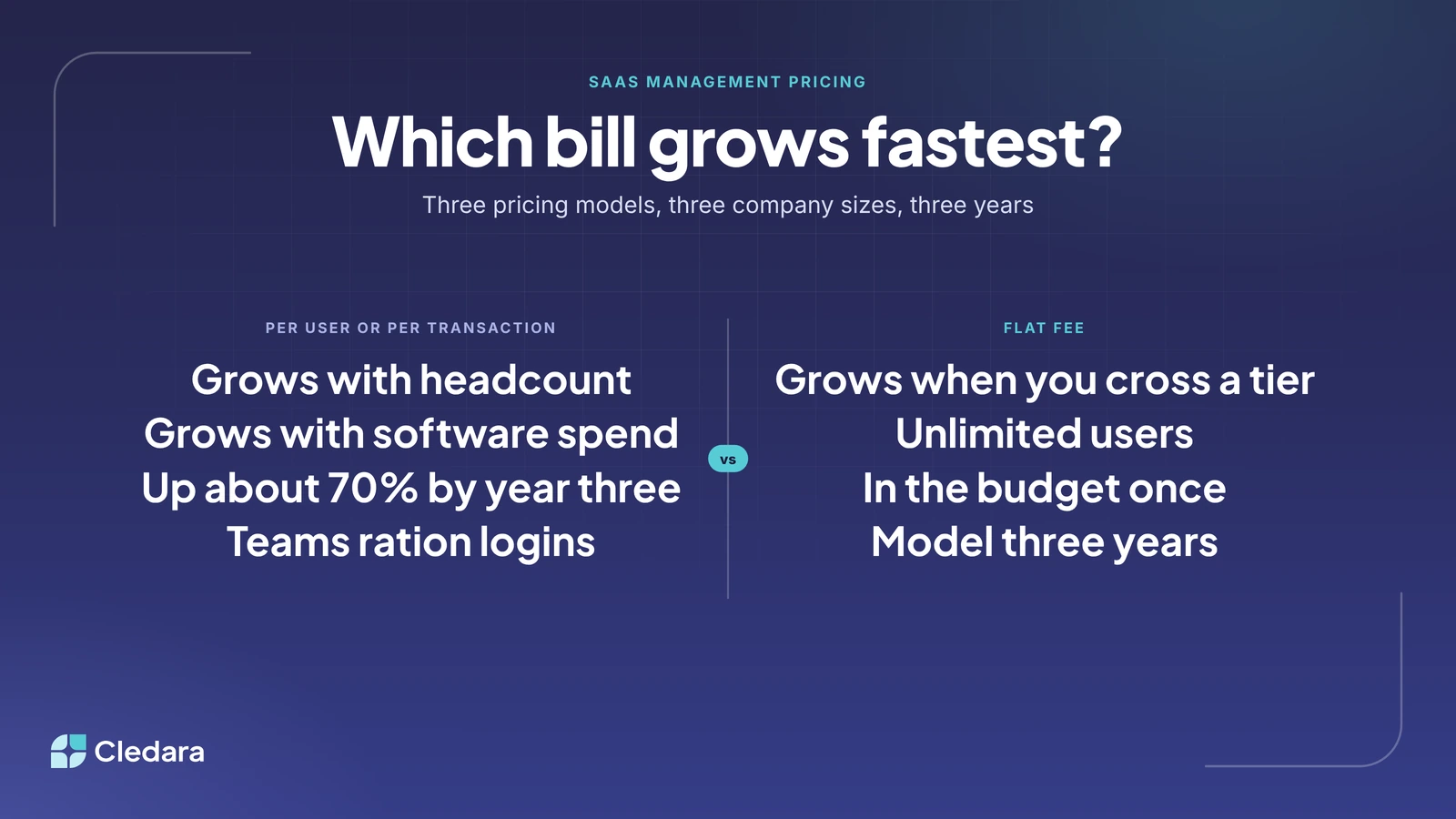
- Per-user pricing grows with headcount, per-transaction pricing grows with software spend, and flat-fee pricing grows when you cross a tier, and only then.
- Cledara data shows the average company on the platform paid for about 35 software tools in the last twelve months (median 32), so tier boundaries at 20, 50 or 100 applications matter.
- In the UK, 81% of software spend on Cledara is billed monthly, which means a lot of transactions for any model that charges per payment.
- Software spend is now the fastest-growing line for many companies because of AI, so percentage-of-spend models get dearer exactly when you'd like them not to.
- Implementation fees, per-card charges, FX fees and add-on modules can outweigh the headline price. Model three years rather than one month.
The three SaaS management pricing models, explained
Most tools that help finance manage software subscriptions use one of these models, or a blend. None of them is wrong. Each one just rewards a different kind of customer.
| Model | What you pay for | Grows with | Typical catch |
| Per user (per seat) | Every employee, or every person with a login | Headcount | You limit who gets access, which defeats the point of visibility |
| Per transaction or percentage of spend | Each payment processed, or a slice of the spend that flows through | Software spend and payment volume | Bills rise with AI usage and monthly billing; savings fees can be opaque |
| Flat fee by tier | A fixed monthly amount for a band of applications or features | Nothing, until you cross a tier | Tier jumps can be steep; check what sits in the next band |
There's a fourth model worth naming: "free" platforms funded by card interchange. Those can be a good deal, but the price is paid in a narrower product (they tend to do the spend stuff, not the subscription stuff) and in the incentive to push every payment onto their card.
What per-user SaaS management pricing does to a growing company
Per-user pricing looks fair. Everyone who benefits pays. The trouble is that a finance tool's value scales with the number of subscriptions it watches, whatever the number of people who log in. A 40-person company and a 200-person company with the same 35 tools get the same visibility, but one pays five times more.
The quieter cost is behavioural. When every seat costs money, teams ration access. The marketing lead who buys three tools a quarter never gets a login, so her purchases never go through the system, and finance is back to discovering subscriptions by invoice. (One prospect told us last summer that she finds out about tools "from time to time" when an invoice turns up. Per-user pricing makes that worse.)
What per-transaction and percentage-of-spend pricing does
Charging per payment, or as a percentage of what flows through, feels low-risk because the fee is small on day one. But look at what it's indexed to. Cledara data shows that in the UK, 81% of software spend on the platform is billed monthly, 15% annually and about 3% quarterly. Monthly billing means roughly twelve payments a year per tool. Thirty-five tools is around 400 payments a year before you count usage-based AI bills, which can arrive weekly or daily.
And software spend is rising. Across Cledara's customers, 27% of software spend now goes to AI-native tools, up from about 3% two years ago. A model that takes a slice of spend takes a bigger slice every year, with no extra work done for it. Percentage-of-savings models (common in procurement-led tools) have a similar problem: the fee is hard to forecast and hard to audit.
What flat-fee SaaS management pricing does
A flat fee, usually tiered by the number of applications you manage, is the only model where the cost doesn't move when the business grows. Hire 50 people, add a dozen AI tools, triple your cloud bill: the fee is the fee. Finance can put it in the budget once and forget it.
The thing to watch is the tier boundary. Cledara data shows the average company on the platform paid for about 35 software tools in the last twelve months, with a quarter of companies above 48. If a plan tops out at 50 applications, a company at 45 will cross that line within a year or two. Ask what the next tier costs before you sign, and ask how the vendor counts an "application" (a tool with three separate billing accounts can count as one or three).
Three companies, three years: a worked model
These numbers are illustrative. They are not any vendor's real prices, including ours. I've used round figures so the shape is easy to see: per-user at £5 per employee per month, per-transaction at 1% of software spend processed, and a flat fee of £250 a month up to 50 applications, £450 up to 100 and £900 above that. Headcount grows 30% a year, tools 20% a year and software spend 35% a year (that last one is the AI effect).
| Company (year 1) | Per user, 3 years | Per transaction, 3 years | Flat fee, 3 years |
| A: 40 people, 30 tools, £8k a month on software | £9,600 | £4,005 | £9,000 |
| B: 120 people, 60 tools, £30k a month | £28,740 | £15,021 | £16,200 |
| C: 300 people, 120 tools, £90k a month | £71,820 | £45,063 | £32,400 |
Three things jump out. For the smallest company, percentage-of-spend is cheapest, because there isn't much spend yet. For the largest, the flat fee is less than half the per-user cost, and the gap widens every year. And in all three cases the per-user bill has grown by about 70% by year three without the company getting anything new.
Change the growth assumptions and the ranking changes. That's the point. The cheapest model is the one indexed to whatever grows slowest in your business, and for most scaling companies right now, the slowest-growing thing is the number of applications.
The hidden line items in SaaS management pricing
The headline fee is rarely the whole bill. Before you compare quotes, add these up:
- Implementation or onboarding fees, sometimes a four-figure sum, sometimes waived if you ask.
- Per-card or per-payment fees on virtual cards, which turn a flat plan into a transaction plan by the back door.
- FX fees on payments in another currency. Nearly every US software vendor bills in dollars, so UK and European companies pay this on most of their stack.
- Add-on modules for compliance, IT management or optimisation. Decide which ones you'll actually switch on in year one.
- Minimum terms and auto-renewal clauses on the management tool itself. (Yes, the tool that tracks your renewals has a renewal.)
- Cashback or rebate offers. Some platforms offer cashback on spend for a period, which can offset the fee. Read the cap and the end date, and treat it as a time-limited discount.
How to choose the right pricing model for your company
You don't need a procurement team for this. An hour with a spreadsheet will do.
- Count your applications properly. Pull twelve months of card and bank statements and count distinct software vendors rather than invoices. Most companies find more than they expected.
- Project headcount, tools and software spend for three years using your actual plan, including AI usage.
- Estimate payment volume: tools on monthly billing multiplied by twelve, plus any usage-based bills.
- List the add-ons you would switch on in year one, and price only those.
- Model each quote over three years with the growth you expect, as in the table above.
- Check the exit terms. A flat fee with a three-year lock-in is not a flat fee.
Tip: ask each vendor for the price at double your current size. The answer tells you more about the pricing model than the brochure does.
Where Cledara sits
For what it's worth, Cledara uses a flat monthly fee tiered by the number of applications you manage, with unlimited users on every plan. Virtual cards are free and there are no per-transaction fees; the only card fee is an FX fee on payments in another currency. The API is included. That's a deliberate choice: we'd rather the whole company could use the tool than have finance ration logins. Current plans are on the pricing page, and the approvals and purchasing page shows what sits inside them.
Whichever tool you pick, model it for the company you're going to be in three years. The companies that get this right treat software management as a fixed cost of running a modern business, and spend their attention on the software itself.