


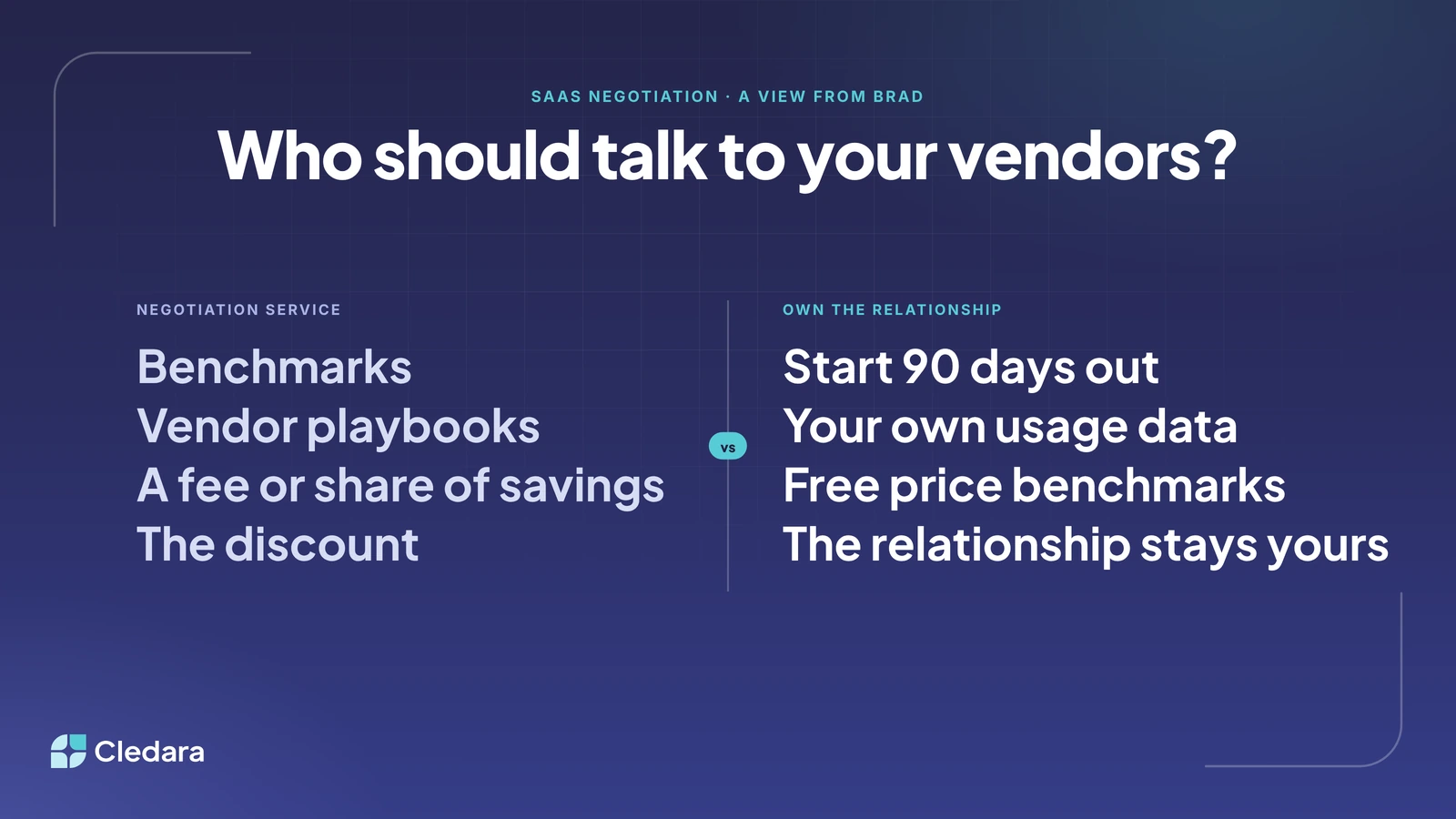
Who should talk to your vendors?
There's a new kind of service doing the rounds in finance teams. For a fee, or a slice of what they save you, someone else will handle your SaaS negotiation. They know the vendor's playbook, they have benchmarks, and they do this all day. It sounds like a relief, and for some companies it is.
But a finance lead told one of our team something recently that stuck with me. He'd looked at a SaaS negotiation service and decided against it, because he didn't want a stranger calling his vendors on his behalf. He wanted to keep the relationship. Fair enough. I think he's onto something, and I think the right answer for most growing companies is a bit more interesting than "outsource it" or "do it yourself".
Key takeaways
- A SaaS negotiation service can win real discounts, especially on large enterprise contracts where the vendor's list price is a starting point.
- The negotiation is a one-day event. The vendor relationship runs all year, and it's where support, flexibility and goodwill come from.
- Most renewals go badly because they start late, whoever does the negotiating. Cledara data shows companies that start 90 days out save about 49% on average, against 19% for those that start later.
- Your strongest card in any software negotiation is your own usage data: who uses the tool, how often, and what it would cost to switch.
- Own the relationship and borrow the data. Free benchmarks at data.cledara.com and a copilot that drafts the email get you most of the way.
How software negotiation ended up on finance's desk
Not long ago, software was bought by IT or procurement, and those teams were good at negotiating because it was their job. That changed. Cledara's research found that about 65% of SaaS is now bought directly by business users, with no IT, finance or procurement involvement at all. Marketing picks its own tools. Engineering picks its own tools. Everyone has a login and a card.
Then the renewal arrives. Nobody in the team that bought the tool thinks of themselves as a negotiator, so the renewal lands on finance. And finance at a growing company usually has no procurement team to hand it to. (If you have one, lucky you.) So you end up with a Head of Finance who was hired to close the books and plan the runway spending an afternoon haggling over seat prices with a vendor's account manager who does this every single day.
That gap is exactly what a SaaS negotiation service fills. The question is whether filling it that way is the best deal for you.
What a SaaS negotiation service actually does
Let me be fair to them, because the good ones are good. Vertice is one well-known example of the category. A negotiation service typically brings three things you probably don't have in-house.
- Benchmarks: what other companies your size actually pay for the same tool, which is the single most useful number in any negotiation.
- Vendor playbooks: how each vendor discounts, when its quarter ends, and which levers (term, seats, payment timing) it's willing to move on.
- Time: someone whose whole job is to run the process, chase the vendor and hold the line while you get on with yours.
On a big enterprise contract where the list price is a polite fiction, that combination pays. If you're spending six figures a year on one vendor and nobody on your side has negotiated with them before, bringing in a specialist is a perfectly sensible call.
What you give up when someone else negotiates for you
Here's where my finance lead had a point. A negotiation is an event that happens once a year. A vendor relationship is a thing that runs all year, and most of what you get from it happens outside the negotiation.
When your account manager knows you, you get the support escalation answered on a Friday afternoon. You get early access to a feature your team asked for. You get flexibility when you need to drop ten seats mid-term because a project ended. You get a heads-up before a price increase rather than a surprise in the invoice. None of that is in the contract. All of it comes from the relationship.
When a third party negotiates for you, a few things change quietly:
- The vendor learns that you've outsourced the conversation, and treats it as a procurement exercise rather than a partnership.
- The context lives with the service, not with you. Next year you start from scratch, or you renew the service too.
- On a savings-share model, the incentive is to maximise this year's discount, which isn't always the same as the right multi-year deal for you.
- The thing that gives you bargaining power (your usage data, your roadmap, your honest view of alternatives) still has to come from you anyway.
That last point matters most. The most persuasive thing you can say to a vendor is "we have 80 seats, 41 people logged in last month, and here's what the alternative costs". A negotiation service can say that for you, but only if you give it to them. If you have the data, you've already done the hard part.
Most SaaS negotiations go badly because they start late
This is the bit I'd want every finance team to internalise. When we looked at renewals across Cledara's customers for our guide to forecasting software costs, the biggest difference between a good outcome and a bad one wasn't who did the negotiating. It was when they started.
Companies that opened the renewal conversation 90 days out averaged about 49% savings. Companies that started between 30 and 90 days out averaged 19%. Start inside 30 days and you're mostly choosing which price increase to accept, because the vendor knows you can't switch in time. On top of that, vendors raise renewal prices by 8 to 12% a year on average, so doing nothing isn't neutral. It's a pay rise for the vendor.
It's also worth knowing where negotiation matters at all. Cledara data for the year to October 2026 shows that monthly billing accounts for roughly 83% of software subscription spend in the UK, 78% in Europe and 73% in the US. Those tools you can cancel next month, so your position is simply "we'll leave". The annual contracts (about 13% of spend in the UK, 17% in Europe and 22% in the US) are where a real negotiation happens, and they're a short enough list that you can put every one of them in a calendar.
Negotiation service or own it yourself: a quick comparison
| | SaaS negotiation service | Own the relationship, borrow the data |
| Best for | A handful of six-figure enterprise contracts | The 30 to 50 tools a growing company actually runs on |
| Who holds the vendor relationship | The service, during the deal | You, all year |
| Where the benchmarks come from | The service's client base | Free price benchmarks, plus your own usage data |
| What it costs | A fee or share of savings | Your time, mostly in the 90 days before renewal |
| What you keep afterwards | The discount | The discount, the context and the relationship |
| Biggest risk | Vendor treats you as a procurement exercise | Starting too late |
Own the relationship, borrow the data
So here's what I'd actually do, and it's what we've built Cledara to make easy. Keep the conversation with the vendor yours, so the relationship stays yours. Hand the preparation to software.
- Put every annual renewal in one list with its date, notice period and owner. If you can't see it, you can't start early. Cledara keeps every renewal date in one place and sends alerts before each one.
- Ninety days out, pull the usage: how many seats you pay for and how many people used the tool last month. Cledara shows last use by person, and Cledara Agent can take back the seats nobody uses before you ever talk to the vendor.
- Check the price against the market. The benchmarks at data.cledara.com are free and built from real payments across Cledara's customers, so you know what "fair" looks like before the first call.
- Draft the email. The Negotiation and Renewal Copilot in Cledara's Spend Optimisation module drafts the renegotiation note and flags the points worth pushing on (seats, term, uplift).
- Have the conversation yourself. You know your roadmap, and your account manager will remember you were straight with them next time you need a favour.
Tip: if the vendor won't move on price, ask for things that cost them nothing. A price cap on next year's uplift, the right to reduce seats at the next quarter, or a longer notice period all protect you more than a one-off discount.
Where this ends up
I think the companies that get this right over the next few years will look like this. The relationship with the vendor stays human, because that's where the goodwill is. The preparation (the list, the dates, the usage, the benchmark, the first draft) is done by machines, because that's repetitive work and people are bad at remembering to do it 90 days early.
It's a bit like what happened to travel. We didn't replace the trip. We replaced the travel agent with data, and then went on the trip ourselves. Software renewals are heading the same way. You'll still have the conversation. You just won't have to do the homework.
If you'd like to see what fair looks like for the tools you pay for, the benchmarks are free at data.cledara.com. And if you'd rather the homework did itself, that's what Cledara is for.
Cheers,
Brad