


SaaS price increases in 2026: list prices went up, seat bills didn't
Every finance team I speak to has a story about a software price increase this year. The renewal quote that came in 12% higher with no new features. The plan that was quietly renamed and repriced. The monthly rate that jumped while the annual rate stayed put. So when we looked at SaaS price increases across Cledara's own payment data for 2026, I expected to see bills climbing everywhere.
That isn't what the data shows. On the core seat-based tools most companies pay for (Microsoft, Google Workspace, Slack, Atlassian, Figma and the rest), the average monthly amount a UK company paid barely moved year on year. The increase is real, but it landed somewhere else: on the AI bill, where spend per company went up several times over.
Key takeaways
- Vendors did raise list prices in 2026. Industry surveys put the share of IT leaders seeing increases at renewal at 79%, and typical renewal uplifts at 8% to 12% a year.
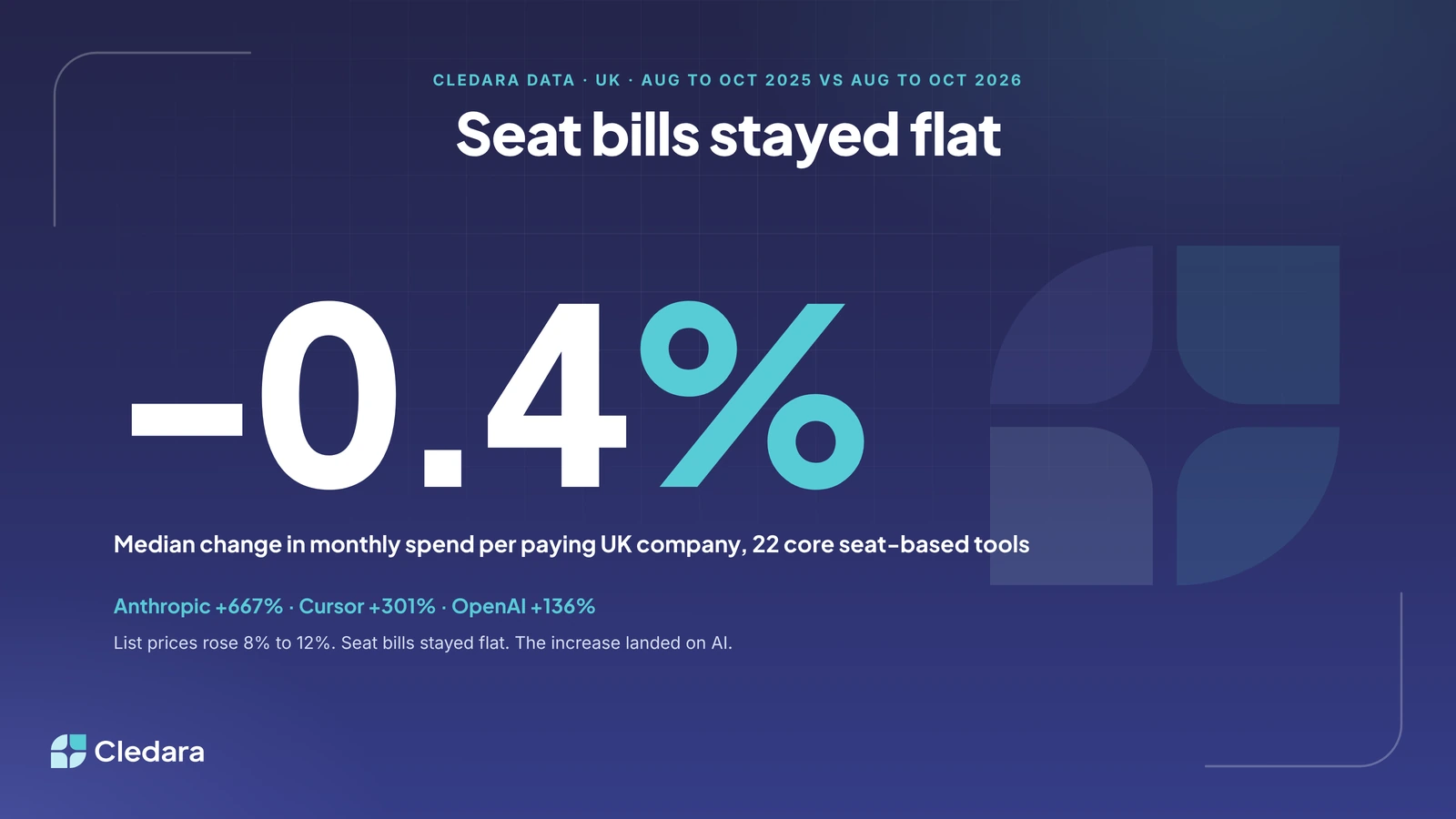
- Cledara data shows the median change in monthly spend per paying UK company across 22 core seat-based tools was minus 0.4% between autumn 2025 and autumn 2026. Eleven tools went up, eleven went down.
- Companies absorbed list-price rises by trimming seats and tiers, which is easier when 90% of software payments are monthly.
- AI is where the money went: spend per paying company on Anthropic (including Claude) rose about 7.7 times, OpenAI about 2.4 times and Cursor about 4 times.
- AI-native tools took 18% of all spend on the Cledara platform in October 2026, up from 6% a year earlier.
- The 2027 budget risk is usage-based AI pricing, so put budgets and alerts on AI keys before you renegotiate your seat tools.
What vendors did to SaaS list prices in 2026
Nobody disputes that list prices rose. Zylo's 2026 SaaS Management Index found that 79% of IT leaders had met a price increase at renewal in the past year, and that total spend across organisations rose nearly 8% in a year, driven by AI monetisation, tier restructuring and consumption charges. A Gartner analyst quoted by CIO.com put subscription cost rises from several large vendors at 10% to 20% in 2025, against IT budget growth of under 3%.
The individual moves tell the same story. Salesforce raised prices 6% across its Enterprise and Unlimited editions in August 2025. SaaS Price Pulse tracked Webflow's Basic plan going up 39% on monthly billing in the second quarter of 2026 while the annual price rose only 7%, a pattern that pushes customers towards annual commitments. Our own renewal management guide puts the average renewal uplift at 8% to 12% a year, with aggressive vendors asking for 15% to 25%.
So the sticker price went up. The question is what happened to the amount companies actually paid.
What Cledara data shows about SaaS price increases per company
We compared software subscription payments by UK companies on Cledara in August to October 2025 with the same three months in 2026, and worked out the average monthly amount paid per paying company for each vendor. This blends list price, seat count and tier, which is the point: it's the number that lands in your management accounts.
Across 22 established seat-based tools, the median change was minus 0.4%. Here are the main ones.
| Vendor | Monthly spend per paying UK company, Aug to Oct 2025 | Aug to Oct 2026 | Change |
| GitHub | £339 | £575 | +70% |
| Atlassian | £1,132 | £1,478 | +31% |
| Microsoft | £1,725 | £2,217 | +29% |
| Xero | £174 | £213 | +23% |
| Google Workspace | £1,133 | £1,314 | +16% |
| Notion | £464 | £513 | +11% |
| HubSpot | £2,346 | £2,548 | +9% |
| 1Password | £232 | £236 | +2% |
| Zoom | £427 | £418 | -2% |
| Adobe | £379 | £366 | -3% |
| Slack | £588 | £548 | -7% |
| Figma | £294 | £251 | -15% |
| Linear | £536 | £428 | -20% |
| JetBrains | £718 | £401 | -44% |
Source: Cledara platform data, UK software subscription payments, isSoftware and isSubscription filters applied. Figures are averages per paying company per month and are rounded.
A few of these are worth a second look. GitHub's rise is consistent with teams adding Copilot seats (our data doesn't split the two), so part of that is an AI story wearing a seat-tool badge. Microsoft's and Atlassian's rises are consistent with the list-price and tier changes both vendors made. On the other side, Figma, Slack and JetBrains per-company spend fell, which is what you'd expect when finance teams trim seats after a price rise or when AI-assisted tools take over part of the job.
Why seat bills stayed flat while SaaS prices rose
If list prices rose 8% to 12% and per-company spend stayed flat, companies must have cut volume by roughly the same amount. That's exactly what we see in customer conversations. A price increase at renewal triggers a seat audit, and the seat audit finds the licences nobody has logged into for a quarter.
Two things make this easier than it used to be. First, most software is billed monthly: Cledara data shows about 90% of software payments on the platform are monthly, so a company can drop seats next month rather than waiting for an annual renewal. Second, usage data is now cheap to get, so "do we still need 40 seats?" is a question finance can answer in a minute rather than a week of emails.
There's a less comfortable explanation too. Some of the flat line is companies paying for fewer tools overall, which the shadow IT data suggests is partly a clean-up of duplicates. Either way, the picture is of finance teams who have learned to respond to price rises rather than absorb them.
Where the SaaS price increase actually landed: AI
Now the other half of the table.
| Vendor | Monthly spend per paying UK company, Aug to Oct 2025 | Aug to Oct 2026 | Change |
| Anthropic (including Claude) | £439 | £3,370 | +667% |
| Cursor | £335 | £1,344 | +301% |
| OpenAI (including ChatGPT) | £549 | £1,295 | +136% |
These aren't price increases in the classic sense. Anthropic and OpenAI didn't put their per-seat prices up by 600%. What changed is how companies use them: more people, more API usage, and more usage-based billing where the invoice follows the tokens rather than the headcount. The result for a finance team is the same as a price increase, though, because the line in the budget is three to eight times bigger than it was a year ago.
At platform level, AI-native tools took 18% of all spend on Cledara in October 2026, up from 6% in October 2025. Looking only at software spend, AI-native tools now account for 27%, up from about 3% two years ago. That's the fastest reallocation of software budget we've seen in the data, and it's happening while the rest of the stack is held flat.
The practical difference between a seat-price rise and an AI usage rise is that one arrives once a year with a quote you can negotiate, and the other arrives every day without asking. We've written about how to manage that in our finance leader's guide to shadow AI.
How to prepare for SaaS price increases in 2027
The companies that held their seat bills flat this year did a handful of things consistently. None of them is complicated.
- Build a renewal calendar with notice deadlines. Start every annual renewal review 90 days out. The deadline that matters is the last day you can change terms, not the renewal date itself.
- Audit seats every quarter, not every renewal. With monthly billing, a quarterly seat audit catches the leaver's licence in March rather than next January. Cledara shows last-used dates per user to make this quick.
- Benchmark before you negotiate. Vendors offer deeper discounts to buyers who arrive with price data. Free benchmarks from Cledara's platform are published at data.cledara.com.
- Ask for a price-rise cap in the contract. A clause limiting annual increases to inflation or a fixed percentage costs nothing to ask for and removes the biggest surprise.
- Put a budget and an alert on every AI key. Cledara connects to providers such as OpenAI, Anthropic and Cursor, tracks usage every day against the budget you set, and warns finance and the owner before spend runs over.
- Consolidate where two tools do one job. Price rises are the moment to ask whether you need both. Most companies find at least one pair.
What this means for next year's budget
My reading of the 2026 data is optimistic. Finance teams have got good at handling the old kind of price increase. The renewal quote comes in, the seat audit happens, the number ends up flat. That took a decade of practice and better tooling, and it works.
The new kind of increase needs the same discipline applied daily rather than annually. AI spend is the fastest-growing line most companies have right now, and probably the best value, but it needs an owner, a budget and an alert in the same way a seat tool needs a renewal date. Get that in place before January and the 2027 budget conversation becomes a decision about where to invest rather than an explanation of where the money went.
A note on method: all Cledara figures are from UK companies' software subscription payments on the Cledara platform, comparing August to October 2025 with August to October 2026, averaged per paying company per month. Claude is counted under Anthropic and ChatGPT under OpenAI. Third-party figures are linked to their sources above.