


Why you should benchmark software pricing before a renewal
Here's a funny thing about software budgets. Most of the effort goes into the buying decision and almost none into the renewal. Yet the renewal is where the money moves. Renewal prices rise 8 to 12% a year on average, and 15 to 25% with aggressive vendors (our 2026 renewal benchmarks have the detail). Across the 32 tools a median company pays for, that compounds. So this is a step-by-step guide to how to benchmark software pricing before a renewal: what to pull, how to read it, and what to say to the vendor.
For most of my career, finance teams couldn't do this. You knew what you paid and had no idea what anyone else paid. The vendor knew both, which is a rubbish position to negotiate from. That's changed. Cledara publishes price data from more than 1,000 companies for free at data.cledara.com, so a SaaS price benchmark is now a ten-minute job.
Key takeaways
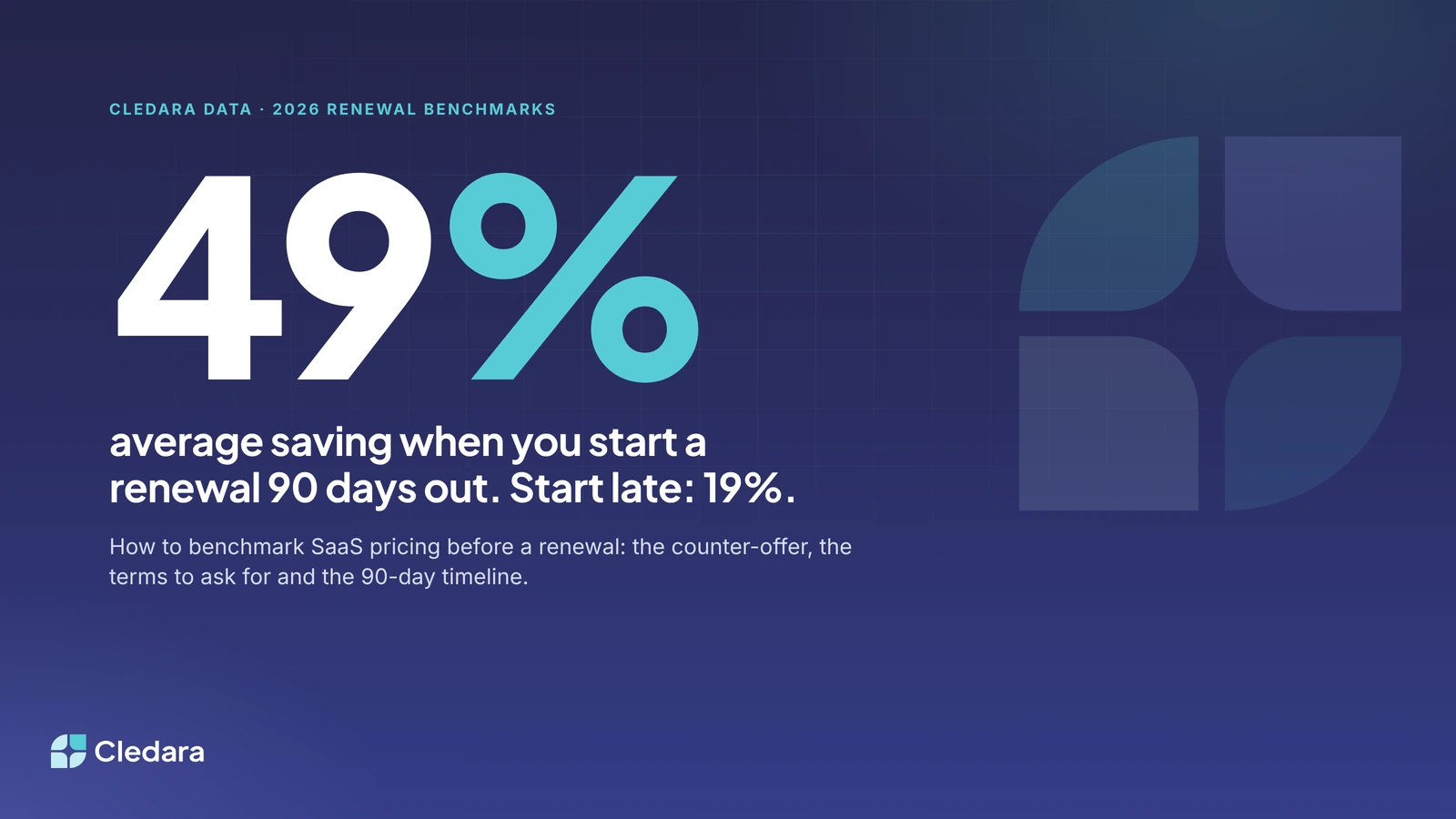
- Companies that start a renewal 90 days out save 49% on average. Those that start 30 to 90 days out save 19%.
- Free market data on what similar companies pay is at data.cledara.com; you don't need a procurement team or a paid service.
- The counter-offer is the benchmark plus your usage: seats actually used, tier actually needed.
- Ask for terms as well as price: a cap on rises, the right to reduce seats, and a shorter notice period.
- 90% of software transactions are monthly subscriptions, so for most tools you can renegotiate any time.
How to benchmark software pricing before a renewal
To benchmark software pricing before a renewal, pull three numbers: what you pay per seat today, what similar companies pay for the same tool (from data.cledara.com), and how much of what you pay for you actually use. The gap between the three is your counter-offer.
- Write down your own number. Annual cost, seats, tier, billing cycle and notice date. In software subscription management software such as Cledara this is one row in the subscription list; otherwise it's the last invoice plus the contract. If the renewal date isn't written down anywhere, fix that first.
- Pull the market number. Look the vendor up at data.cledara.com: average spend per paying company by region, how it's billed, and which alternatives in the category are gaining ground.
- Read the range, not the point. An average is a midpoint, not a price list. What matters is where you sit against it and why. Above it with a small team? You're probably paying for a tier or seats you don't need. Below it? Your room is in terms rather than price.
- Add your usage. Seats active in the last 90 days against seats paid for. This is the number vendors least want you to have.
- Build the counter-offer. The seats you use, at a unit price at or below the benchmark, on the tier you need. Write it as one sentence you'd be happy to send.
- Ask for the terms. A cap on rises, the right to reduce seats, and a shorter notice period. Often easier to win than a discount and worth more over three years.
A worked example: benchmark SaaS pricing for a CRM renewal
Let's take a CRM, because nearly everyone has one. The company is illustrative: a 120-person UK business with sales and marketing on HubSpot, paying £27,000 a year for 40 seats, renewal on 1 March. The market figures are real, from data.cledara.com, October 2025 to September 2026.
First, the market. Across Cledara customers, the average HubSpot spend per paying company over those twelve months was £20,437 in the UK, €13,645 in the EEA and $29,133 in the US (each in its own currency, no conversion). Only 13% of UK HubSpot spend was billed yearly; 74% was monthly and 12% quarterly. For contrast, the average Pipedrive spend per paying UK company was £4,986. Same job, very different price point.
Second, the category. Cledara tracks 37 CRM products within its Sales and Revenue category. Salesforce takes about half the CRM spend and Attio is the rising star, up 34 places in the spend rankings in a month. You won't switch CRM over a renewal, but the data makes the alternative credible.
Now the table. The vendor has proposed a 10% rise, squarely in the 8 to 12% average range. Our company has 31 of its 40 seats active in the last 90 days.
Read it right to left. The counter-offer is the seats we use (32, with one spare) at the unit price we pay today, which lands at £21,600: 20% below what we pay now, 27% below the proposal, and close to the UK average. Nobody has asked for a discount. We've asked the vendor to charge us for what we use, at the price they already agreed, with the terms in writing. That's a much easier yes for an account manager than "give us 20% off".
The terms to ask for when you benchmark SaaS pricing
Price is one line in the contract. The terms protect the next three renewals, and vendors often trade terms more readily than discount because terms don't dent this quarter's bookings.
- A cap on rises. "Renewal pricing shall not increase by more than 3% a year." Against an 8 to 12% average rise, a 3% cap is worth more than a one-off discount by year two.
- The right to reduce seats. Most contracts let you add seats any time and remove them never. Ask for a seat true-down at each anniversary. Leavers happen; your contract should allow for them.
- A shorter notice period. 90 days' auto-renewal notice is the vendor's friend, not yours. Ask for 30. If they won't move, get the notice date into your renewal tracker today.
Note: a three-year discount with no cap, no true-down and 90 days' notice is often worse than list price on a one-year deal. Run both through the table above before you sign.
When should you start negotiating a SaaS renewal?
Start 90 days before the renewal date. Companies that start negotiating 90 days out save 49% on average, against 19% for those that start 30 to 90 days out, according to Cledara's renewal data. At 90 days you have time to benchmark, check usage and credibly consider alternatives. At 30 days you're negotiating against the clock, and the vendor knows it. Here's the 90-day timeline I'd run.
Important: 90% of software transactions on Cledara are monthly subscriptions, and in the UK 81% of software spend is billed monthly. If your tool is monthly there's no renewal date to wait for. Run the same steps any quarter; the only thing you lose by waiting is a few more months of overpaying.
How much can you save by negotiating a renewal early?
On average, 49% when you start 90 days out, against 19% when you start late. Those are averages across the renewals in Cledara's data, so results vary, and a tool already priced at the benchmark won't give you 49%. But the direction is consistent: the earlier you benchmark software pricing before a renewal, the more you keep. And the saving isn't only the discount. It's the seats you stop paying for, the rise you cap and the auto-renewal you catch.
Put it against a real bill. The median UK company on Cledara spends £73,846 a year on software (the middle half between £29,549 and £161,780). Benchmark every renewal in a year and I'll let you do the maths. Our customers save 23% on software spend on average, and our guide to reducing IT costs has more ways to find that money.
What market-data tools help finance teams compare SaaS quotes across license tiers and multi-year contract terms?
You need three kinds of data to benchmark software pricing before a renewal, and no single source has all of them.
- Market price data. What similar companies pay for the same tool, by region and billing cycle. data.cledara.com publishes this free from real payments across Cledara customers, by vendor and category. Cledara's Spend Optimisation module puts the same benchmark next to your own subscriptions and flags price increases, duplicates and unused seats.
- Tier and list-price data. The vendor's pricing page plus the quote. Benchmarks tell you what people pay; the pricing page tells you what each tier includes, so you can check you're not on Enterprise for one feature one person uses.
- Your own usage data. Seats used against seats paid, from your single sign-on provider, the tool's admin panel, or a browser extension such as Cledara Engage, which shows which of 8,000+ tools people use.
For multi-year terms there's no public dataset of contract clauses, so use the terms list above as your benchmark.
How does Vertice compare to other contract negotiation tools?
Vertice, Vendr and Sastrify are negotiation services: you hand them the renewal, they use their own price data and negotiators to get a better deal on your behalf, and you pay for the service. They suit companies with a procurement function and a lot of contracts. A benchmark you run yourself with free market data is the alternative for finance teams without a procurement team, who want to keep the vendor relationship.
Honestly, both approaches are fine. The question is who holds the data and the relationship. Our view at Cledara is that the finance team should hold both, which is why the benchmark data is free and why the Negotiation and Renewal Copilot drafts the negotiation rather than running it without you. Hundreds of contracts and a procurement team? A managed service may earn its fee. 32 tools and a Head of Finance? You can do this yourself in an afternoon.
The email that follows a SaaS price benchmark
Here's the email I'd send at 90 days. It's short and friendly, and it puts the number on the table so the account manager can take it straight upstairs. Replace the figures with yours.
- Subject: HubSpot renewal, 1 March: our proposal
- Open warmly and get to the point. "Hi Sam, thanks for sending the renewal through. We'd like to stay on HubSpot, and I want to get this agreed early rather than in the last week of February."
- State the usage fact. "We're paying for 40 seats and 31 have been active in the last 90 days, so we'll be renewing at 32."
- State the benchmark, with the source. "The proposal is £743 a seat. We're at £675 today, and the market data we use (data.cledara.com) puts average UK HubSpot spend per company at about £20,400 a year, so a rise doesn't make sense for us."
- Make the one clear ask. "Our proposal is 32 seats at £675, £21,600 a year, on yearly billing, with a 3% cap on future rises, the right to reduce seats at each anniversary, and 30 days' notice."
- Give something and set the clock. "We're happy to sign for a year and to be a reference for you. Could you come back with a written proposal by the 20th?"
- Sign off. "Cheers," and your name.
No threats, no "we're evaluating alternatives" (they assume you are), and no asking for a discount. You've told them what you use, what the market pays and what you'll sign.
Why benchmarking software pricing will soon seem obvious
Not that long ago, finance teams renewed software the way people renewed car insurance: the letter arrived, the price had gone up, and you paid it because comparing was a big job. Then comparison data became free and everyone started shopping around. Software renewals are at that point now.
The companies that win from here will benchmark software pricing before a renewal as a matter of routine, and treat every renewal as a decision, not a charge. Finance makes the decision (resize, replace, renew) and software does the chasing, the benchmarking and the drafting. That's what Cledara is built for: one list of every subscription with its renewal date, benchmarks next to each price, a copilot that drafts the email, and Cledara Agent to take back unused seats once you've approved it.
If you'd like to see your own renewals against the benchmark, book a demo and bring your next renewal date. Or go to data.cledara.com, look up the vendor and send the email. It's a good afternoon's work.
Cheers,
Brad