


Why you keep finding software subscriptions you didn't know about
Most finance teams find out about a new software subscription the same way. An invoice turns up. Or a card statement has a vendor name nobody recognises. Or someone in a Slack channel mentions a tool as if everyone already uses it. One operations lead put it to us plainly: from time to time she discovers an invoice, or hears about a subscription, that she didn't even know the company had.
It's what happens once a business passes about 30 software subscriptions, rather than a sign of a badly run company. That's roughly where most companies on the Cledara platform now sit. Cledara data shows the median company paid for 27 different software tools between May and October 2026, with a quarter of companies paying for 40 or more. Nobody can hold that list in their head, and a spreadsheet only knows what someone remembered to type into it.
The good news is that the subscriptions you don't know about hide in a small number of predictable places. Once you know where to look, finding them is a half-hour job rather than a quarterly archaeology project.
Key takeaways
- Discovery by invoice is normal past about 30 software subscriptions; the median company on Cledara paid for 27 tools over the last six months, and a quarter paid for 40 or more.
- Unknown subscriptions hide in three places: personal cards and expense claims, shared or legacy company cards, and API keys and usage-based accounts.
- Roughly three in ten tools appearing on the Cledara platform for the first time each month in 2026 were AI tools, so the list is growing fastest where finance has the least sight of it.
- A 30-minute self-audit (card statements, expense claims, login data and the leavers list) finds most of them.
- The fix is structural: an owner and a payment method per subscription, so new tools show up on the list the day they're bought.
Where unknown software subscriptions come from
Software used to be bought by IT. Now it's bought by whoever needs it, usually in about two minutes, with whichever card is closest. That's mostly a good thing. People get the tools they need without a procurement process for a tool that costs less than lunch.
The side effect is that the buying is distributed and the paying is distributed, so the knowing is distributed too. A marketing manager knows about the three tools her team uses. The CTO knows about the dozen engineering buys, one of which sits on his personal card. Finance knows about whatever reached the accounts. Nobody has the whole list, and the gaps only show up when something goes wrong: a renewal nobody expected, a leaver who still has access, or an auditor asking who approved a tool.
AI has made this faster. Cledara data shows that roughly three in ten of the software tools appearing on the platform for the first time each month in 2026 were AI tools, peaking at 46% in May. Those tools are often bought by an individual, on a personal account, and expensed later, which is exactly the pattern that keeps them off the list.
The three places software subscriptions hide
When we help a new customer build their first complete list of software subscriptions, the surprises almost always come from the same three places.
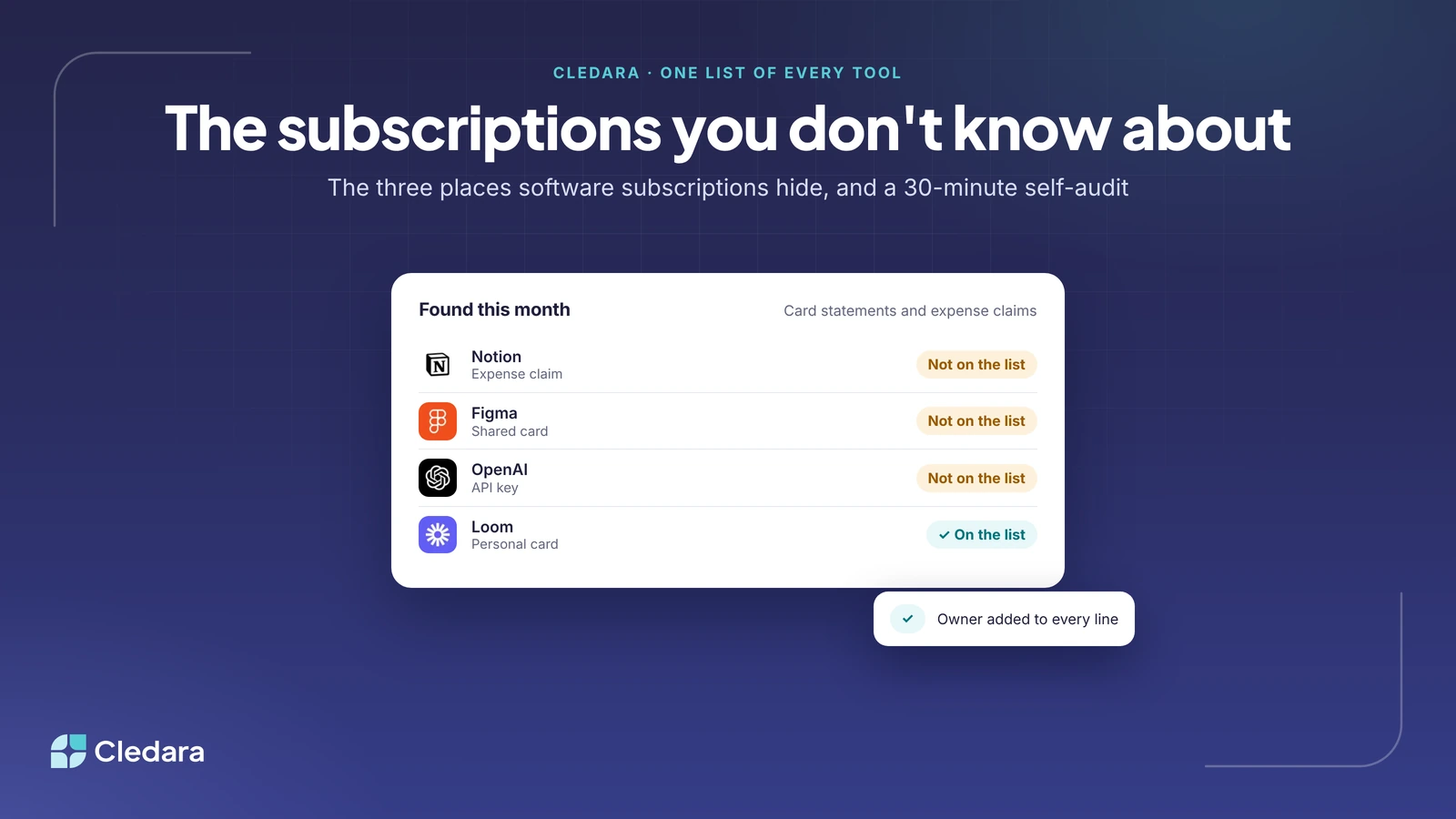
- Personal cards and expense claims. Someone pays for Notion, Figma or Loom on their own card and claims it back. The tool is in your expenses as a line item with a person's name on it, so it never looks like a subscription. One customer, Jenny Liu at Marshmallow, told us Cledara Engage immediately captured 15% more subscriptions than the team had heard of.
- Shared and legacy company cards. The card the founder set up in year one is still attached to a dozen tools. Two or three people know the details, so it gets used for anything new. A statement for that card is a list of subscriptions, but nobody reads it that way.
- API keys and usage-based accounts. An engineer creates an OpenAI or Anthropic account, adds a key, and the meter starts. There's no seat, no licence and often no invoice until the end of the month. These are the hardest to spot and the fastest-growing part of the bill.
| Hiding place | What it looks like in your records | How to find it | How to stop it recurring |
| Personal cards | An expense claim with a person's name | Filter claims by recurring vendor names | A company payment method per tool, so nobody needs to pay personally |
| Shared and legacy cards | One card with 10 to 20 recurring charges | Read the statement vendor by vendor | One card per subscription, with an owner |
| API keys | A monthly charge that changes every month | Ask engineering for the account list and keys | A budget and owner per key, tracked daily |
| Freemium that became paid | A charge from a tool you thought was free | Login data from your identity provider or browser | An approval step when a free tool turns paid |
How many software subscriptions does a company actually have?
More than it thinks, almost every time. The honest answer for any company is "the number on the list, plus the ones you'll find next month". Cledara data gives a sense of the range: across companies paying for software through the platform between May and October 2026, the lower quartile paid for 14 tools, the median 27, and the upper quartile 40 or more.
The number itself matters less than the gap between the list and reality. Demet Durmuscelebi, Group Financial Controller at IMMO Capital, found that Cledara flagging duplicates let the team cancel 10% of their software applications. Those were known tools bought twice by two teams who didn't know about each other, which is the same problem wearing a different hat.
If you want to know where your company sits, data.cledara.com publishes the benchmarks, and our post on the true cost of shadow IT covers what the unmanaged share tends to cost.
A 30-minute self-audit for software subscriptions
You don't need a tool to do the first pass. You need four sources and a spreadsheet you're willing to throw away afterwards.
- Export the last three months of every company card statement and sort by vendor. Anything that appears monthly is a subscription, whether or not it's on your list.
- Export expense claims for the same period and filter for software vendor names. This is where personal-card subscriptions live.
- Ask engineering for every account with an API key, and who owns it. If the answer takes more than a day, that's a finding in itself.
- Take the leavers list from HR for the last year and check whether each person still appears as a user in your top ten tools. Leavers' seats are the subscriptions you know about but are still paying for by accident.
Put the four exports side by side and you'll have a list that's much closer to the truth. The last step is the one most people skip: write an owner's name next to every line. A subscription with no owner is the one that renews by itself.
What to do once you've found them
The audit tells you where you are today. It doesn't stop next month's surprises, because the causes (distributed buying, shared cards, usage accounts) are still there. The structural fix is to make the payment itself the record.
When every subscription has its own payment method and its own owner, a new tool shows up on the list the day it's bought, with a name attached. Finance stops discovering subscriptions by invoice because the subscription is already there when the invoice arrives. That's how Cledara works: one list of every tool, built from the payments, with the owner, users, cost and renewal date on each line, and Cledara Engage showing which of 8,000+ tools the team actually logs into, including the ones nobody approved.
The companies that do this well buy software faster, because nobody's afraid of what they can't see. The list is complete, the owners are named, and the next unknown subscription is a two-minute fix rather than a quarterly surprise. That's a much nicer way to run a finance team, and a much nicer way to be the person who used to get chased about the invoice.