


What happened to AI software spend from August to October 2026?
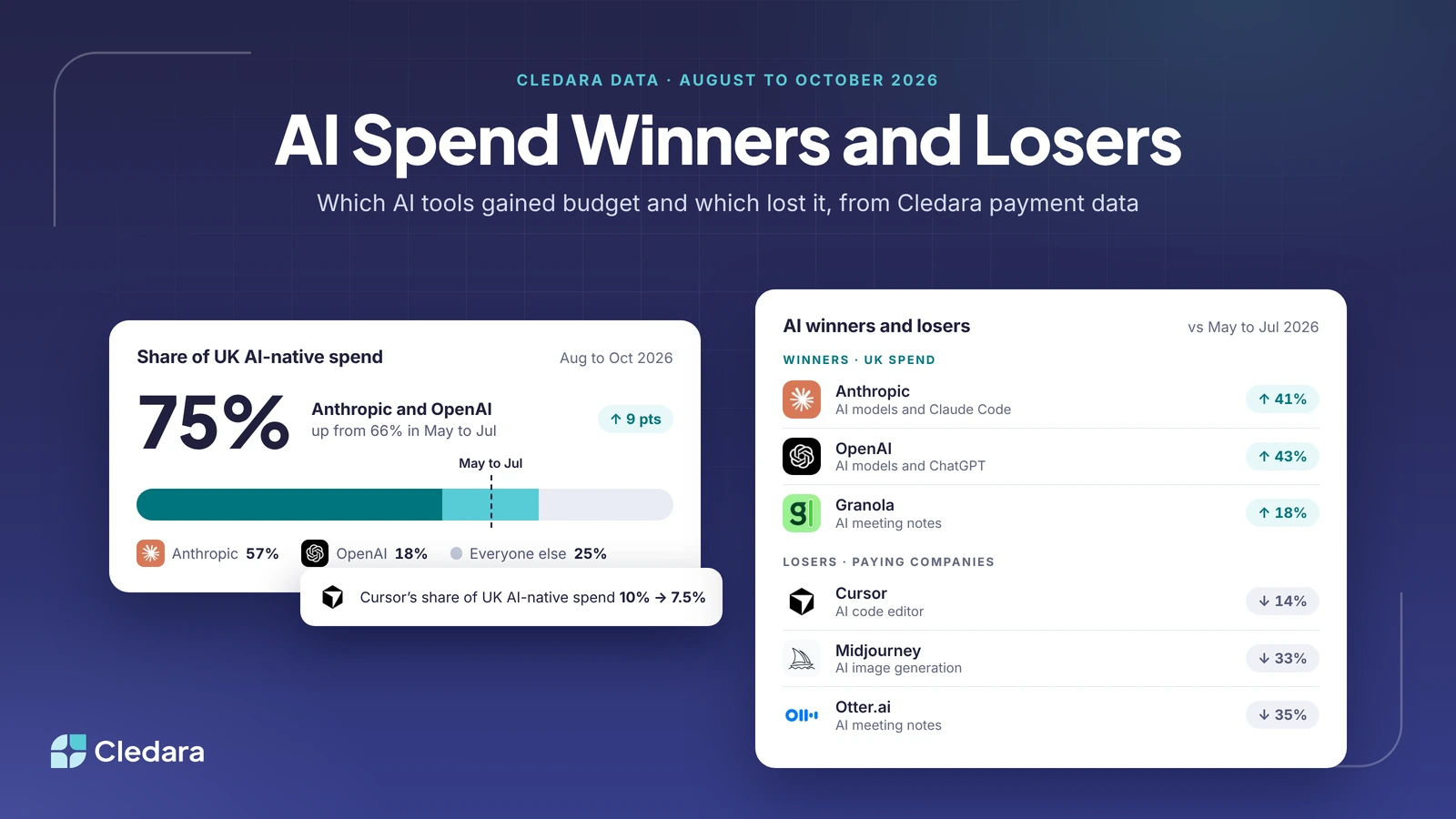
AI software spend kept climbing from August to October 2026, and most of the new money went to two companies. Cledara data shows spend on AI-native tools rose 25% in the UK, 23% in Europe and 16% in the US compared with May to July. Anthropic and OpenAI took most of that growth, while Cursor lost paying companies and spend in every region.
This is the latest edition of our AI software spend winners and losers report. It compares the three months from August to October 2026 with the three months before, using payment data from companies that manage their software with Cledara. For the previous quarter, see the Q3 2026 edition.
Key takeaways
- Spend on AI-native tools grew 25% in the UK, 23% in Europe and 16% in the US between May to July and August to October 2026.
- 27% of software spend on Cledara now goes to AI-native tools, up from about 3% two years ago.
- Anthropic was the biggest winner: its spend rose 41% in the UK and 38% in Europe, and it now takes 57% of UK AI-native spend.
- Anthropic and OpenAI together now take 75% of UK AI-native spend, up from 66%, with similar gains in Europe and the US.
- Cursor was the biggest loser: 14% fewer paying companies, and spend down 7% in the UK and 29% in Europe.
- Smaller winners included OpenRouter (64% more paying companies), Granola and Wispr Flow; Perplexity, Midjourney and Otter.ai lost paying companies.
- For finance teams, the risk has moved from too many small AI tools to fast-growing bills from two big ones.
How fast is AI software spend growing?
AI-native spend grew by a quarter in three months in the UK, and almost as fast in Europe. Compared with May to July 2026, spend on AI-native tools from August to October rose 25% in the UK, 23% in Europe and 16% in the US. In the UK, October was the biggest month of the six we analysed.
The bigger picture is the share of the budget. 27% of software spend on Cledara now goes to AI-native tools, up from about 3% two years ago. Our AI spend benchmarks for 2026 show what that looks like per company and per team.
Note: we compare each region in its own currency (pounds, euros and dollars) and never add them together, so the growth rates are not distorted by exchange rates.
Who are the biggest AI software spend winners?
The biggest winners from August to October 2026 were Anthropic and OpenAI, by a wide margin. Behind them, OpenRouter, Granola, Wispr Flow and Higgsfield grew their paying companies, their spend or both. The table compares each tool with May to July 2026.
Anthropic: the clear winner
Anthropic's spend grew 41% in the UK, 38% in Europe and 19% in the US. Its share of AI-native spend rose from 50% to 57% in the UK, from 47% to 53% in Europe and from 43% to 45% in the US. No other AI vendor comes close.
Most of the growth came from existing customers spending more, rather than from new ones. The number of UK companies paying Anthropic each month barely moved between May and October (up 3%), but the average UK company paying Anthropic spent about £4,570 in October, up from about £2,390 in May. In Europe the average rose from about €2,150 to €3,770. One possible factor: Claude's Pro and Max plans include Claude Code, according to Anthropic, so heavy coding use now runs through the same subscription.
OpenAI: growing alongside Anthropic
OpenAI grew slightly faster than Anthropic in the UK (up 43%) and the US (up 24%), though from a much smaller base, and its share of AI-native spend rose in all three regions. The number of companies paying OpenAI dipped 4%, so, as with Anthropic, the growth came from spend per company rather than new customers.
OpenRouter: the multi-model bet
OpenRouter lets developers reach many AI models through one API and one bill. It had 64% more paying companies from August to October than from May to July, and its US spend more than doubled (up 161%). It was also among the ten most-added software tools on Cledara in each of the three months.
The smaller AI tools gaining ground
- Granola: the UK-built meeting notes tool grew in every region, with 14% more paying companies and spend up 58% in Europe.
- Wispr Flow: 18% more paying companies, and one of the ten most-added software tools on Cledara in August.
- Higgsfield: 34% more paying companies, with UK spend more than tripling.
- Grok: from a small base, the number of companies paying for xAI's assistant each month rose 50% between August and October, and it was one of the ten most-added software tools on Cledara in September.
Who are the AI software spend losers?
The biggest loser from August to October 2026 was Cursor, which lost paying companies and spend in every region. Point tools in search, image generation, meeting notes and translation also lost ground, even as AI-native spend overall grew by a fifth or more.
Cursor: fewer companies and less spend in every region
Cursor had 14% fewer paying companies from August to October than in the three months before, and its spend fell 7% in the UK, 29% in Europe and 28% in the US. The decline was steady rather than sudden: the number of UK companies paying Cursor each month fell 19% between May and October, and 22% in Europe.
Its share of AI-native spend fell from 10% to 7.5% in the UK and from 14% to 8% in Europe. Over the same months, Anthropic's spend rose fastest, and Claude Code is part of its plans. Payment data cannot show why a company stops paying for a tool, but the timing fits coding budgets moving towards the model providers themselves.
Perplexity, Midjourney and Otter.ai: point tools under pressure
Perplexity had 23% fewer paying companies, with spend down 39% in Europe. Midjourney lost a third of its paying companies, and its spend fell in all three regions. Otter.ai lost 35% of its paying companies, while Granola, in the same category, grew.
The likely common thread is overlap. Each of these tools does one job that the big assistants now also do, at least well enough for many teams. When a company already pays for Claude or ChatGPT, a separate subscription for search, images or notes is an easy one to cut.
DeepL and Replit
DeepL lost 15% of its paying companies, and its spend fell in every region. Replit, the AI app builder, had 12% fewer paying companies and lower spend everywhere.
Is AI software spend consolidating around two platforms?
Yes. Anthropic and OpenAI together took 75% of UK AI-native spend from August to October 2026, up from 66% from May to July. Their combined share also rose in Europe, from 66% to 73%, and in the US, from 64% to 67%. Everyone else shared what was left.
The pattern is concentration: more of each AI budget goes to the two biggest platforms, and spend per company on each of them is rising. For more on how companies end up with too many AI tools in the first place, see AI tool sprawl.
Key takeaway: the AI market is not settled. Cursor held a tenth of UK AI-native spend in May to July; three months later it was below 8%. Leaders can lose ground within a single quarter.
What should finance teams do about AI spend now?
Finance teams should treat Anthropic and OpenAI as their biggest AI cost lines, track them every month, and question every smaller AI tool that overlaps with them. With spend per company growing fast, the risk is no longer a long tail of small tools: it is two large bills that change every month.
- Put Anthropic and OpenAI on a monthly review. Check spend per seat and per team, and whether heavy users have moved to bigger plans or usage-based API billing. Our guide to tracking and controlling AI spend sets out the method.
- Look for overlap in coding tools. If engineers pay for Claude or ChatGPT and a separate coding assistant, ask which one they use. Take back the seats nobody uses; see how to cut unused SaaS licences.
- Keep unproven AI tools on monthly billing. This quarter shows how quickly leaders can lose ground. Avoid annual contracts for point tools until usage is proven.
- Set renewal alerts on every AI contract. Decide 90 days out whether to renew, downgrade or cancel; our guide to SaaS renewal management explains how.
- Find the AI tools nobody approved. Many AI subscriptions start on personal or team cards. See how to find shadow IT and shadow AI.
- Budget for growth, not last year's run-rate. Build AI spend into the forecast with scenarios; see how to build a SaaS budget.
Cledara is software subscription management for finance teams. It keeps every AI tool on one list with its owner, users and cost, gives each subscription its own virtual card, and tracks AI usage every day against the budget you set, with a warning before spend runs over. See how Cledara manages software subscriptions.
How we measured AI software spend winners and losers
This report uses Cledara's own payment data from companies that manage their software with Cledara. Cledara tracks 9,691 software tools across 2.35 million purchases in 32 countries. You can explore the live data at data.cledara.com.
- Periods: 1 May to 31 July 2026 compared with 1 August to 30 October 2026 (data to 30 October).
- AI-native tools: vendors Cledara classifies as AI-native, software vendors only.
- Spend: payments in each buyer's local currency (UK in pounds, Europe in euros, US in dollars), compared within each currency with no exchange-rate conversion.
- Paying companies: companies with at least one payment to the vendor in each three-month period.
- Vendors: Claude is counted with Anthropic, and ChatGPT with OpenAI. We left out vendors paid by only a handful of companies, because a single customer can swing their figures.
- Most-added tools: Cledara's monthly ranking of new software subscriptions across all software.
Note: data to 30 October 2026, published November 2026. We will publish the next edition in early 2027.