


What is happening between Granola and Wispr Flow?
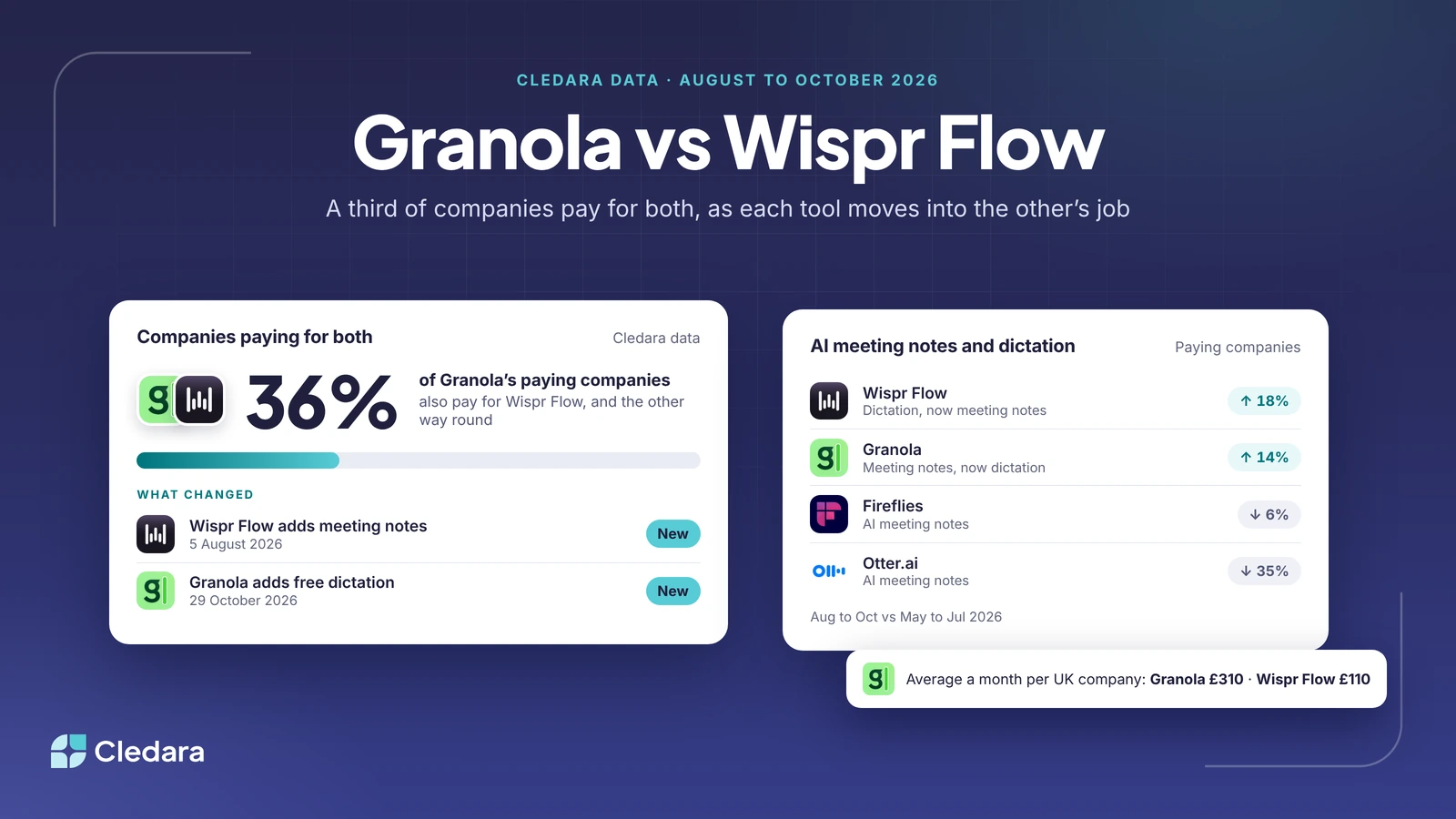
Since August 2026, Granola and Wispr Flow have been moving into each other's job. Wispr Flow, a dictation app, added a meeting notetaker for Mac on 5 August 2026. Granola, a meeting notes app, answered on 29 October with voice typing in any Mac app, free for all Granola users. Granola vs Wispr Flow is now a straight contest for the same jobs.
Tom Ladds, who joined Granola as its eighth employee, described what that looks like for a user. When Wispr Flow added notes, he kept paying for both tools. When Granola added dictation, he wrote: "I deleted Wispr Flow before I'd even tried it". Cledara's payment data shows how many companies are in the same position, and what it means for AI budgets.
Key takeaways
- 36% of companies that pay for Granola on Cledara also pay for Wispr Flow, and 36% of Wispr Flow's paying companies also pay for Granola.
- Both tools kept growing after Wispr Flow added meeting notes: from August to October 2026, Granola had 14% more paying companies than in May to July, and Wispr Flow 18% more.
- Granola is the bigger bill: in October 2026 the average UK company paying for Granola spent about £310 on it, against about £110 for Wispr Flow.
- Granola's free dictation launched on 29 October, so its effect on Wispr Flow will show in the next few months of payment data, not yet.
- Other meeting notes tools lost ground: Otter.ai had 35% fewer paying companies and Fireflies 6% fewer.
- Almost every company paying for Granola or Wispr Flow also pays for Anthropic and OpenAI.
- For finance teams, the risk is paying twice for the same job. Review AI tools by the job they do, not by vendor.
How many companies pay for both Granola and Wispr Flow?
About a third. Of the companies that pay for Granola on Cledara, 36% also pay for Wispr Flow, and 36% of Wispr Flow's paying companies also pay for Granola. Until August that was not a duplicate: one tool wrote meeting notes and the other turned speech into text. Now each tool does both jobs, so those companies pay twice for some of the same features.
The two tools also sell to the same kind of company. 95% of Granola's paying companies also pay for Anthropic, and 95% for OpenAI; for Wispr Flow the figures are 95% and 93%. By comparison, about 70% of Otter.ai's paying companies pay for Anthropic. Granola vs Wispr Flow is a contest for the most AI-heavy teams.
The spending gap matters if you pay for both. The average company spends nearly three times as much on Granola as on Wispr Flow in the UK, and about four times as much in Europe. For a company paying for both, Granola is usually the larger bill, and Wispr Flow is the one whose original job Granola now includes for free.
Did Wispr Flow's meeting notes hurt Granola?
Not in the first three months. Wispr Flow launched its notetaker on 5 August 2026, and from August to October Granola had 14% more paying companies than in the three months before. Its spend rose 18% in the UK, 58% in Europe and 30% in the US. The number of UK companies paying for Granola each month held steady from July to October.
Wispr Flow grew too, with 18% more paying companies. Its UK spend rose 9% and its US spend 77%, while its European spend fell 29%. The data is consistent with Tom Ladds' experience: a new feature in one tool did not make companies drop the other. Paying for both was the easier choice.
What will Granola's free dictation mean for Wispr Flow?
It is too early to see in payment data. Granola launched voice typing on 29 October 2026, the day before our data ends, so the first effects will show from November. What the data does show is how much is at stake: 36% of Wispr Flow's paying companies already pay for Granola, and for them dictation now comes with a tool they already have.
According to Granola, voice typing is free for all Granola users, with unlimited words. It works on Mac first, with Windows, iOS and Android versions to follow, so teams that dictate on other devices will not feel the overlap yet.
Note: we will track how Granola's and Wispr Flow's paying companies move after 29 October in the next edition of our AI software spend winners and losers report, due in early 2027.
Is Granola vs Wispr Flow part of a wider shift in AI tools?
Yes. Granola vs Wispr Flow is the clearest case of a wider pattern: AI tools are adding each other's features, and tools that do only one job are losing paying companies. In meeting notes, Granola and Wispr Flow grew from August to October 2026, while Otter.ai and Fireflies lost paying companies.
All figures compare August to October 2026 with May to July 2026.
The same thing is happening outside voice tools. Cursor, the AI code editor, had 14% fewer paying companies over the same months, while spend on Anthropic, whose plans include Claude Code, rose 41% in the UK. Perplexity, the AI search tool, lost 23% of its paying companies. Our AI software spend winners and losers report has the full data.
Tom Ladds drew the lesson for founders: when features are easy to copy and switching costs nothing, what keeps customers is their belief in what the team will build next. For buyers, the lesson is different. When every tool can do every job, the job of finance is to make sure the company pays for each job once, and on purpose.
What should finance teams do when AI tools overlap?
List your AI tools by the job they do, not by vendor, and look hard at every job with more than one tool. 27% of software spend on Cledara now goes to AI-native tools, up from about 3% two years ago, so overlap between AI tools is now a real cost line rather than a rounding error.
- Map tools to jobs. Group your AI subscriptions by job: meeting notes, dictation, search, coding, images and writing. Granola and Wispr Flow now sit under two jobs each. Our guide to AI tool sprawl explains why the list is usually longer than you expect.
- Check who uses what. For any job with two tools, look at seat-level usage before you cut anything. Some people rely on one tool's version of a feature and never touch the other. See how to cut unused SaaS licences.
- Pick a primary tool for each job. Paying for two can be the right call, as Tom Ladds decided at first, but it should be a decision with an owner and a reason, not an accident.
- Use monthly billing to your advantage. 99% of Granola payments and 95% of Wispr Flow payments on Cledara this year were on monthly plans, so the tool you no longer need can go at the end of the month. Hold off moving overlapping tools to annual plans until the market settles.
- Watch for free features. When a tool you already pay for adds a feature for free, as Granola did with dictation, check what else you pay for that does the same job. Our guide to tracking and controlling AI spend sets out a monthly review.
- Decide before renewal. For anything on an annual plan, decide 90 days before it renews; see SaaS renewal management.
Cledara is software subscription management for finance teams. It keeps every AI tool on one list with its owner, users and cost, gives each subscription its own virtual card, and tracks AI usage against the budget you set. The Spend Optimisation add-on also alerts you to duplicate tools; see what each plan includes on the pricing page, or how Cledara manages software subscriptions.
How we measured Granola vs Wispr Flow
This analysis uses Cledara's own payment data from companies that manage their software with Cledara. Cledara tracks 9,691 software tools across 2.35 million purchases in 32 countries. You can explore the live data at data.cledara.com.
- Overlap: the share of companies paying for one tool on Cledara that also pay for the other.
- Periods: 1 May to 31 July 2026 compared with 1 August to 30 October 2026 (data to 30 October).
- Paying companies: companies with at least one payment to the vendor in each period.
- Spend: payments in each buyer's local currency (UK in pounds, Europe in euros, US in dollars), compared within each currency with no exchange-rate conversion.
- Average monthly spend: a vendor's spend in a region in October 2026, divided by the number of companies in that region paying it that month.
- Monthly plans: the share of each vendor's payments from January to October 2026 billed monthly.
- Vendors: Claude is counted with Anthropic, and ChatGPT with OpenAI.
Note: data to 30 October 2026, published November 2026.