


Why AI spend turned into a black box
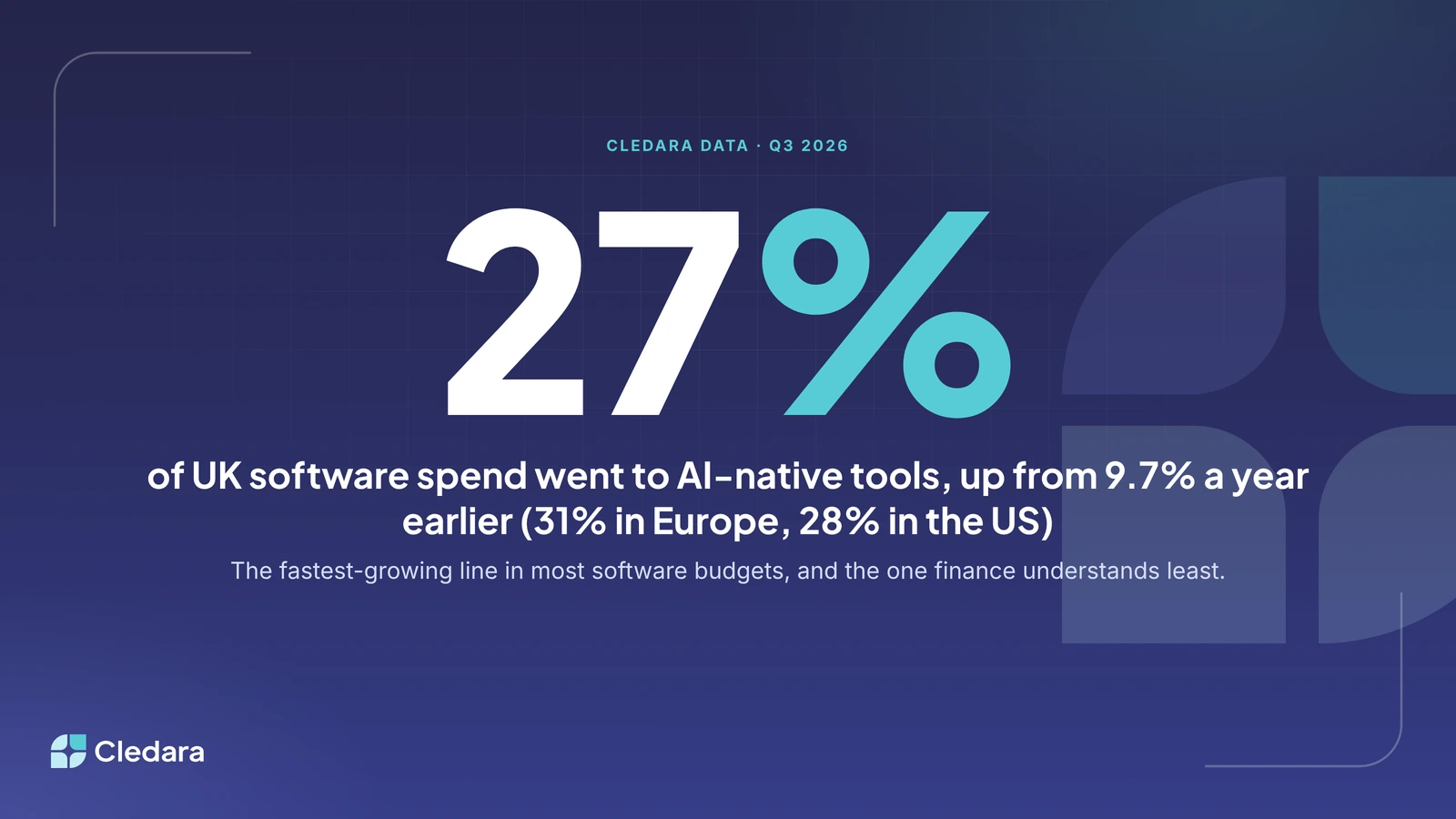
Here's a funny thing about AI spend. It's the fastest-growing line in most software budgets, and it's the one finance understands least. Cledara data shows AI-native tools took 27% of UK software spend in the third quarter of 2026, up from 9.7% a year earlier. In Europe the figure was 31%, and in the US it was 28%. A line that nearly triples in a year would normally get a lot of attention.
And yet most finance teams can't say much about it. A CTO told us recently that his company spends more with one AI provider than on every seat-based tool put together, and that what drives the number is a black box. Finance gets a total at month end. Nobody can say which model, which project or which developer it belonged to, or why it was higher than last month.
It's a measurement problem rather than a people problem, and it has a fairly simple fix.
Key takeaways
- AI-native tools took 27% of UK software spend in Q3 2026 on the Cledara platform, up from 9.7% a year earlier.
- AI spend is metered rather than seat-based, so last month's bill tells you very little about next month's.
- Among subscriptions that pay like usage-based services, AI-native tools pay every 5.6 days on average, against 11.7 days for traditional software.
- Five numbers make AI spend readable: by model, by project, by person, by day, and against budget.
- The fix starts with one API key per project, an owner for each key, and a daily view that warns before the budget runs out.
How AI spend got away from finance
For twenty years software had a simple formula. Seats times price. Finance could forecast it from the headcount plan, and the only surprises were renewals and the odd price rise.
AI doesn't work like that. The big providers charge for what you use: tokens, requests, minutes of audio, images generated. The meter runs whenever an engineer or an agent sends a request, and the price per token varies by an order of magnitude between a frontier model and a small one. So the same project can cost ten times more one week than the next, depending on which model somebody picked and how much they ran it.
You can see this in the payment data. Cledara data shows that among software subscriptions whose payment pattern looks usage-based, AI-native tools pay on average every 5.6 days, compared with 11.7 days for traditional software and 15 days for AI-embedded tools (May to October 2026). Just over half of all those usage-style payments came from AI-native tools. An AI vendor sends you a stream of charges rather than a bill.
Then there's who buys it. AI spend usually starts in engineering, on an API key, paid with whatever card was to hand. The provider's dashboard was built for the developer who set it up rather than the finance manager who pays for it. A Deloitte survey of 3,500 leaders, cited by Finout, found that 71% of organisations track total AI spend, but only 51% track token volume and 44% track the cost per unit. Most companies know the total. Far fewer know what's in it.
The five numbers that open the AI spend black box
You don't need a data team to make AI spend readable. You need five cuts of the same number, and you need them without asking an engineer to pull them for you.
- Spend by model. Which models are running, and what each one costs you a month. Most surprise bills are one team moving to a bigger model without telling anyone.
- Spend by project or API key. Each product feature, internal tool or experiment on its own key. This is the number that tells you whether the new feature is paying for itself.
- Spend by person. Who holds the key and who is running the requests, so there's a quick answer when the number moves.
- Spend by day. A daily run rate, so a problem shows up on the second day of the month rather than the thirtieth.
- Spend against budget. How far through this month's budget you are, and the date you'll hit it at the current rate. This is the only one of the five that finance really wants, and it needs the other four to be worth anything.
| Number | The question it answers | Who needs it | Where it comes from |
| By model | Why did the bill go up? | Engineering lead | Provider usage export or API connection |
| By project or key | Is this feature worth what it costs? | Product and finance | One API key per project |
| By person | Who do I ask? | Finance manager | Key owner recorded next to the key |
| By day | Is this month on track? | Finance manager | Daily pull of usage rather than a monthly invoice |
| Against budget | When do we run out? | Finance and the owner | A budget set per key, with an alert before it's spent |
Notice that four of the five need a daily feed. A monthly invoice can't give you any of this, because by the time it arrives the month is over and the money is gone.
What finance can do about AI spend this month
You can get most of the way there with a bit of discipline and no new software. The rest is plumbing.
- Ask engineering for one API key per project, and record an owner against each key. Shared keys are where visibility goes to die.
- Set a monthly budget per key, even a rough one. A budget that's wrong by 30% is still far more useful than no budget.
- Keep API spend separate from AI seats. Team plans for chat assistants and coding tools are seat-based and behave like normal software. The metered API spend is the part that needs daily attention.
- Put AI spend on its own cards, one per provider or project, so the payment itself tells you where the money went.
- Decide who gets warned, and when. The owner should hear before finance does, and both should hear before the budget runs out rather than after.
This is the part Cledara does for you. It connects to AI providers such as OpenAI, Anthropic and Cursor, tracks usage every day against the budget you set, and warns finance and the subscription owner before spend runs over. It sits alongside the rest of your software, so AI spend is one more line on the same list rather than a separate project. If you want the broader picture on AI tools nobody approved, our guide to shadow AI for finance teams covers it.
Where AI spend goes from here
I think AI spend will end up being managed the way cloud spend is today, just with far less drama. Cloud bills were a black box too, about ten years ago. Engineers spun up servers, finance got a number, and the number went up. Then daily usage data, budgets per team and alerts became normal, and nobody thinks of a cloud bill as mysterious any more. It's just a cost with an owner.
The companies that get this right will be the ones where engineers are free to experiment, because finance can see the run rate every morning and nobody gets a surprise at month end. That's a better deal for everyone. The engineer gets to use the best model for the job, and the finance team gets to stop reverse-engineering invoices.
Five numbers, pulled daily, with an owner and a budget against each one. That's the whole trick. The sooner you start, the smaller the first surprise.
Cheers,
Brad