


Synthesia vs ElevenLabs: which is better?
Neither is better overall, because they do different jobs. Synthesia is an AI video platform that turns scripts, slides and documents into presenter-led videos with AI avatars, while ElevenLabs is an AI voice and audio platform for text to speech, voice cloning, dubbing and voice agents. Choose Synthesia when the finished product is a video with a presenter, and ElevenLabs when it is a voice.
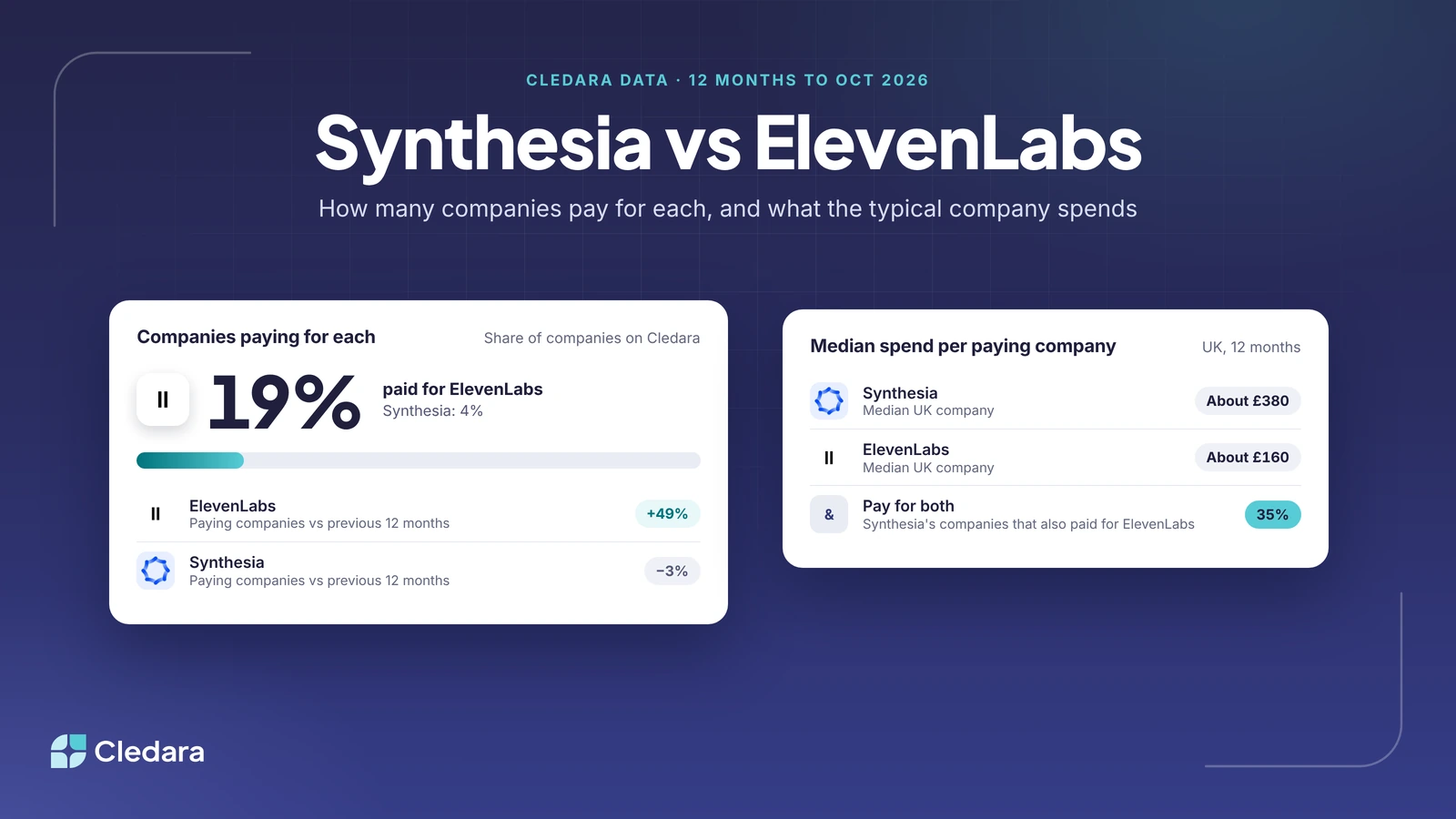
The line between them is starting to blur. ElevenLabs launched Avatars on 11 June 2026 for lip-synced talking-head videos, and Synthesia offers AI dubbing with voice cloning. To see how companies actually buy them, we looked at software payments on Cledara for the 12 months to October 2026. The short version of Synthesia vs ElevenLabs in the data: ElevenLabs is far more widely bought, but the typical company spends more on Synthesia.
Key takeaways
- They do different jobs: Synthesia makes presenter-led videos with AI avatars; ElevenLabs makes speech, voices and other audio, and now avatar videos too.
- ElevenLabs is far more widely bought: 19% of companies on Cledara paid for it in the 12 months to October 2026, against 4% for Synthesia.
- ElevenLabs is growing faster, with 49% more paying companies than in the year before, while Synthesia's number was flat.
- The typical company spends more on Synthesia: the median UK company paid about £380 for it over the year, against about £160 for ElevenLabs.
- ElevenLabs spend is concentrated: a handful of heavy users account for about two-thirds of its UK spend.
- 35% of the companies that have paid for Synthesia on Cledara have also paid for ElevenLabs.
- Both are bought mostly month to month: 98% of ElevenLabs payments and 90% of Synthesia payments are monthly.
What is the difference between Synthesia and ElevenLabs?
Synthesia starts from video and ElevenLabs starts from voice. Synthesia's core product is an editor that builds a video with an avatar presenter from a script, a slide deck, a document or a link. ElevenLabs' core product is speech: it turns text into spoken audio, clones and designs voices, and powers voice agents and developer APIs. The table compares what each vendor says it offers on its own site.
Note: features come from synthesia.io, elevenlabs.io and ElevenLabs' October 2026 certification update, checked on 3 November 2026. Plans and prices change often, so check both sites before you buy.
How many companies pay for Synthesia vs ElevenLabs?
About five times as many companies pay for ElevenLabs. In the 12 months to October 2026, 19% of companies with software payments on Cledara paid for ElevenLabs, against 4% for Synthesia. ElevenLabs was the 25th most popular software product on Cledara in October 2026, up from 52nd in November 2024. Synthesia was 206th.
ElevenLabs is also growing faster. It had 49% more paying companies in the 12 months to October 2026 than in the 12 months before, and 40% more companies paid it in October 2026 than in October 2025. The number of companies paying for Synthesia was flat, down 3% on the year.
Synthesia's smaller base is not only about voice versus video. Within AI avatar video, HeyGen had about twice as many paying companies on Cledara as Synthesia over the same 12 months. Cledara's customers are mostly growing companies, so this data says little about large enterprises, where Synthesia says it is used by over 90% of the Fortune 100.
How much do companies spend on Synthesia vs ElevenLabs?
The typical company spends more on Synthesia. Over the 12 months to October 2026, the median UK company paying for Synthesia spent about £380 on it, against about £160 for ElevenLabs. In Europe the medians were about €700 for Synthesia and about €160 for ElevenLabs.
Averages tell the opposite story, because ElevenLabs spend is concentrated. A handful of heavy users account for about two-thirds of ElevenLabs' UK spend, which lifts its average to £1,186 per paying company, against £435 for Synthesia. Most companies pay for ElevenLabs on a small monthly plan, and a few use it at a much larger scale.
Note: Synthesia's figures come from a small number of paying companies, so treat them as a guide rather than a precise benchmark. Too few US companies pay for Synthesia on Cledara to compare US spend. The overlap figures cover every company that has paid for either tool on Cledara.
Billing is mostly monthly for both. Across all software on Cledara, 90% of transactions are monthly subscriptions, so ElevenLabs is bought even more month to month than usual. Synthesia leans more on annual plans: about a third of its UK spend comes through annual payments, against about 1% for ElevenLabs.
Do companies pay for both Synthesia and ElevenLabs?
Some do. Of the companies that have paid for Synthesia on Cledara, 35% have also paid for ElevenLabs. Because ElevenLabs has a much larger base, those shared customers are only about 10% of its paying companies. For most of that time the two did not overlap much: one made the video and the other the voice. Synthesia even announced a partnership in May 2024 to bring ElevenLabs voices to its Enterprise plan.
Both tools sell to AI-heavy companies. About nine in ten companies that pay for either one also pay for OpenAI, and more than eight in ten pay for Anthropic. That matches what we saw in Granola vs Wispr Flow: the companies buying specialist AI tools are the ones already paying for the big model providers.
Are Synthesia and ElevenLabs becoming competitors?
At the edges, yes. ElevenLabs' Avatars pair its speech models with lip-sync models to make talking-head videos, aimed at marketing variants, course content and localised explainers, and its creative platform now generates images and video with third-party models. Synthesia has moved the other way, with AI dubbing, voice cloning for personal avatars and interactive avatar Sessions for roleplay and surveys.
Payment data does not show a switch yet. Avatars launched in June 2026, and the number of companies paying for Synthesia on Cledara is too small to say whether any have moved. For now, Synthesia vs ElevenLabs is still mostly a choice between two different jobs, with a growing area in the middle where either could do it.
For finance teams, the overlap matters more than the winner. When two AI tools add each other's features, companies end up paying twice for some of the same work unless someone checks. Our AI software spend winners and losers report tracks the same pattern across other AI categories.
Synthesia or ElevenLabs: how to choose
Choose by the job, then test both on one real piece of work. These steps keep the decision quick.
- Start with the output. If the finished piece is a video with a person on screen, such as a training module or a product walkthrough, start with Synthesia. If it is audio, such as a voiceover, narration or a phone agent, or a voice inside your own product, start with ElevenLabs.
- Check where it will live. Synthesia exports SCORM for learning systems and updates shared links and embeds when you edit a video. ElevenLabs offers APIs for speech, music, dubbing and agents.
- Check languages. Synthesia lists 140+ languages for video and 130+ for dubbing; ElevenLabs lists 90+ for speech, with the count varying by model.
- Check controls. Both list SOC 2 Type II, ISO 27001 and ISO 42001. Synthesia also lists SSO, SCIM and approval before videos go live; ask ElevenLabs about the equivalents on its enterprise plans if you need them.
- Check what you already pay for. Before buying, see whether another team already pays for the other tool, or for a similar one such as HeyGen. A third of Synthesia's customers on Cledara also pay for ElevenLabs.
Tip: if you need both a presenter and a voice, try one tool first for a month before paying for two. Both sell monthly plans, so a short trial costs little.
How to keep track of AI tools like Synthesia and ElevenLabs
AI content tools are often bought on a card by one team and found later by finance. Cledara is software subscription management for finance teams: it keeps every AI tool on one list with its owner, users, cost and renewal date, and Cledara Engage shows who actually uses each one. For more, see our guides to finding the AI tools already in your stack and tools to track AI spend.