


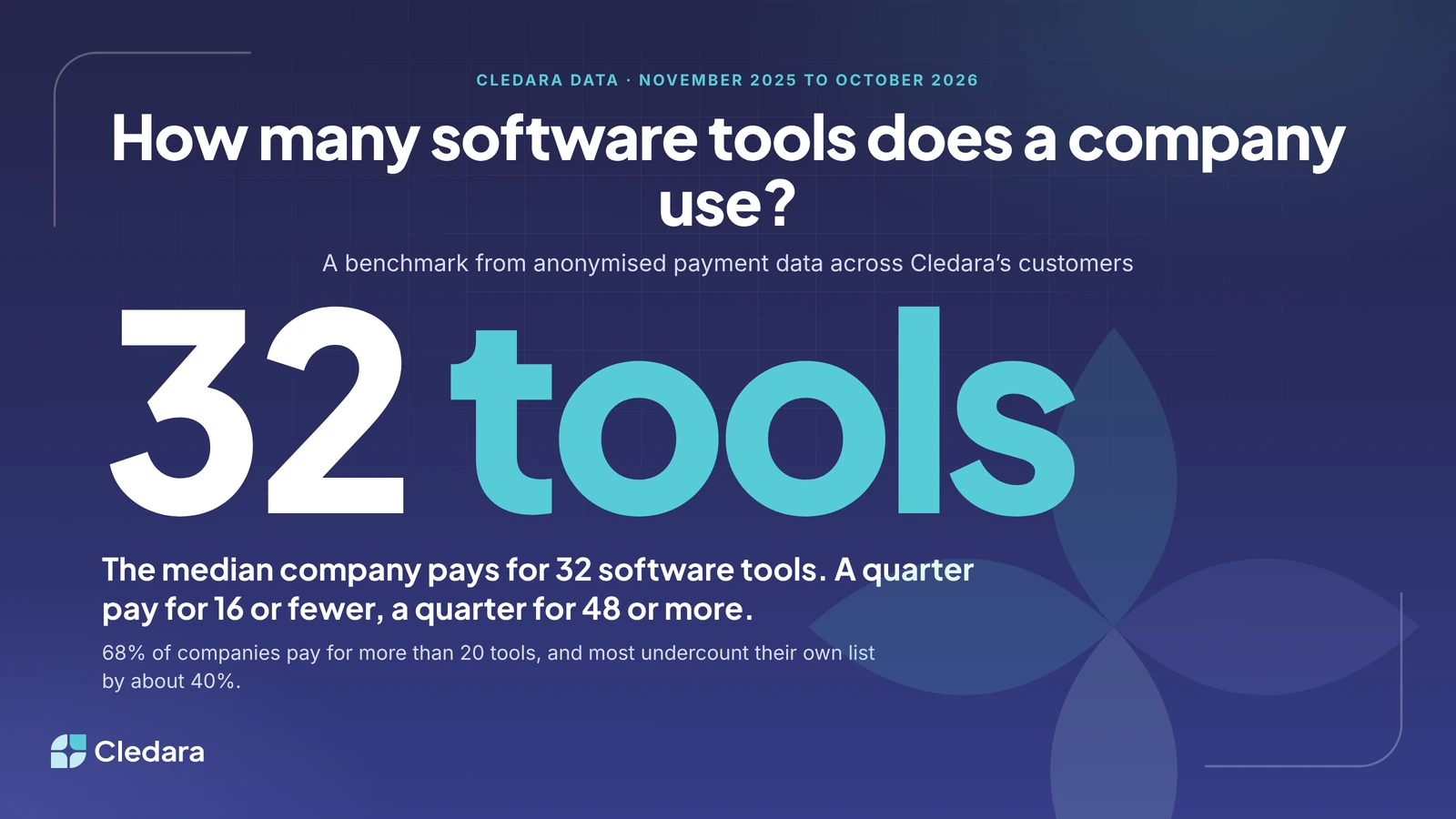
How many software tools does a company actually use?
Ask a finance lead how many software tools the company pays for and you'll usually get a confident, round number. Fifteen. Twenty-five. "About 50, give or take." Then someone checks the card statements and the number turns out to be quite a bit bigger. True story: in our 2025 Software Spend Report, companies underestimated their software usage by about 40%. For every ten tools they thought they had, they were paying for roughly fourteen.
So the honest answer to "how many software tools per company" is: more than you think. But that's not very useful on its own. What you want is a benchmark. Here is one, built from the last twelve months of anonymised, aggregated payment data across Cledara's customers (November 2025 to October 2026, software vendors only).
Key takeaways
- The median company on Cledara pays for 32 software tools. The middle half sit between 16 and 48.
- 68% of companies pay for more than 20 tools, and 23% pay for more than 50.
- US companies run slightly larger stacks (median 37) than UK companies (34) or those in the EEA (28).
- Companies underestimate their own tool count by about 40%, so a guess of 15 is more likely to be 21.
- Around four fifths of software spend is billed monthly, which is why the list changes faster than anyone's spreadsheet.
- Once you pass about 20 tools, manual tracking stops working. Most companies passed that point a while ago.
The benchmark: software tools per company in 2026
The median company on the Cledara platform paid for 32 distinct software tools over the last twelve months. The average is a little higher at 34.8, pulled up by a long tail of companies with very large stacks. A quarter of companies pay for 16 tools or fewer, and a quarter pay for 48 or more.
That's a wide range, so the more useful way to read it is as a distribution rather than a single number.
| Size of software stack | Share of companies | Average tools in the group |
| 1 to 5 tools | 10% | 2.7 |
| 6 to 20 tools | 22% | 13.1 |
| 21 to 50 tools | 45% | 34.9 |
| 51 or more tools | 23% | 70.9 |
Source: Cledara data, software vendors only, November 2025 to October 2026. Groups are based on the number of distinct vendors each company paid in the period.
Two things jump out. The biggest group by far is companies paying for 21 to 50 tools, which is almost half of all companies. And nearly one in four companies is paying for more than 50 tools, averaging 71. If you think of a 50-tool stack as something only a big company has, the data says otherwise.
This is a step up from the figures in our earlier post on why companies need SaaS management, which found a median of 25 active subscriptions on an older window. Stacks are getting bigger, and the AI wave is a big part of why.
How many tools does a 50-person company use?
Cledara's customers are mostly growing companies with a dedicated finance function, so the benchmark above is a fair proxy for the question in the title. A 50-person company with a 15-tool stack is in the bottom quarter. A 50-person company with 32 is bang on the median. One with 48 or more is in the top quarter, and still not unusual.
It helps to think about where the tools come from. In a 50-person company, you'll typically find:
- The company-wide layer: Google Workspace or Microsoft 365, Slack, a password manager, a video tool, an HR system, an accounting system. Six to ten tools before anyone does any actual work.
- The per-team layer: a CRM and sales tooling, a marketing stack, design tools, a project tracker, a support desk, engineering and hosting. Each team adds five to ten.
- The AI layer: OpenAI, Anthropic, Cursor and friends, often bought on a personal card at first and then expensed. This layer barely existed two years ago.
- The long tail: the scheduling app one person loves, the analytics tool from a project that ended, the second e-signature tool nobody remembers buying.
Add those up and 30-odd tools is the natural resting state of a 50-person company that is getting on with things. Nothing has gone wrong. It's just that software is now bought by everyone, for everyone, and the list grows one sensible purchase at a time.
In our 2025 report, companies with 50 to 100 employees spent around $193,716 a year on software, which works out at roughly $2,583 per person. Per head, smaller companies spend more, because the fixed layer gets spread across fewer people.
Software tools per company by region
The pattern holds across regions, with the US running slightly bigger stacks.
| Region | Median tools | Middle half (P25 to P75) | Median annual software spend |
| United States | 37 | 21 to 54 | $161,726 |
| United Kingdom | 34 | 18 to 48 | £75,043 |
| EEA | 28 | 12 to 45 | €64,290 |
Source: Cledara data, software vendors only, November 2025 to October 2026, per company. Spend is shown in each region's own currency with no conversion.
US companies on Cledara pay for about three more tools than their UK counterparts at the median, and roughly twice the annual spend. Some of that is pricing (US list prices are often higher) and some of it is a US customer base that skews a little larger. The EEA median of 28 tools covers a more varied group of countries and company sizes, which shows in the wider spread at the bottom end.
Why your own software tool count is probably too low
There are three reasons companies undercount, and they're all perfectly human.
- Nobody owns the list. Finance sees the payments, IT sees some of the logins, team leads know their own tools. Nobody sees all three, so each person's count is their own slice.
- Most tools are billed monthly. Cledara data shows that between 73% and 81% of software spend (depending on region) is billed monthly rather than annually. Monthly tools can be added in an afternoon and don't show up as a big annual line anyone reviews.
- AI tools arrived fast and sideways. The AI-native share of software spend on Cledara rose from 9.5% in November 2025 to 22.7% in October 2026. A lot of that started as a developer putting a subscription on a personal card and expensing it, which never makes it onto a tools list at all.
Put those together and the 40% undercount from our 2025 report makes sense. The spreadsheet isn't wrong, exactly. It's just a photo of a thing that moved.
What to do with the benchmark
Knowing you have 32 tools instead of 20 is only useful if it changes what you do. Three practical steps:
- Build the real list from payments, not memory. Start from twelve months of card and bank statements and tag every software vendor. This is the only way to catch the monthly tools and the expensed AI subscriptions. Cledara does this automatically because every subscription pays with its own virtual card, but a careful afternoon with a bank export gets you most of the way.
- Give every tool an owner. The count only stays accurate if someone is responsible for each line. That person decides on renewals, knows who uses it, and is the one who gets asked "do we still need this?"
- Compare yourself to the distribution, not the average. If you're a 50-person company with 60 tools, you're in the top quarter and it's worth asking whether some of them overlap. If you're at 18, you're probably running lean and the question is whether anything is hiding in expenses.
Industry figures suggest a lot is hiding. Zylo's 2025 SaaS Management Index puts idle licences at 53% of all SaaS licences, and Vertice's 2025 benchmark found 15% of applications entirely unused and 51% underused. Across Cledara's customers, the average saving once everything is in one place is 23% of software spend. The count is the first step to that number.
Where this is heading
I don't think stacks are going to get smaller. Every team now has AI tools on top of its normal tools, and the companies that win will be the ones that let people buy what they need without finance losing track of it. That means the job of knowing what you have, who owns it and when it renews has to stop being a manual one.
The good news is that this is a solved problem. A company of 50 people with 32 tools doesn't need a procurement team. It needs one live list, an owner per tool and the admin done for it. If you want to see how your own stack compares, the benchmarks at data.cledara.com are updated in real time, and Cledara's plans start at the size where the spreadsheet first breaks.