


Spend management vs SaaS management: what's the actual difference?
A conversation we have most weeks goes like this. A finance lead says, "We already have a spend management tool, so don't we already do this?" Fair enough. The two categories get lumped together, the vendors borrow each other's words, and from a distance they both look like "cards plus a dashboard".
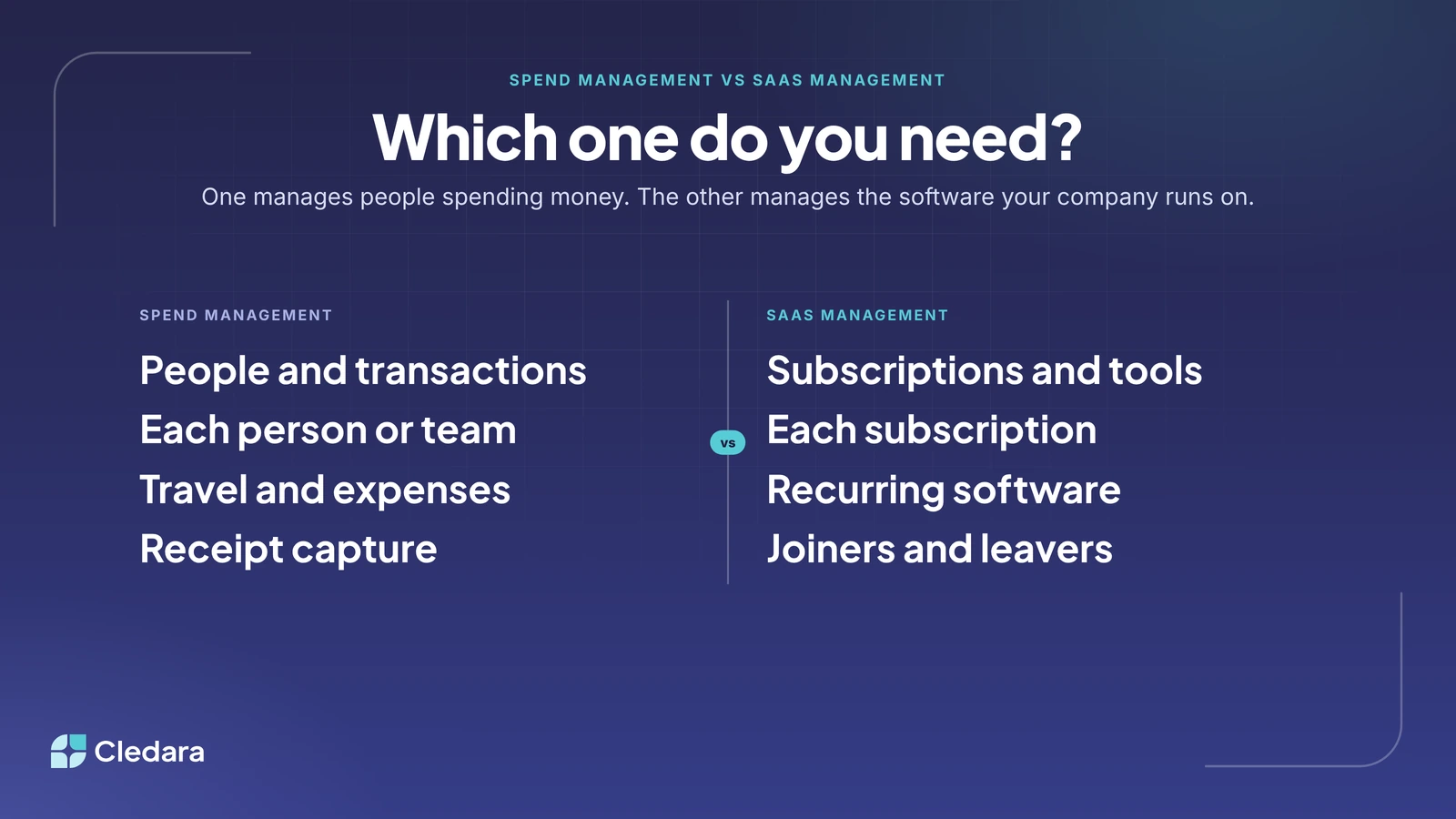
Up close they do different jobs. Spend management vs SaaS management isn't a question of which is better. It's a question of what you're trying to manage. One manages people spending money. The other manages the software your company runs on. Plenty of companies need both, and quite a few only need one. This post is about working out which you are.
Key takeaways
- Spend management is built around people and transactions: who spent what, with receipt and approval. It's excellent at travel, expenses and one-off purchases.
- SaaS management (or software subscription management) is built around subscriptions: which tools you pay for, who owns and uses each one, when it renews, and the admin inside it.
- The unit of analysis is the giveaway. A spend tool sees a £49 transaction. A SaaS tool sees a seat on a tool with a renewal date and an owner.
- On the Cledara platform, software subscriptions are more than half of all spend that runs through it, and the median company pays 33 different software vendors.
- If most of your spend is T&E, you need spend management. If you pay for 20 or more software tools, you need SaaS management, whether or not you also run a spend tool.
- Many companies run both, and they get on fine: the spend tool does the spend stuff, the SaaS tool does the subscription stuff.
What spend management does well
Spend management grew out of expenses. Someone travels, buys lunch for a client, orders a monitor, and the company needs a card, a receipt, a policy check and a line in the accounts. Tools like Pleo, Spendesk, Payhawk, Ramp or Brex do this very well. They give every person a card, make the receipt capture painless, apply spending limits per person or team, and push coded transactions into the ledger.
The design centre is the person and the transaction. Everything hangs off "who spent this, and was it allowed?" That's exactly right for travel and expenses, and for the long tail of one-off purchases that every company has.
It's also why spend tools struggle with subscriptions. A subscription isn't a transaction. It's a relationship: a tool, a contract, a renewal date, a set of seats, an owner who may have left, and a login that holds the invoices. A spend tool records the charge when it lands and does the receipt. It has no idea that the charge is the 14th month of a tool nobody has opened since March, or that the annual renewal fires next Tuesday with a 30-day notice period that already passed.
What SaaS management does that spend management doesn't
SaaS management starts from the subscription and works outwards. The core object is the tool, and around it sit the things a finance team needs to know and do:
- One list of every software tool the company pays for, with its owner, users, cost, renewal date and payment method. Including the ones nobody approved.
- Renewals as decisions rather than charges: alerts before each one, with the notice period and the price in front of you.
- Who actually uses each tool, so seats come back when people leave and duplicates get spotted.
- The invoice for every payment, including the ones that only live behind a vendor login and never get emailed.
- Approvals for new software that route to the right person based on cost, with the tool getting its own payment method once approved.
- AI spend tracked against a budget, with a warning before it runs over.
- The admin inside each tool: adding joiners, removing leavers, collecting invoices. This is the part Cledara Agent now does.
Cledara is built this way. Every subscription gets its own virtual card rather than every person, so a tool doesn't stop working when someone leaves, and cancelling is a click. The payment layer exists to serve the subscription, which is the reverse of how a spend tool is arranged. You can read more about what a complete platform includes in our guide to the key features of SaaS management platforms.
Spend management vs SaaS management, side by side
| | Spend management | SaaS management |
| Built around | People and transactions | Subscriptions and tools |
| Cards issued to | Each person or team | Each subscription |
| Strongest at | Travel, expenses, one-off purchases | Recurring software, AI tools, renewals |
| Knows when a tool renews | Rarely | Yes, with alerts and notice periods |
| Knows who uses each tool | No | Yes, by owner and by login |
| Collects invoices behind vendor logins | No | Yes (Cledara Agent) |
| Handles joiners and leavers in each tool | No | Yes |
| Receipt capture and reimbursements | Core strength | Included in some (Cledara Spend, UK and Europe) |
| Typical owner | Finance ops | Finance, with IT and operations alongside |
Which one do you need? A short decision tree
Work through these in order. Stop when you get a clear answer.
- Count your software tools. Pull twelve months of card and bank statements and tag every software vendor. If the number is under about ten, a spend tool and a tidy spreadsheet will do for now. If it's over twenty (and across Cledara's customers the median is 33), move to the next question.
- Look at where the money goes. On the Cledara platform, which handles both software and everyday spend, software subscriptions make up 54% of spend in the UK, 53% in the EEA and 60% in the US. Everyday non-subscription spend is roughly a third. If your mix looks anything like that, your biggest controllable cost is subscriptions, and that's what you need a system for.
- Ask who got surprised last quarter. If the painful moment was an expense claim with no receipt, that's a spend management problem. If it was an auto-renewal, a leaver still being billed, a duplicate tool, or an AI bill nobody owned, that's a SaaS management problem.
- Check where your invoices live. If finance is logging into vendor portals to download invoices, or chasing colleagues who hold the logins, you have a subscription admin problem that a spend tool will never see.
- Decide whether you need both. If you have real travel and expense volume and twenty-plus tools, run both. Let the spend tool do the spend stuff and the SaaS tool do the subscription stuff. They don't compete for the same work, and the overlap is smaller than it looks.
A Cledara customer put the split better than any of us: their spend tool "does the spend stuff" and Cledara "does the SaaS subscription stuff". Different unit of analysis, different job.
Why the distinction matters more every year
Two things are pushing subscriptions to the centre of the finance agenda.
The first is sheer count. Software is bought by every team now, one sensible monthly purchase at a time. Cledara data shows the median company pays 33 software vendors, and that the top 10 vendors account for only about 40% of software spend. The other 60% is spread across a long tail of smaller tools. That long tail is exactly what a transaction-centred tool can't keep track of, because each item is small and recurring and belongs to someone outside finance.
The second is AI. AI-native tools went from 9.5% of software spend on Cledara in November 2025 to 22.7% in October 2026. A lot of that is usage-based billing, bought by engineers, often on a personal card to begin with. It behaves nothing like an expense claim. It needs a budget, daily tracking and a warning before it runs over, which is subscription management work.
So the companies that get ahead of this aren't the ones with the best receipt capture. They're the ones who know exactly what software they pay for, who owns it, and who have the admin done for them. If you're comparing options, our round-up of the best SaaS management tools is a reasonable place to start, and Cledara's plans are sized from the point where the spreadsheet first breaks.
The short version
If your pain is people spending money, buy spend management. If your pain is software, buy SaaS management. If you have both pains, run both, and stop expecting either one to do the other's job. Spend management vs SaaS management was never really a contest. It was two different questions wearing similar clothes.