


Why one card per subscription beats one card per person
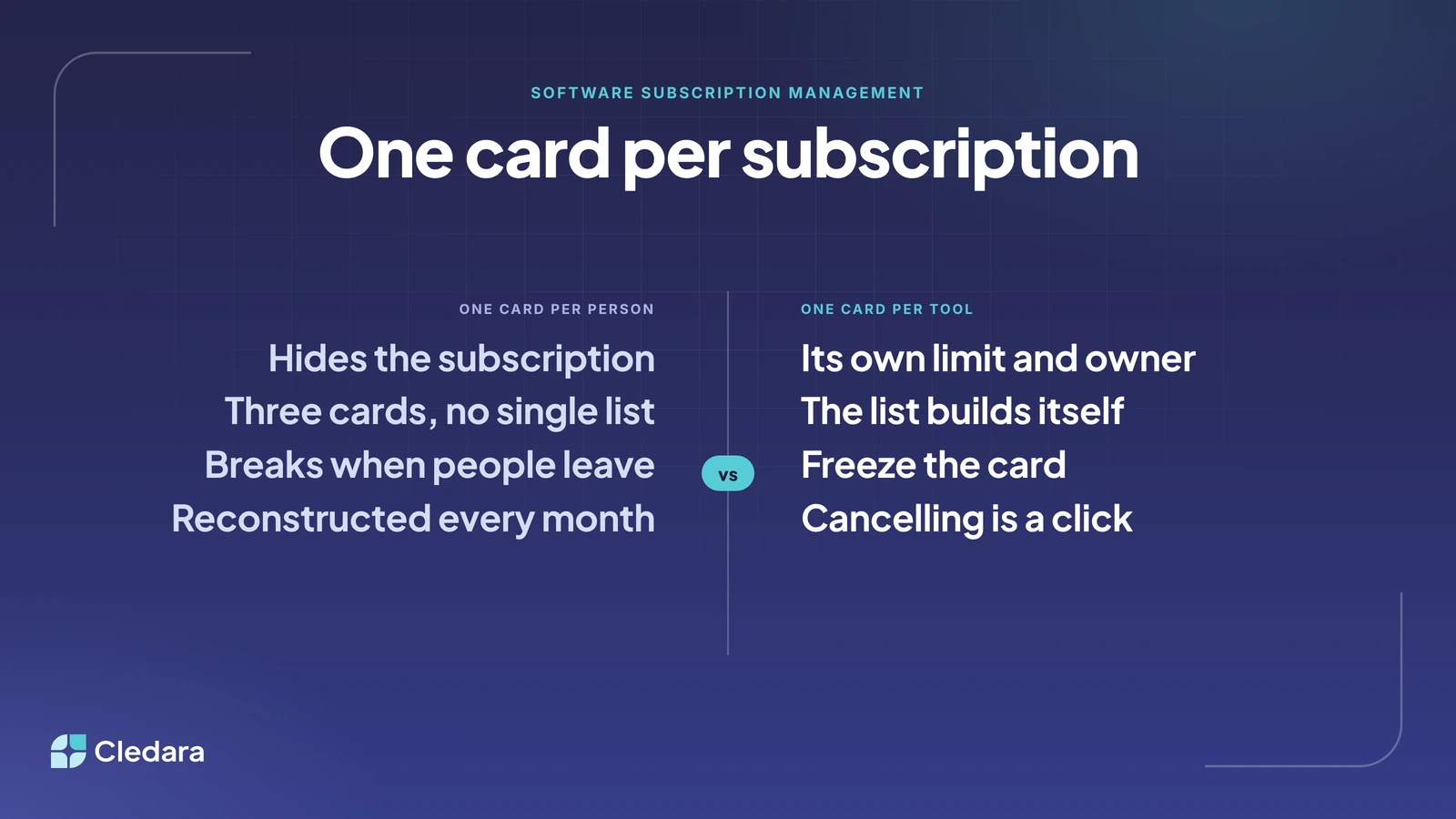
Here's a pattern I see on almost every call with a finance team. Software gets paid for on whoever's card was nearest at the time. The CTO's card has the cloud bill and the AI tools on it. The office manager's card has the design tools. A founder's personal card is still paying for something from 2021, and nobody is quite sure what. Virtual cards for subscriptions fix this in one move: every tool gets its own card, with its own limit and its own owner, rather than each person getting a card and paying for whatever lands on their desk.
It sounds like a small change. It isn't. It changes who owns each tool, what happens when someone leaves, how much any one vendor can take, and how fast you can switch something off. This post walks through how the pattern works, where a hard limit helps, and the one place a hard limit can hurt you.
Key takeaways
- A virtual card per subscription ties every payment to one tool, one owner and one limit, so the list of what you pay for builds itself.
- Cards tied to people break when people leave. Cards tied to tools don't.
- Cledara data shows about 77% of UK software spend runs on soft limits and about 23% on fixed limits, and that split is deliberate.
- Among subscriptions with a usage-style payment pattern, AI-native tools pay on average every 5.6 days, so a fixed limit on them declines at the worst possible moment.
- Use fixed limits for seat-based tools with predictable bills, and soft limits with alerts for anything that scales with usage or keeps your product running.
- One-click cancelling only works if there is a card to freeze, which is the quiet reason the pattern matters.
What goes wrong when subscriptions share a card
Before virtual cards for subscriptions were common, shared cards felt efficient, right up until the day they weren't. One finance lead told us she keeps finding invoices for subscriptions she didn't know the company had. Another had three different cards paying different tools, with no single list of what was on which. A third had moved off shared virtual cards because nobody could control them, only to find the replacement cards were tied to individuals, so a tool would go down if its cardholder left. (True stories, all from the last few months.)
The common thread is that a shared card hides the subscription inside a statement line. You see "Vendor Ltd, 4 Nov" and have to work out which tool it is, who uses it, whether it's still needed and whether the price went up. Multiply that by 70 or 80 tools and you have a monthly job that nobody wants.
There's a security angle too. If a shared card is compromised, every tool on it needs new card details entering, one portal at a time. If a virtual card for one subscription is compromised, you freeze that card and reissue one. Nothing else notices.
How virtual cards for subscriptions work in practice
The mechanics are simple, and the order matters because each step feeds the next.
- Someone requests a tool. The request goes to whoever your rules say should approve it (a manager, finance or IT, often based on annual cost).
- On approval, the tool gets its own virtual card with a limit and a named owner. Cards are free, so there's no reason to share one.
- The owner puts the card into the vendor's billing page. From then on every payment for that tool arrives already labelled.
- Each payment is matched to its invoice and coded to the right expense account and cost centre, so month-end starts with the work done rather than with a hunt.
- When the tool is no longer needed, you freeze the card. The vendor can't charge it again, and the cancellation is a click rather than a support ticket.
The outcome is a live list of every subscription, built from the payments themselves rather than from a spreadsheet someone has to remember to update. That is the difference between a card programme and software subscription management: the card is how the control works, and the list is the thing you actually wanted.
Fixed limit or soft limit? Where a hard limit bites
This is the part most guides to virtual cards for subscriptions skip. A fixed limit declines any charge above the number you set. A soft limit lets the charge through and tells you about it. Both are useful, and picking the wrong one is how a cost control turns into an outage.
A finance manager at a messaging company put it well on a recent call. He loved hard limits on the small stuff, and he was nervous about them on the cloud bill and the ad spend, because a declined payment there doesn't save money. It takes the product down, or pauses campaigns mid-flight. Hosting providers suspend accounts that stay unpaid, and the time you spend on a support ticket getting it reinstated costs more than any overspend you prevented.
The data backs him up. Cledara data shows that across UK software payments in the last twelve months, about 77% of spend ran on cards with soft limits and about 23% on fixed limits. In the EEA it was roughly 69% soft and 31% fixed. Finance teams aren't being lax; they're putting hard stops where a decline is harmless and alerts where a decline is dangerous.
AI tools make the choice sharper. Among subscriptions on the Cledara platform whose payment pattern looks usage-based (May to October 2026), AI-native tools paid on average every 5.6 days, against 11.7 days for traditional software and 15 days for AI-embedded tools. A tool that charges every five days as usage builds is exactly the tool whose bill a fixed monthly limit will cut off halfway through the month, usually the week a team is shipping something. For those, Cledara tracks usage daily against the budget you set, and you choose whether that budget is a soft cap that warns finance and the owner before spend runs over or a hard cap that stops it. Most teams start soft and harden it once they know the pattern.
| Tool type | Billing pattern | Limit to use | What to set up |
| Seat-based collaboration tools (chat, docs, design) | Same amount every month or year | Fixed limit at the agreed seat count | Alert on any price increase, review seats quarterly |
| Cloud hosting and infrastructure | Variable, billed in arrears | Soft limit | Alerts at a sensible share of budget, named owner in engineering |
| AI APIs and usage-priced tools | Charged every few days as usage builds | Soft limit plus daily usage tracking | Budget per tool, warnings to finance and the owner before it runs over |
| Advertising platforms | Variable, often pre-paid or threshold-billed | Soft limit | Weekly alert, owner in marketing, never a decline mid-campaign |
| Trials and one-off purchases | One payment, then nothing | Fixed limit at the trial price | Renewal reminder before the trial converts |
| Annual contracts | One large payment a year | Fixed limit set just above the contract value | Renewal alert 60 to 90 days out, so the renewal is a decision rather than a charge |
Tip: if you are unsure, start soft and tighten. A soft limit with an alert tells you what the tool really costs over a few months. A fixed limit set from a guess tells you nothing until something declines.
What happens when the card owner leaves?
With cards tied to people, a leaver is a small crisis. Their card gets cancelled, and every tool on it starts failing one by one over the following month, usually discovered by the people who needed the tool that morning. Re-entering card details across dozens of vendor portals is a long day for somebody, and it lands at the worst time, because the person who knew where everything was has just walked out.
With a card per subscription, the leaver's departure changes one field: the owner. The card keeps working, the payments keep flowing, and the new owner inherits a tool with its history attached. The question moves from "which card was that on?" to "who should own this now?", which is the question you actually want to be asking.
The leaver's own seats are a separate problem, and a card won't solve it. Someone still has to go into each tool and remove them. That is one of the four jobs Cledara Agent does, alongside collecting invoices, setting up new joiners and taking back paid seats nobody uses. You approve, it does the admin.
What a virtual card for every subscription can't do on its own
I'd be overselling if I said virtual cards for subscriptions fix everything, so here's the full list of what they leave for you.
- They don't find the tools that aren't paid for on them. Software bought on personal cards and reimbursed through payroll, or signed up to for free, stays invisible to the card layer. For that you need usage data from something like Cledara Engage, which records only a username and a timestamp when someone uses a tool.
- They don't get the invoices that are never emailed. Plenty of vendors leave the invoice behind a login. The card tells you the payment happened; someone, or something, still has to get the document.
- They don't make a renewal decision for you. They do make it visible, which is most of the battle.
None of this is an argument against the pattern. It's an argument for treating the card as the foundation and building the rest, invoices, access and renewals, on top of it. That's how we've designed Cledara, and the plans reflect it: cards are free on every plan, and the admin around them is where the work gets done.
Where this is going
Not that long ago, finance teams typed bank statements into the accounts by hand. Then bank feeds arrived and the whole job quietly disappeared. I think the card-per-subscription pattern is at the same stage. In a few years it will seem odd that a company ever paid for 80 tools on three people's cards and reconstructed the list every month from statements.
The companies that get there first will have something simple and valuable: a true list of what they pay for, who owns it, and a switch next to each line. Everything else, from renewals to leavers to AI budgets, gets easier once that list exists. We wrote about why virtual cards suit startups back in 2022; the argument has only got stronger since.