How to Build a Business Case for SaaS Management Software Ahead of a Renewal (Template)

A one-page business case for SaaS management software, timed to a renewal: the template, a worked example on the median UK spend and the figures a CFO checks.

by
Brad van Leeuwen
November 11, 2026
3
MIN READ
Share
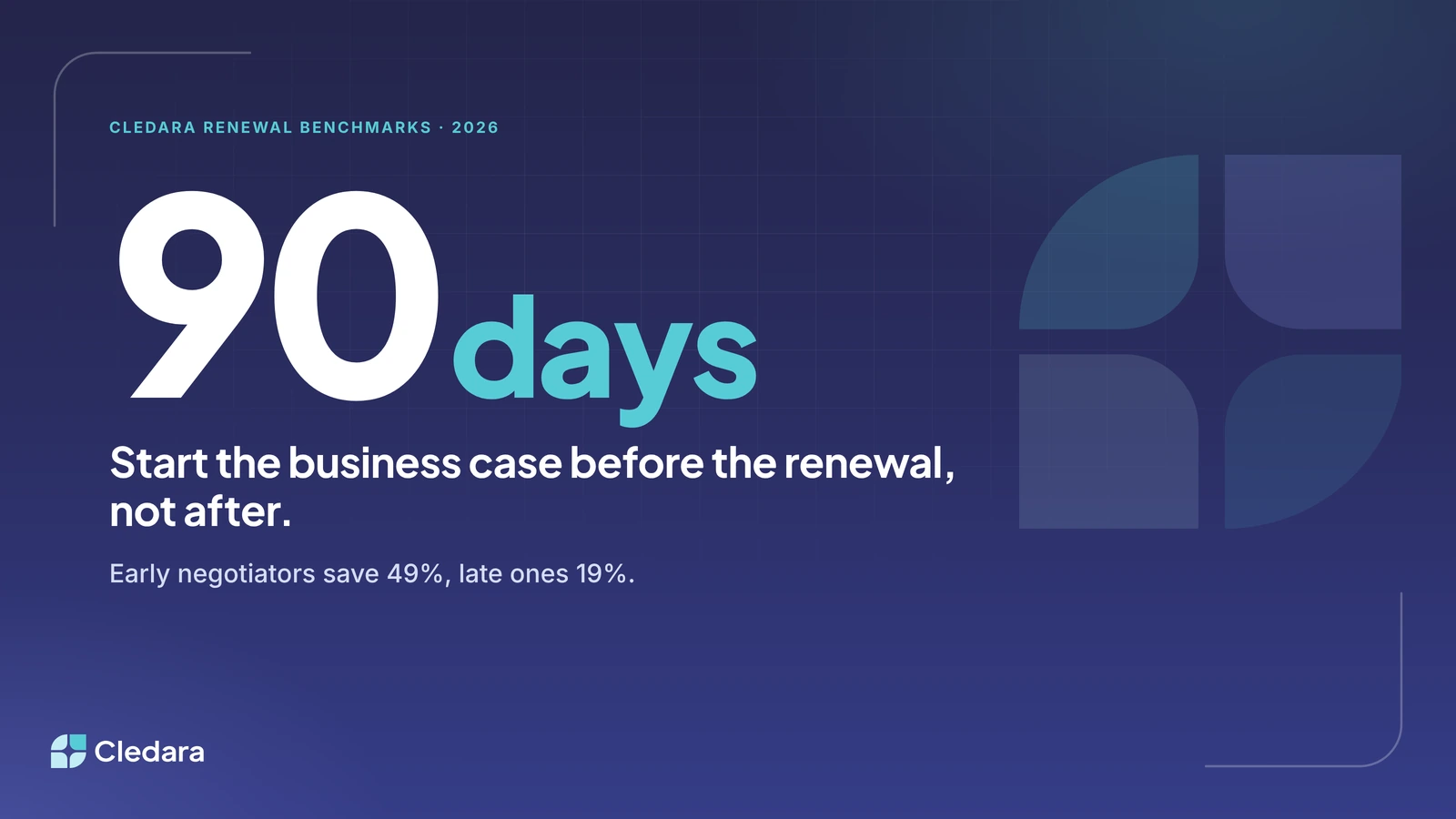
Big-number poster reading 90 days: start the business case before the renewal, not after. Early negotiators save 49%, late ones 19%, from Cledara's renewal benchmarks.

In short

The easiest business case for SaaS management software is the one tied to a specific renewal, because the saving becomes a line on an invoice rather than a forecast. Start 90 days before the renewal: companies that negotiate that early average 49% savings against 19% for those that start later. Use a one-page table with nine rows (problem, cost of doing nothing, options, recommended option, benefits, costs, risks, timeline and the ask), fill it in with your own card statements and the free benchmarks at data.cledara.com, and let the renewal prove the case at the 90-day review.

On this page

Why the week before a renewal is when a business case for SaaS management software writes itself

Here's a funny thing about software budgets. Nobody wants to read a business case for SaaS management software in March. Then a big renewal lands with a 12% increase on it, and suddenly everyone wants one by Friday. The arguments haven't changed. What changed is that the saving is now provable, because there's a real invoice to measure it against.

So the trick isn't writing a better business case. It's starting it 90 days out, while the saving is still available. Our renewal benchmarks show that companies that start negotiating 90 days out average 49% savings, against 19% for those that start 30 to 90 days out. The business case and the negotiation are the same piece of work, and they share a deadline.

This is the renewal-timed version of our software business case guide: a one-page template to copy, a worked example on the median UK spend from Cledara's data, and the figures a CFO will push back on.

Key takeaways

  • A business case for SaaS management software is easiest to win when it's tied to a specific renewal, because the saving becomes a line on an invoice rather than a forecast.
  • Start the business case before the renewal, not after. Early negotiators save 49%, late ones 19%.
  • The one-page format has nine rows: problem, cost of doing nothing, options, recommended option, benefits, costs, risks, timeline and the ask.
  • Doing nothing isn't free. Renewal prices rise 8 to 12% a year on average, so the median UK software budget of £73,846 costs about £5,900 to £8,900 more next year.
  • Use three benefit lines: spend saved (Cledara customers average 23%), hours back (a typical customer gets 30+ a month) and the renewal saving itself.
  • Source every figure from your own card statements and the free benchmarks at data.cledara.com.

How do you build a business case for any category of software?

The pattern is the same whether it's procurement software, a CRM or a SaaS management platform: state the problem in numbers, cost the option of doing nothing, compare at least two alternatives, recommend one, show benefits, costs, risks and a timeline, then make a clear ask. Learn it once and every software business case gets faster, including the business case for SaaS management software.

What changes by category is where the evidence comes from. A CRM case leans on pipeline data. A business case for SaaS management software leans on three things you already have: your card statements (what you pay for), your renewal calendar (when it can change) and your finance team's time (what the admin costs).

The one-page business case for SaaS management software (template)

Here's the whole business case for SaaS management software as a table. Copy it into a doc, keep it to one page and put the evidence in an appendix. Each row has the question a CFO is really asking and the figures to fill in.

RowWhat the CFO is askingWhat to write (fill in the figures)
ProblemWhat's actually wrong?We pay for [number] tools, [number] renew in the next 90 days and nobody owns [number]. Finance spends [hours] a month on invoices, access and renewals.
Cost of doing nothingWhat happens if I say no?Renewals rise 8 to 12% a year on average, so the same tools cost [£ figure] more next year, plus [hours] a month of admin.
OptionsDid you look at alternatives?1. Do nothing. 2. A spreadsheet and a calendar. 3. SaaS management software such as Cledara. One line each.
Recommended optionWhich one, and why?Option 3, because it collects invoices, tracks renewals and manages seats without adding headcount.
BenefitsWhat do we get, in numbers?Spend saved: [annual spend] x 23%. Hours back: 30+ a month at [hourly rate]. Renewal saving: early negotiators average 49% against 19%.
CostsWhat does it cost us?Plan and modules from the published price list, plus [hours] of set-up time.
RisksWhat could go wrong?Adoption (one owner per tool). Vendor won't negotiate (start 90 days out). Team time (set-up help).
TimelineWhen does this happen?Day 0: audit. Day 30: options and quotes. Day 60: decision. Day 90: renewal negotiated with the tool in place.
AskWhat do you need from me?Approve [plan] at [annual cost], with [name] as owner and a 90-day review.

Note: the "cost of doing nothing" row is the one most people leave out, and it's the one that wins.

How do I build a business case for procurement software around an upcoming renewal?

Work backwards from the renewal date in three 30-day blocks: audit what you have, compare options and get quotes, then decide and negotiate with the new tool in place before the renewal lands. The sequence is the same whether you call it procurement software or SaaS management. The renewal is the deadline that makes a business case for a renewal real.

  1. Day 0 to 10: pick the renewal. Choose the biggest one in the next 90 days. The business case is strongest when the first saving is a single, visible invoice.
  2. Day 10 to 30: audit. Pull 12 months of card statements and list every software payment, its owner and its renewal date. Count the tools nobody owns. Our guide to reducing IT costs shows how.
  3. Day 30 to 45: cost doing nothing. Apply 8 to 12% to the spend that renews in the next year. Add the hours finance spends on invoices, access requests and chasing. That's your baseline.
  4. Day 45 to 60: compare options and get quotes. A spreadsheet, a procurement tool and a SaaS management platform. Benchmark the renewal price at data.cledara.com so you walk into the negotiation with a number.
  5. Day 60 to 75: write the one page. Fill in the table above. Statements, benchmarks and quotes go in the appendix.
  6. Day 75 to 90: decide and negotiate. Get sign-off, set the tool up (days, not months) and open the renewal conversation with the benchmark in hand.

Important: if you're already inside 30 days, build the case now and attach it to the next renewal on the calendar. The timeline resets every renewal.

A worked example: the business case for SaaS management software at a median UK company

Here's the table filled in for a UK company on the median figures from Cledara's data (October 2025 to September 2026): 32 software tools and £73,846 a year on software. The middle half of UK companies spend between £29,549 and £161,780, so scale the rows to your own statements.

RowWorked example (median UK company)Source
Problem32 tools and £73,846 a year. 90% of software transactions are monthly subscriptions, so renewals happen all year round.Cledara data, Oct 2025 to Sep 2026
Cost of doing nothingRises of 8 to 12% add about £5,900 to £8,900 next year for the same tools. Aggressive vendors push 15 to 25%.Cledara renewal benchmarks 2026
Options1. Do nothing. 2. Spreadsheet plus calendar reminders. 3. SaaS management software (Cledara).Your assessment
Recommended optionOption 3: one list of every tool with owner, cost and renewal date, invoices synced to Xero, a virtual card per subscription.Cledara product
Benefit 1: spend saved£73,846 x 23% = about £17,000 a year.Cledara customer average
Benefit 2: hours back30+ hours a month, or 360+ a year. At the £40 an hour our business case guide uses, about £14,400 a year.Cledara typical customer
Benefit 3: renewal saving49% average saving on the renewal if negotiation starts 90 days out, against 19% if it starts later, applied to the renewal's value.Cledara renewal benchmarks 2026
CostsPlan and modules from the pricing page, plus set-up time (days, with help included).cledara.com/pricing
RisksAdoption: one owner per tool. Vendor won't move: benchmark in hand. Team time: set-up help included.Your assessment
Timeline and ask90 days in 30-day blocks. Approve the plan, name the owner, review at day 90.This post

I'll let you do the maths on the ROI, because the cost line depends on your plan. But put about £17,000 of spend saved next to about £14,400 of time back, before you count the renewal itself, and compare that with the published prices. Cledara pays for itself.

The figures a CFO will challenge in a business case for SaaS management software, and where to get them

A good CFO will challenge four numbers: the saving percentage, the hours figure, the price rise and the renewal timing. Source each one from something they can check themselves: your own card statements first, public benchmarks second. A business case built on a vendor's slide deck gets sent back.

FigureThe challengeWhere to get it
23% spend saved"That's the vendor's number."It's the Cledara customer average. Check it against your own audit: 69% of companies paying for Zoom also pay for Google Workspace, and Jiminny found 15% more subscriptions than it knew about.
30+ hours a month"Whose hours?"Time your own team for a fortnight on invoices, access and chasing. Use your figure if it's lower; 30+ is a typical customer.
8 to 12% price rises"Our vendors don't do that."Compare this year's invoices with last year's for your top ten tools, then check each tool's benchmark at data.cledara.com.
49% vs 19% renewal saving"We always negotiate."Check when your last three negotiations started against their renewal dates.
£73,846 median spend"Is that companies like us?"Free benchmarks by company and category at data.cledara.com, with the middle half shown.

Tip: never put a figure on the page you can't trace in one click. Then the conversation moves from "is that true?" to "when do we start?".

How do I prove ROI on a SaaS management platform?

Prove it against the renewal, not the forecast. Record the proposed price, the negotiated price and the date you started, and show the difference at the 90-day review. Then add the subscriptions cancelled and the hours back. Three lines from your own records beat any projected ROI in a business case for SaaS management software.

SaaS management software produces its own evidence. Every payment goes through a card you can see, every renewal has a date, and every cancelled tool is a charge that stopped. What3words cut software spend by over 10% by catching duplicates. If the first renewal saved what the case said, the second one is already approved.

What's a reasonable budget for a SaaS spend optimisation tool at a 200-person company?

Size the budget against the spend it manages, not the headcount. A 200-person company's software bill varies enormously by industry, so start from your own annual spend and set the budget as a fraction of the saving you expect. The full answer is in our post on how much SaaS management software costs.

One rule of thumb: the tool should pay for itself out of the first renewal it helps with, which is why the business case for SaaS management software is timed to one.

Where Cledara fits in the business case

Cledara is software subscription management for finance teams. Every subscription gets its own virtual card (free on every plan), so the list of tools builds itself from payments. Invoices are collected and synced to Xero, QuickBooks, NetSuite or Tripletex, and every renewal date sits in one place with an alert before it.

For the renewal itself, the Spend Optimisation module benchmarks what you pay against similar companies and flags duplicates, unused seats and price increases, and the Negotiation and Renewal Copilot drafts the negotiation. The same benchmarks are free at data.cledara.com, so they can go in the business case before you've bought anything.

Honestly, the best business case is the one you don't have to write twice. Start it 90 days before the next big renewal, fill in the one page and let the renewal prove it. If you'd like to see how the list builds itself from your own statements, book a demo and bring your renewal calendar.

Cheers,

Brad

Frequently asked questions

What should a one-page business case include?
Nine rows: the problem in numbers, the cost of doing nothing, the options considered (including doing nothing), the recommended option, the benefits with figures, the costs, the risks with mitigations, a timeline and a clear ask. Keep the page to those rows and put the evidence (statements, benchmarks, quotes) in an appendix. A finance leader should be able to read it in two minutes and know exactly what they are approving.
How do I build a business case for procurement software around an upcoming renewal?
Work backwards from the renewal date in three 30-day blocks. Days 0 to 30: audit 12 months of card statements and cost the option of doing nothing. Days 30 to 60: compare options, get quotes and benchmark the renewal price. Days 60 to 90: write the one page, get sign-off and negotiate with the tool in place. Starting 90 days out matters: early negotiators average 49% savings against 19% for those who start later.
How do you build a business case for any category of software?
The pattern is the same for every category: state the problem in numbers, cost the option of doing nothing, compare at least two alternatives, recommend one, show the benefits, costs, risks and timeline, then make a clear ask. What changes is the evidence. A CRM case leans on pipeline data, while a business case for SaaS management software leans on your card statements, your renewal calendar and your finance team's time.
What's a reasonable budget for a SaaS spend optimisation tool at a 200-person company?
Size the budget against the software spend it manages rather than the headcount, because a 200-person company's software bill varies enormously by industry. Start from your own annual spend, apply the saving you expect and set the budget as a fraction of that. A sensible rule of thumb is that the tool should pay for itself out of the first renewal it helps with. Our post on SaaS management software cost covers plan prices in detail.
How do I prove ROI on a SaaS management platform?
Prove it against a real renewal rather than a forecast. Record the proposed price, the negotiated price and the date you started, and show the difference at the 90-day review. Then add the subscriptions cancelled and the hours your finance team got back. Three lines from your own records are more convincing to a CFO than any projected ROI, and they make the next business case much easier to approve.
Does Cledara help with the business case for SaaS management software?
Yes, in two ways. Before you buy, the benchmarks at data.cledara.com are free, so you can put the median spend for companies like yours and the price benchmark for the tool you are renewing straight into the business case. After you buy, Cledara builds the list of every tool from payments, collects invoices, tracks renewals, and its Spend Optimisation module flags duplicates, unused seats and price increases, which gives you the evidence for the 90-day review.
Brad van Leeuwen

Brad is the co-founder and COO of Cledara. Prior to Cledara, Brad scaled partnerships, infrastructure and Go-to-Market at several fintech companies. He also led multiple early-stage investments into fintech and financial services for the EBRD and is one of highest-ranked Techstars startup mentors globally.

Found this useful? Share it with your team.

Share

Cledara

Software that runs itself

Cledara manages every software subscription and does the admin for you, from invoices and renewals to new starters and leavers.

  • 23% average savings on software spend
  • 4.6 out of 5 on G2
  • SOC 2 Type II certified
Book a demo

Subscribe to our newsletter

Receive the latest insights in your inbox

Software and AI management for finance teams

Software that runs itself.

Cledara manages every software subscription and does the admin for you, from invoices and renewals to new starters and leavers. You approve, Cledara does the rest.

4.6 on G21,000+ customersSOC 2 Type II