


What is the cost of SaaS spend management software?
SaaS management software (Cledara is one example) is the category of tools that keeps one list of every software subscription a company pays for, with its owner, cost and renewal date, and does the admin around it. The SaaS management software cost depends on the vendor's pricing model, and there are five in use: per employee per month, a percentage of managed spend, flat tiers, usage-based add-ons, and card-funded models where interchange or cashback offsets the fee.
Here's a funny thing about this question. The first thing finance teams ask is "what does it cost?". Fair enough, it's finance. But after a few hundred of these conversations, I think the better question is "what does it cost me not to have one?". This guide answers both, with a worked example in pounds and a rule of thumb for your CFO.
Key takeaways
- There are five pricing models in the category. The model matters more than the headline figure: it decides whether the vendor is rewarded for your savings or your spend.
- The main cost drivers are the number of tools, entities, integrations and the add-on jobs you switch on.
- The median UK company on Cledara spends £73,846 a year on software (middle half £29,549 to £161,780), and the median company pays for 32 tools.
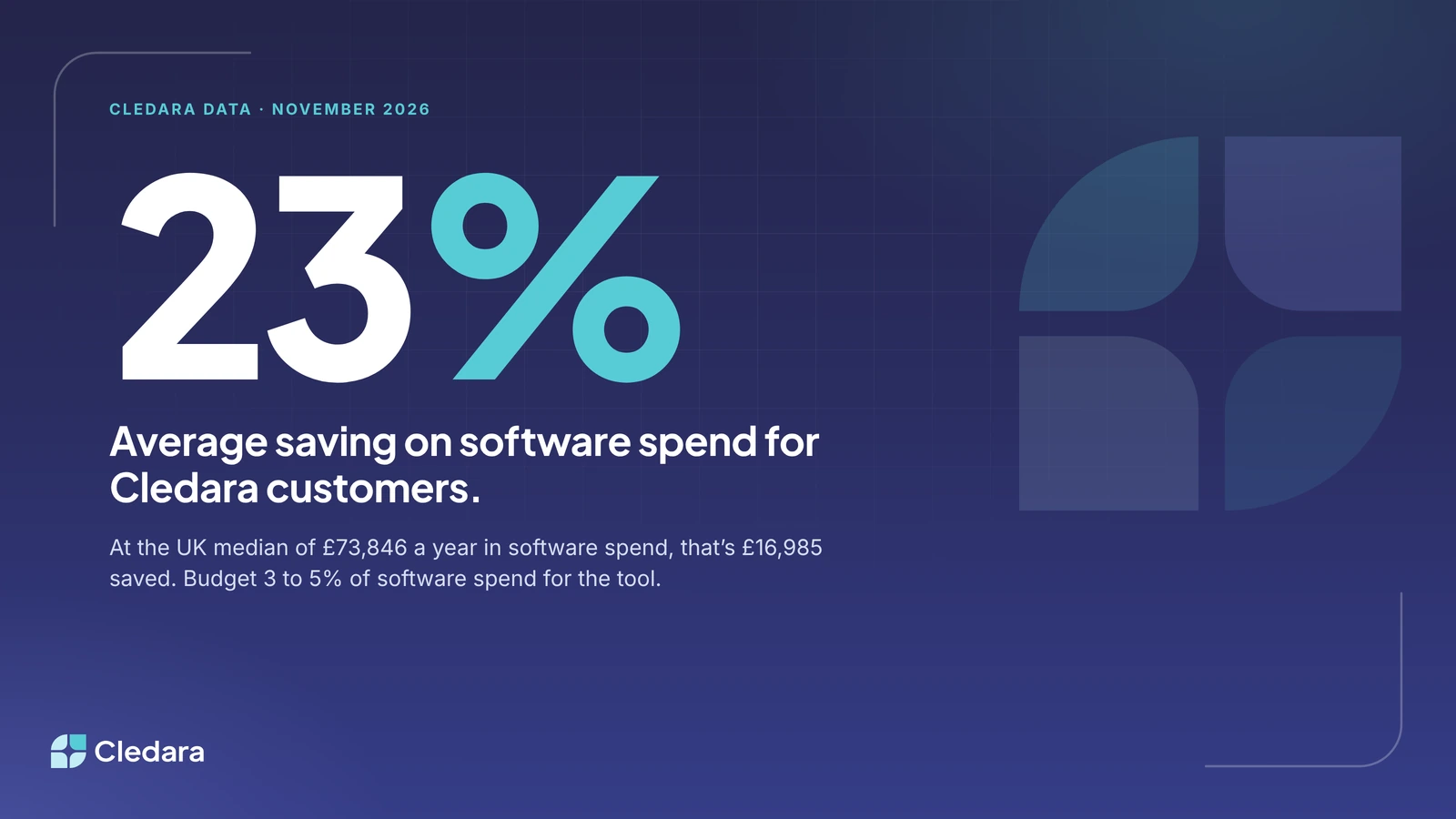
- Cledara customers save 23% on software spend on average, which at the UK median is £16,985 a year, and a typical customer gets 30+ hours a month back.
- My rule of thumb: budget 3 to 5% of annual software spend for the SaaS management software cost, and expect it back several times over in year one.
The five pricing models behind SaaS management software cost
Every vendor in this category uses one of five pricing models, or a mix. Before you compare two quotes, work out which model each is on, because the model tells you what the vendor is rewarded for. A tool that earns more when you spend more is in a different business from one that earns the same whether you spend £30,000 or £160,000. (Cledara, for the record, uses flat tiers by number of applications, with modules and Cledara Agent jobs as add-ons.)
Tip: ask one question on the first call: "what happens to my bill if I cut my software spend by a quarter?". "Nothing" means a flat tier, "it goes down" means a percentage model, and "it goes up when you hire" means per employee.
What drives the SaaS management software cost up or down?
Four things move the price more than anything else: how many tools you manage, how many legal entities you run, which integrations you need, and how much of the admin you want done for you.
- Number of tools. The median company we see pays for 32 software tools, and the middle half pay for between 16 and 48. The guide to reducing IT costs shows how to build that count from your bank statements in an afternoon.
- Entities. A group with three companies in three countries needs separate balances, accounting connections and consolidated reporting, which usually means a higher tier or a bespoke package.
- Integrations. Xero and QuickBooks are table stakes. NetSuite, HR systems (BambooHR, HiBob, Personio, Workday, Gusto) and Okta single sign-on tend to come with higher plans.
- Agent jobs and modules. The newest driver. Collecting invoices from vendor billing pages, setting up joiners, taking back unused seats and removing leavers are now jobs an agent can do inside your tools, with your approval. Each job is priced separately.
What's a reasonable budget for a SaaS spend optimisation tool at a 200-person company?
A reasonable budget is 3 to 5% of your annual software spend, not a fixed sum in pounds. That's my rule of thumb, and it comes from the savings data: Cledara customers save 23% on software spend on average, so a tool costing 5% of that spend returns its budget 4.6 times over in the first year, before you count the hours.
Let's make that concrete for a 200-person company. We don't bucket our data by headcount, but a company that size sits comfortably within the range we see, so I'll use the UK median and show the middle half either side of it. Figures are Cledara data, October 2025 to September 2026.
At the median, a 5% budget is £3,692 a year against a £16,985 saving. I'll let you do the maths on the 3% version. The return is the same at every size because both lines scale with spend, which is why the budget is a share, not a figure. The table also leaves out the time: a typical Cledara customer gets 30+ hours a month back, most of a working week.
Do spend management vendors offer month-to-month plans?
Yes. Month-to-month plans are standard across the category, usually alongside a discounted annual plan. Start monthly, prove the saving in the first quarter, then switch to annual once the tool has earned its place. A vendor that insists on a multi-year contract before you've seen a single invoice collected is asking you to carry the risk.
At Cledara, plans can be changed, or switched between monthly and yearly, at any time. Yearly billing is discounted on plans and modules, and Cledara Agent jobs cost the same monthly or yearly, so there's no penalty for trying the agent monthly first. The terms are on the pricing page.
How do expense management apps handle interchange revenue sharing?
When you pay a vendor with a card issued by your expense or SaaS management platform, the card issuer earns interchange from the vendor's payment processor. Card-funded platforms use that revenue to offset their subscription fee, pay cashback, or make the card free. So part of the SaaS management software cost is being paid by the merchants you buy from.
It's a good model for the customer, as long as you read the terms: is the cashback capped, is it time-limited, which spend qualifies, and does the fee rise if card spend falls?
Cledara's virtual cards are free on every plan, one per subscription, and new Premium and Pro customers get cashback on software and cloud hosting spend in their first year (the terms differ by region and are on the pricing page). But cashback isn't the reason to buy. The card is what makes a renewal a decision rather than a charge, and cancelling a click rather than a chase.
What platforms offer the best overall value for managing SaaS applications?
The best value platforms are the ones where the fee buys back more than it costs: one list of every tool with its owner, cost and renewal date, payments and invoices handled in the same place, and increasingly an agent that does the admin inside the tools. Value is the gap between the SaaS management software cost and what it finds, not the lowest price. I've compared the options in the best SaaS management tools post; here are three tests for any shortlist:
- Does it see the spend or just report on it? A virtual card per subscription sees every charge as it happens and can stop the next one. A bank feed sees it a month later and can only tell you about it.
- Does the invoice end up in your accounts? The time saving is in the invoice arriving matched and coded in Xero, QuickBooks or NetSuite. If the tool stops at a dashboard, finance still does the chasing.
- Does it do the admin, or hand you a to-do list? Flagging an unused seat is useful. Taking it back, with your approval, is what saves money.
For what it's worth, Cledara is rated 4.6 out of 5 on G2, and Jiminny's finance team captured an extra 15% of subscriptions it didn't know it was paying for.
What SaaS management software costs you when you don't have it
This is the number nobody budgets for. Without a tool, the median UK company's £73,846 of software spend renews on the vendor's terms, not yours. Renewal prices rise 8 to 12% a year on average, and 15 to 25% with aggressive vendors, according to our renewal benchmarks. On the median spend, a 10% rise you didn't negotiate is £7,385 a year, compounding.
The same benchmarks show that companies that start negotiating 90 days before a renewal save 49% on average, against 19% for those who start 30 to 90 days out. You can only start early if you know the date. Then the quieter costs: the leaver still holding a seat (and access to your data!), two teams paying for the same product, the VAT never reclaimed because nobody downloaded the invoice.
Honestly, that's why "what does it cost?" is the wrong first question. Every company already pays for SaaS management. The only choice is whether you pay in software, or in renewals you didn't negotiate and hours finance spent being the battlefield IT manager. To make that case to a board, the software business case guide has the template.
How to budget for SaaS management software in five steps
Budgeting for this takes an afternoon if you do it in the right order.
- Count your tools. Pull 12 months of card and bank statements and list every software vendor. The middle half of companies land between 16 and 48.
- Total your annual software spend. This is the base for everything. Compare it with the free benchmarks at data.cledara.com.
- Apply the rule of thumb. Take 3 to 5% of that total. That's your ceiling for the SaaS management software cost, including add-ons.
- Choose the jobs, not the features. Decide which admin you want done (invoices, joiners, unused seats, leavers) and price the base plan plus only those jobs.
- Start monthly, prove it, go annual. Run a quarter on a monthly plan, measure the saving against the 23% average, then take the annual discount.
Important: write the expected saving next to the cost, for the same 12 months. A budget showing only the cost of SaaS spend management software looks like an expense. One showing both looks like what it is, a return.
The short version on SaaS management software cost
The SaaS management software cost is a small share of your software spend, and the model matters more than the number. Budget 3 to 5% of what you spend on software, pick a vendor whose pricing rewards your savings rather than your spend, start monthly, and measure it against the 23% average. If you'd like the worked example run on your own numbers, book a demo and we'll do it live.
Good luck with the budget round.
Cheers,
Brad