


What tools automatically remove leavers from all the apps they used?
Yes, there are tools that remove leavers from apps automatically, and they work in three different ways. Identity and HR platforms (Okta, JumpCloud and Rippling) switch off access in the apps connected to them, through single sign-on (SSO), SCIM or their own integrations. IT and SaaS management tools (Torii, Zluri, BetterCloud and Lumos) run offboarding workflows through API integrations. And an agent, such as Cledara Agent, signs in to each tool and removes the person, with or without an integration.
The way a tool works decides what it can reach, and that's the part worth understanding before you pick one. Across Cledara's customers, the median company paid for 32 software tools between October 2025 and September 2026 (the middle half paid for 16 to 48). So there's a lot more to remove than Google and Slack, and a lot of seats you'd otherwise keep paying for!
I've compared eight tools below. If you'd rather start with the process, read our guide to automating employee offboarding across SaaS apps first.
Key takeaways
- Tools that remove leavers from apps come in three kinds: SSO and SCIM deprovisioning, API integrations, and an agent that signs in.
- SSO and SCIM reach the apps connected to your identity provider. Integrations reach the apps with a connector. An agent reaches every tool you connect.
- Okta and JumpCloud suit companies with most apps behind SSO, and Rippling suits companies that run HR on it. Torii, Zluri, BetterCloud and Lumos suit IT teams that want to design workflows.
- Cledara Agent removes leavers from every tool they had, with or without an integration, across 8,000+ SaaS and AI tools, after one approval.
- Every tool here sets up new starters too, and the HR system usually starts both jobs.
- The median company on Cledara pays for 32 software tools, so ask every vendor how many of yours it reaches.
The three ways automated offboarding tools remove leavers from apps
Automated offboarding tools remove a leaver in one of three ways: through your identity provider (SSO and SCIM), through API integrations with each app, or through an agent that signs in the way an admin would. Each way reaches a different share of your tools, so it helps to know which one you're buying.
- SSO and SCIM deprovisioning. You switch the person off in your identity provider. SSO stops them signing in through it, and SCIM (the open standard for creating and deactivating accounts) deactivates their account in each app that supports it. What it reaches: SSO apps only, and SCIM only where the app and your plan include it. Slack, for example, offers SCIM on its Business+ and Enterprise plans.
- API integrations. The tool connects to each app's admin API and runs a workflow: remove the user, hand over their files, take back the licence. What it reaches: integrated apps. For anything else, some tools send a task to the app's owner instead.
- An agent that signs in. The agent signs in to the tool and removes the person, the same way you would by hand. What it reaches: every tool you connect, with or without an integration.
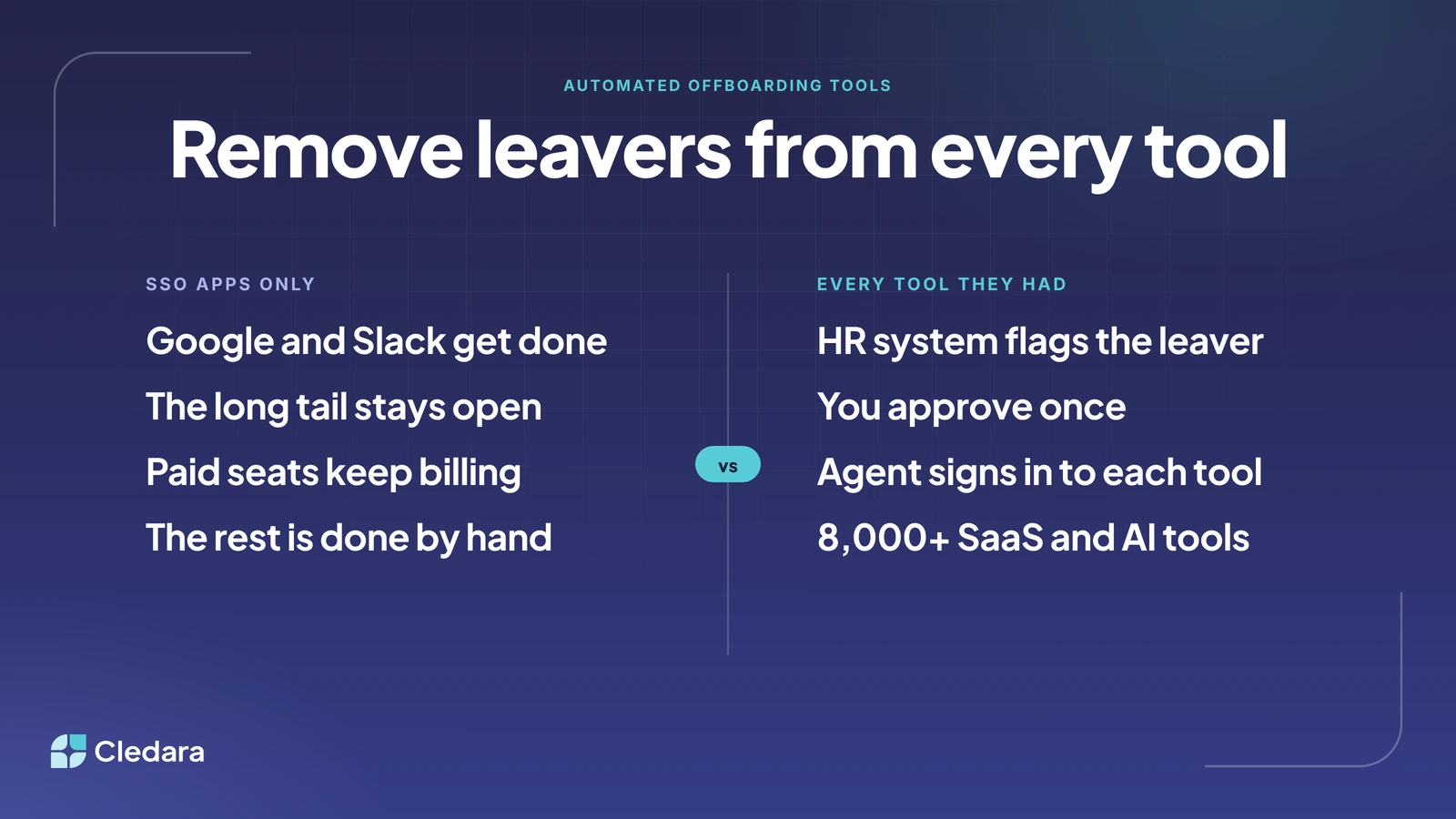
The difference shows up on someone's last day. When offboarding stops at SSO, Google and Slack get done, the long tail stays open, paid seats keep billing and the rest is done by hand. With an agent, your HR system flags the leaver, you approve once, and the agent signs in to each tool to remove them.
That long tail is bigger than most people think. On Cledara, about a third of software spend goes to vendors outside the 50 biggest (Cledara data, October 2025 to September 2026, with free benchmarks at data.cledara.com). I think of those smaller tools as the ones least likely to have a connector, and the easiest to forget when a colleague leaves.
Tools that remove leavers from apps, compared
These eight tools that remove leavers from apps are grouped by how they do it, and each has a real "best for". I checked each row against the vendor's own site in November 2026, and each name links to the page I used.
Note: vendors change their products often, so check the current detail on each link before you shortlist anyone.
Identity and HR platforms: Rippling, Okta and JumpCloud
These are the natural starting point when most of your apps sit behind SSO. Okta treats your HR system as the source of truth and supports automated provisioning for thousands of apps using SCIM. JumpCloud adds device management, so a leaver's laptop is handled along with their logins. Rippling starts from the employee record itself: offboard someone there and their app access goes at the time you set.
IT and SaaS management tools: Torii, Zluri, BetterCloud and Lumos
These are built for IT teams that want to design the workflow themselves. Torii lets you choose a method for each app: automatic, or delegated to the app's owner by email, Slack or a ticket. BetterCloud goes deep on what happens around the removal (reassigning data, reclaiming licences), and Lumos ties leavers to access requests and reviews. Zluri pairs API integrations with what it calls AI-powered integrations, which is browser automation for apps without an API, so the three ways are starting to overlap.
An agent: Cledara Agent
Cledara is software subscription management for finance teams, so it starts from one list of every tool you pay for and who has access to it. When your HR system says someone has left, Cledara lists every tool they had, you approve once, and Cledara Agent removes them from each one. It's an add-on for any Cledara plan, it only works in the tools you connect, and it's the only SaaS management agent verified by Cloudflare.
Is there a tool that sets up new starters in all their apps and removes leavers automatically?
Yes. Every tool in the table sets up new starters as well as removing leavers, and in most of them the HR system starts both jobs. A new starter's record sets their accounts up, and a leave date takes them away again.
What changes from tool to tool is what it can reach, the same as for leavers. An identity platform creates accounts in the apps connected to it, and a workflow tool creates them where it has an integration. An agent signs in and adds the person, so it isn't limited to apps with a connector.
With Cledara Agent's User Management job, it works like this:
- Your HR system tells Cledara. BambooHR, HiBob, Personio, Workday, Gusto and 30+ other HR systems tell Cledara when someone joins or leaves.
- Cledara builds the list. For a new starter, it suggests the tools their team already uses. For a leaver, it lists every tool they had, including the ones you'd forgotten about.
- You approve once. Each change waits for approval, unless you set a standing approval for routine work such as removing leavers.
- The agent does the rest. It signs in to each tool and sets the new starter up before day one, or removes the leaver from every tool they had.
- Unused seats come back too. In between, the agent takes back paid seats nobody uses, once you approve.
Tip: our SaaS onboarding and offboarding checklist lists the manual steps for a new starter and a leaver, and I've written up how software access works from HiBob, BambooHR and Personio.
What to check before you choose a tool that removes leavers
Before you choose between automated offboarding tools, count your tools, count how many sit behind SSO, and ask each vendor what happens to the rest. The point is to remove leavers from every tool, so these are the questions I'd take into a demo.
- ✓ How many of our tools does it reach? Bring your full list and ask for a yes or a no for each one.
- ✓ What happens when a tool has no integration? Some tools do the removal themselves. Others send a task to the app's owner, and then someone still has to do it.
- ✓ Does each app support SCIM on the plan we pay for? If the answer is "upgrade first", add that to the cost.
- ✓ Does it know every tool a person had, including the ones nobody approved? (Here's how SaaS management tools find your apps.)
- ✓ What starts it? A leave date in the HR system beats an email to IT.
- ✓ Who approves each removal, and can routine ones run on a standing approval?
- ✓ Where are sign-in details kept, and can we limit it to the tools and jobs we choose?
- ✓ Does it set up new starters and take back unused paid seats too, or is that another tool?
Important: the sign-in question deserves a proper answer, so I've covered it in is it safe to let a tool log in to your software accounts?
Which automated offboarding tool fits your company?
The right automated offboarding tool depends on where your apps live and who looks after them.
- Most of your apps are behind SSO and you have an IT team: start with your identity provider (Okta or JumpCloud) and turn on SCIM wherever your plans include it.
- You run HR on Rippling: its identity and access product keeps app access tied to the employee record.
- Your IT team wants to design detailed workflows: look at Torii, Zluri, BetterCloud or Lumos.
- Finance or operations looks after software, or lots of your tools sit outside SSO: Cledara Agent removes leavers from every tool they had and takes back paid seats nobody uses, alongside the invoices and renewals for the same tools.
Key takeaway: whichever you choose, keep switching off the leaver's identity provider account on their last day. It closes the front door, and removing them from each tool closes the rest.
Where removing leavers from apps is going
I think removing leavers from apps will soon be a job nobody does by hand. Nobody joins a finance or IT team because they love deleting users from a design tool late on a Friday. It's repetitive, it's easy to miss one, and a missed one is a former colleague who can still see your data.
Not that long ago, plenty of finance teams typed bank statements into the accounts by hand. Then bank feeds arrived, and nobody would go back. Offboarding is heading the same way: software does the removing, and a person approves. A typical Cledara customer already gets 30+ hours a month back, and I'd much rather those hours went on work people enjoy.
If you'd like to see it, have a look at how Cledara Agent works, compare the plans and add-ons, or book a demo and we'll walk you through it.
Cheers,
Brad