


Cashback vs spend control: which is better for finance teams?
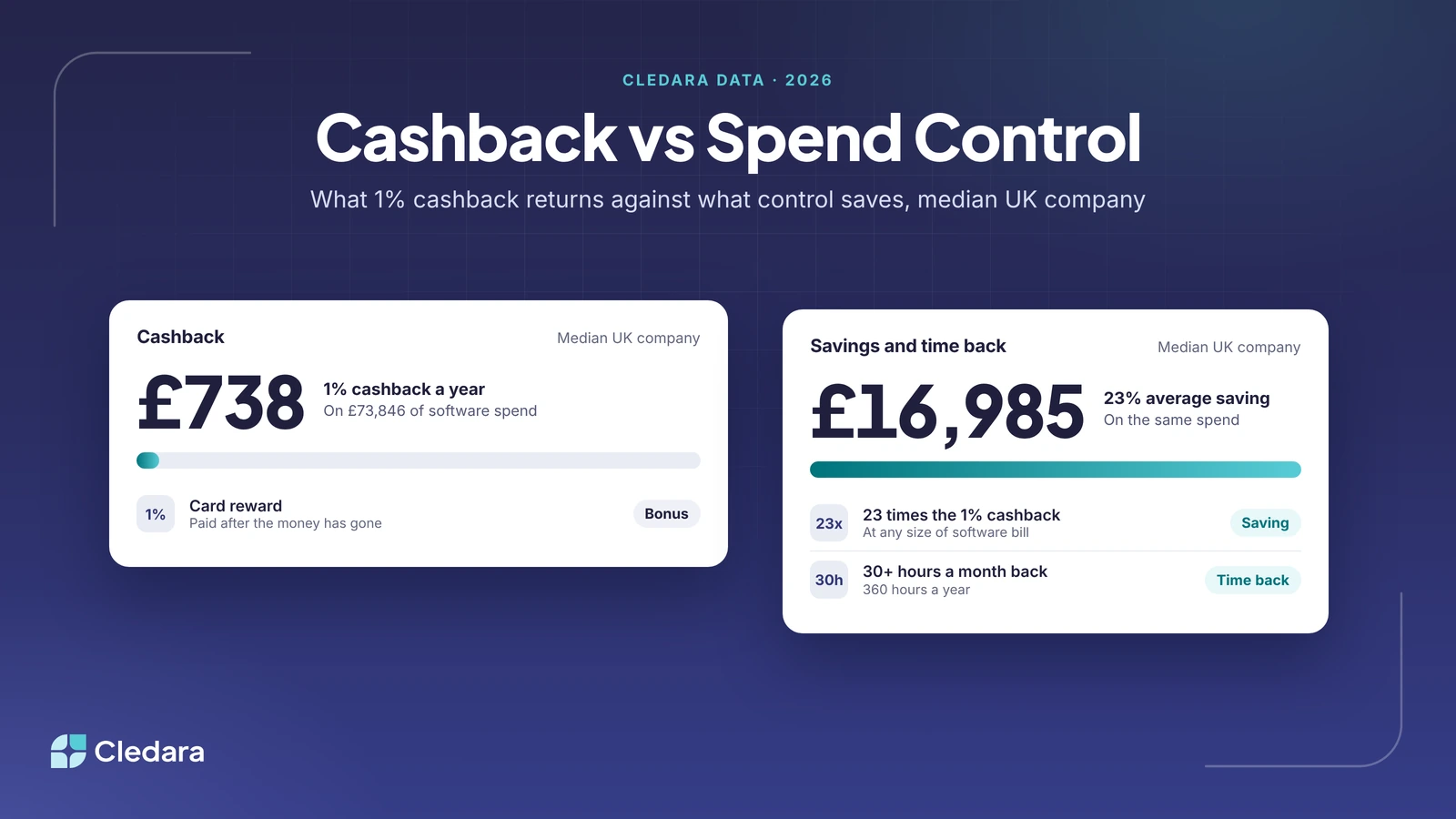
Spend control is better for almost every finance team: cashback on software spend usually returns 1 to 2% of what you pay, while Cledara customers, who control every subscription with approvals, named owners and renewal alerts, save 23% on software spend on average. A typical Cledara customer also gets 30+ hours a month back, because Cledara automates the admin around each subscription.
On the median UK company's software bill, that is the difference between about £738 a year in cashback and about £16,985 in savings, before you count the time. This post sets out the maths on cashback vs spend control for UK, European and US companies, explains when cashback does matter, and shows what control looks like in practice.
Key takeaways
- Business cards commonly advertise about 1% cashback, and some pay 2% up to a yearly spending cap.
- On the median UK company's £73,846 of annual software spend, 1% cashback is £738; the 23% average saving Cledara customers make is £16,985.
- The gap holds in Europe (€604 against €13,902) and the US ($1,463 against $33,659), because a 23% saving is 23 times a 1% reward at any size.
- If average renewal price rises of 8 to 12% hit the whole stack, the extra the median UK company pays is eight to twelve times what 1% cashback gives back.
- Time is the bigger prize: 30+ hours a month is more than nine working weeks a year.
- Cashback is a fair tiebreaker for the smallest companies, never a reason to give up control.
What is the difference between cashback and spend control?
Cashback is a reward: the card provider pays back a small percentage of eligible card spend. Spend control is a process: deciding what the business buys, who owns it, what it costs and when it stops. Cashback grows when you spend more; spend control works by making sure you only pay for what you use.
For software, spend control means approving each new tool before anyone buys it, giving each subscription its own limit, warning the owner before every renewal and taking back seats nobody uses. Cashback does none of this. It also only applies to card payments, so software paid by bank transfer or direct debit earns nothing.
The maths: cashback vs spend control on a typical software bill
Here is a worked example using Cledara data. Across Cledara's customers between October 2025 and September 2026, median annual software spend per company was £73,846 in the UK, €60,444 in Europe (EEA) and $146,344 in the US. Business cards commonly advertise about 1% cashback, and some pay 2% on spending up to a yearly cap. Cledara customers save 23% on software spend on average.
Note: each region uses its own currency and its own median, with no currency conversion. The 2% column is generous: one widely used US business card, for example, pays 2% on the first $50,000 of purchases each year and 1% after that.
The ratio is the point. A 23% saving is 23 times a 1% reward and more than 11 times a 2% reward, whatever the size of the bill. Even a company that saved only a third of the average (about 8%) would beat 2% cashback nearly four times over.
Then add the time
Money is only half of it. A typical Cledara customer gets 30+ hours a month back, which is 360 hours a year, or more than nine 37.5-hour working weeks. Those hours come from work that cashback never touches: chasing invoices, coding payments, checking renewals, and adding and removing people from tools.
Put any cost you like on an hour of finance time. Nine working weeks of it is worth more than £738 to almost every business.
Why renewal price rises outweigh cashback
Uncontrolled renewals cost more than cashback returns. According to Cledara's SaaS renewal benchmarks, vendors raise renewal prices by 8 to 12% a year on average, and aggressive vendors by 15 to 25%. If average rises hit the whole stack, the median UK company would pay £5,908 to £8,862 more the next year: eight to twelve times what 1% cashback gives back.
Timing matters as much as the rise. Companies that start negotiating 90 days before a renewal average 49% savings, against 19% for those that start 30 to 90 days out. Cashback pays you a little after the renewal has charged; spend control gives you the 90 days to change the price.
Billing patterns make this a monthly job, not an annual one. 90% of software transactions on Cledara are monthly subscriptions, and monthly billing is 81% of UK software spend, 78% in Europe and 73% in the US. Every month is a chance for a seat to be added, a plan upgraded or a leaver's account to keep charging.
Key takeaway: the biggest wins in cashback vs spend control come before a payment is made, not after. Approving, owning and reviewing each subscription is where the money is.
When does cashback matter?
Cashback matters most to the smallest companies, where a few hundred pounds is a real share of costs and there is little software admin to automate. A quarter of UK companies on Cledara spend £29,549 or less on software a year; at 1%, that is £295 or less in cashback.
For everyone else, cashback is a tiebreaker. If two tools give you the same control and automation, take the one with the better reward. Never trade approvals, owners or renewal alerts for a percentage point.
Tip: work out your own numbers. Multiply last year's card spend on software by the cashback rate on offer, then compare it with what your last three renewal price rises cost and how many hours month-end software admin takes.
How to choose between cashback and spend control
Compare what each would be worth to your company over a year, using your own figures. These six steps take an afternoon and settle the cashback vs spend control question with numbers instead of opinions.
- Total your software spend. Add up the last 12 months from card statements and the ledger, including tools paid by invoice.
- Work out the cashback. Apply the rate to card spend only, and check for caps, eligible purchases and annual fees.
- Price your renewal risk. List the renewals in the next 90 days and apply an 8 to 12% rise to each one.
- Count the waste. Look for unused seats, duplicate tools and leavers still on paid accounts. Our guide to finding unused and duplicate subscriptions shows how.
- Count the admin hours. Time spent collecting invoices, coding payments, chasing renewals and handling joiners and leavers.
- Compare savings, not rewards. Choose the option that saves the most money and time, and treat any cashback as a bonus.
How Cledara puts spend control first
Cledara is software subscription management for finance teams. It controls software spend at each point money leaves the business and automates the admin around it, so the savings and the hours come back without extra work. You approve, Cledara does the rest.
- Approvals. Requests for new tools route to the manager, finance or IT based on rules you set, such as annual cost thresholds. Approved tools get their own card.
- A card per subscription. Every subscription gets its own virtual card with its own limit. Freeze the card and the vendor can't charge it again.
- Renewals with owners. Every renewal date and price sits in one place, each subscription has a named owner, and alerts go to the owner and finance before each renewal.
- Spend Optimisation. Benchmarks against what similar companies pay, flags for duplicate tools, unused seats and price increases, and the Negotiation and Renewal Copilot to draft the renewal negotiation.
- Invoices and accounting. Invoices are matched to each payment and synced with their codes to Xero, QuickBooks or NetSuite.
- Cledara Agent. An add-on that signs in to your SaaS and AI tools to collect invoices nobody emails you, set up new joiners, take back unused seats and remove leavers, with your approval. See which spend management tools have AI agents.
Premium and Pro plans also include cashback for the first year, with terms that differ by region (see Cledara pricing). It is a bonus on top of the savings, not the reason to choose.
For the wider picture, read how spend management software compares with subscription management, or see how Cledara manages software subscriptions.