Practical insights for managing software and AI spend

Guides, spend benchmarks and side-by-side comparisons for finance teams who manage every software subscription. Get the best of it in your inbox.

Prefer LinkedIn? Follow the newsletter there.

Sign up

Featured articles

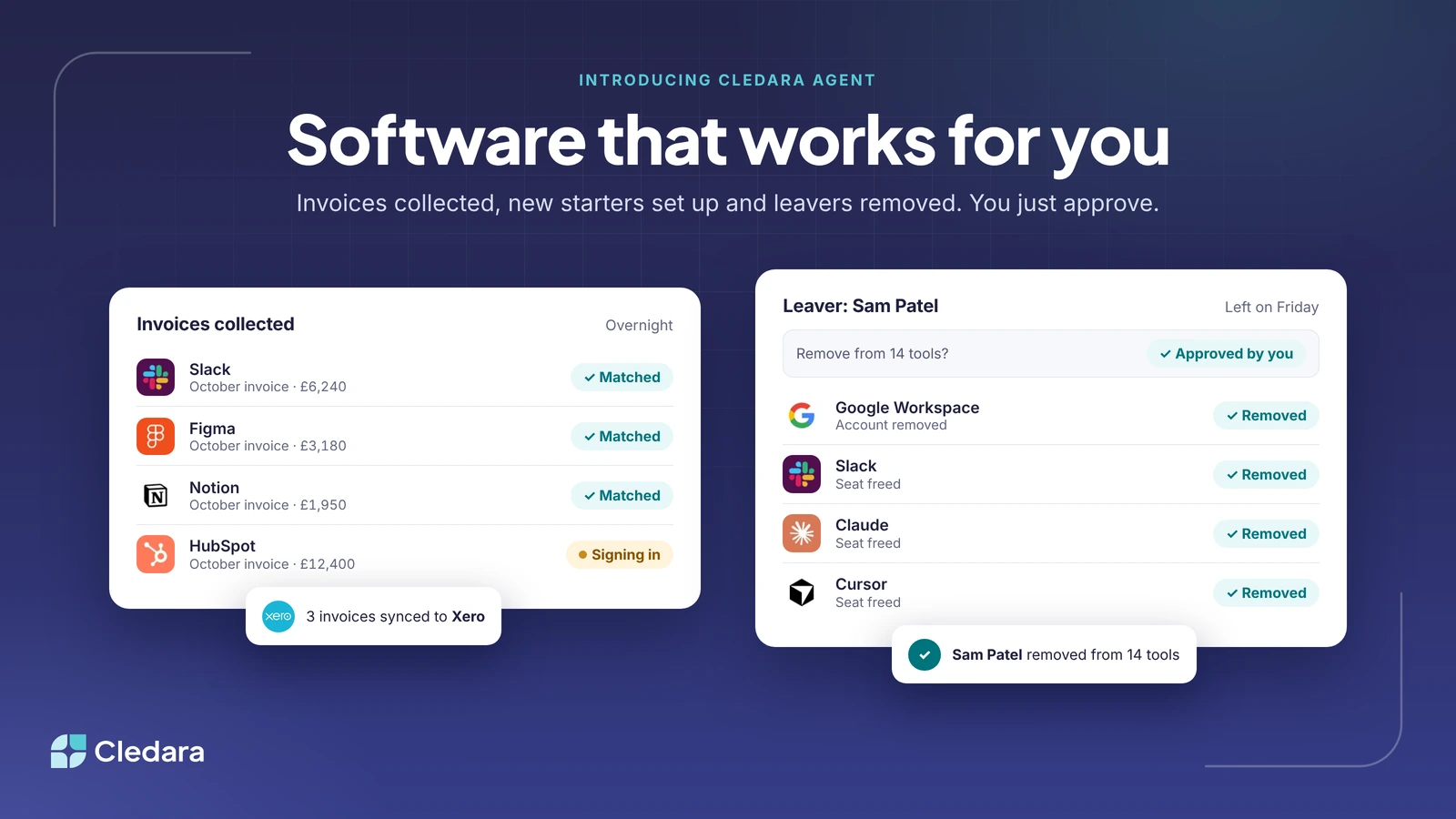
Introducing Cledara Agent: software should work for you, not the other way round

Cledara Agent is an AI agent that signs in to your SaaS and AI tools and does the admin behind them: it collects and matches invoices, sets up new joiners, reclaims unused seats and removes leavers, all with your approval. It works with more than 8,000 tools, is the only SaaS management agent verified by Cloudflare, and keeps passwords in a secure vault that AI never sees, so finance teams can spend their time on finance instead of chasing.

What Is SaaS Management? The Definitive Guide (2026)

SaaS management is the practice of tracking, buying, renewing and cancelling every software subscription your company pays for, so each tool has an owner, a known cost and a decision at renewal. It follows each tool through five stages (discover, buy, manage, renew and cancel) and covers the admin finance teams do every month: getting invoices, approving purchases, setting up new starters, removing leavers and taking back unused seats. It matters more now because the median company pays for 32 software tools, most billed monthly, and AI tools add bills that follow usage. Start early: past 10 to 15 subscriptions, spreadsheets stop keeping up.

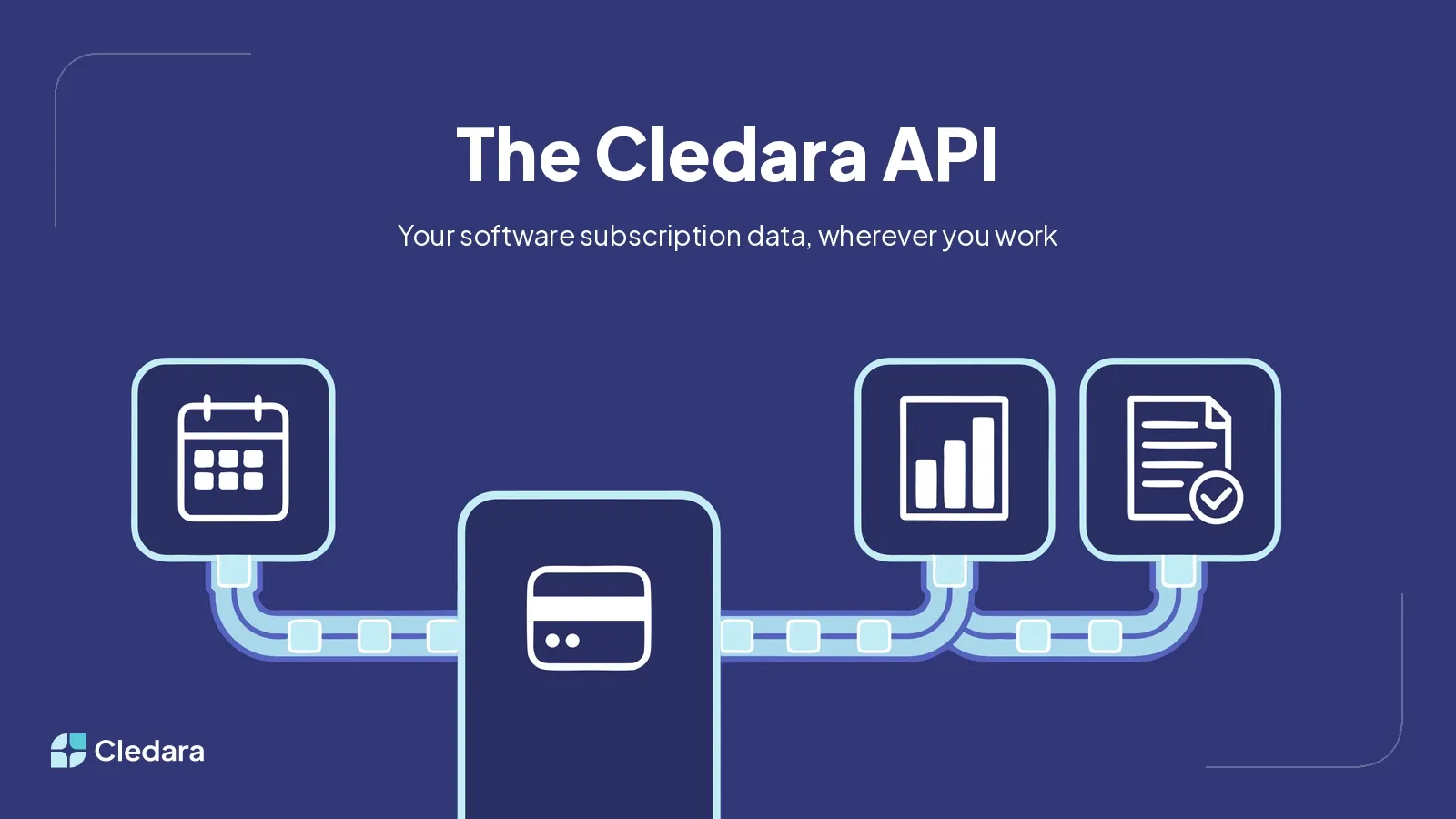
Introducing the Cledara API: Your Software Subscription Data, Wherever You Work

Your software subscription data, available programmatically. What the new Cledara API includes, why we built it, and what customers made in the first weeks.

Most read

Popular with finance teams

The guides and data readers come back to most.

How to Write a Software Business Case in 6 Steps (+ Template)

To write a software business case, follow six steps: define the problem in numbers, check what the company already pays for, compare at least two options plus doing nothing, build a three-year cost model, value the benefits and risks, then get sign-off with a named owner and review dates. The same pattern works for any category of software, and a one-page version fits in a seven-line table. A business case for SaaS should cover seats, billing and notice periods, renewal price rises of 8 to 12% a year, security evidence and an exit plan, and a renewal case should start 90 days out. Cledara's Software Compliance module has templates for the business case, risk assessment, contract review and exit plan.

Introducing Cledara Agent: software should work for you, not the other way round

Cledara Agent is an AI agent that signs in to your SaaS and AI tools and does the admin behind them: it collects and matches invoices, sets up new joiners, reclaims unused seats and removes leavers, all with your approval. It works with more than 8,000 tools, is the only SaaS management agent verified by Cloudflare, and keeps passwords in a secure vault that AI never sees, so finance teams can spend their time on finance instead of chasing.

What Is SaaS Management? The Definitive Guide (2026)

SaaS management is the practice of tracking, buying, renewing and cancelling every software subscription your company pays for, so each tool has an owner, a known cost and a decision at renewal. It follows each tool through five stages (discover, buy, manage, renew and cancel) and covers the admin finance teams do every month: getting invoices, approving purchases, setting up new starters, removing leavers and taking back unused seats. It matters more now because the median company pays for 32 software tools, most billed monthly, and AI tools add bills that follow usage. Start early: past 10 to 15 subscriptions, spreadsheets stop keeping up.

Software Tail Spend: Why It Matters and How to Manage It

Software tail spend is the long tail of small, low-cost subscriptions that people across a company buy on cards and expenses. Each tool is too small to need approval, but together they make up a real share of software spend and much of the admin: duplicates, renewals nobody owns, invoices behind vendor logins and access that outlives leavers. Across UK companies on Cledara, the 2,781 vendors outside the top 50 shared 34% of software spend between October 2025 and September 2026. To manage it, build one list of every subscription, give each an owner and its own card with a limit, set renewal alerts and automate invoice capture.

CFO Performance Metrics: 20 KPIs to Measure a Finance Leader

CFO performance metrics work on two levels. The first is the company KPIs a CFO owns: cash runway, operating cash flow, margins, growth, burn multiple, forecast accuracy and days to close. The second is the quality of their leadership: reporting, strategic input, team management and risk control. To measure CFO performance fairly, agree goals and baselines at the start of the year, score the numeric KPIs each quarter, and gather structured feedback from the CEO, board and finance team. Most CFOs should track 8 to 12 core KPIs in depth, drawn from six groups: liquidity, profitability, growth, efficiency, forecasting accuracy and finance operations.

Budget Reporting: How to Build a Budget Report (Free Template)

A budget report compares what you planned to spend and earn with what actually happened in a period, usually a month or a quarter. For each line it shows the budget, the actual, the variance in money and as a percentage, a short commentary on the cause and the owner who will act. Good budget reports explain only the variances that pass a set threshold, separate timing from permanent changes and end with an updated forecast. Software subscriptions and AI tools deserve their own lines, because monthly billing, renewal price rises and fast-growing AI usage make them drift from budget faster than most costs.

Every article

Latest articles

Newest first, twelve at a time. Or see every article on one page.

All articles

AI Procurement Policy Template: How to Govern AI Tool Purchases

AI tools are entering every company faster than governance can keep up. With 68% of employees using unauthorised AI tools at work and shadow AI costing companies an average of $412,000 per year, a clear AI procurement policy is no longer optional. This guide provides a complete, seven-section AI procurement policy template designed for companies with 30 to 500 employees. It covers approved vendor lists, data classification tiers, cost-tiered approval workflows, usage-based spending caps, and quarterly review processes. The template includes actual policy language you can copy and adapt in an afternoon, plus practical advice on rolling out the policy without stifling the AI adoption your teams need. You will also learn how to automate enforcement using virtual cards, compliance questionnaires, and approval workflows so the policy works even when people are busy.

AI Tool Sprawl: Why Your Company Has More AI Subscriptions Than You Think

AI tool sprawl is the fastest-growing category of unmanaged software spend. Based on Cledara platform data, 85% of companies now have dedicated AI subscriptions, with the average business paying for 4.5 AI tools. AI subscriptions grew 84% year over year, and nearly one in three new software purchases is now an AI tool. But the visible subscriptions are only part of the picture: AI spend also hides inside price increases from existing vendors like Notion, Canva, and Salesforce, plus variable API costs buried in cloud budgets. This post maps the three layers of hidden AI spend, quantifies the costs beyond money (redundancy, data risk, integration chaos), and provides a practical framework for getting AI sprawl under control without suppressing the adoption that drives competitive advantage.

The Engineering Team's SaaS Stack: Managing Developer Tools at Scale

Engineering teams run the most complex SaaS stack in most companies, accounting for roughly 23% of all software vendors and some of the highest per-tool spend. This guide maps the typical engineering tool stack by function (source control, CI/CD, infrastructure, monitoring, developer productivity, and AI coding assistants), quantifies the scale of each category using Cledara platform data, and identifies the most common problems: redundancy across teams, zombie subscriptions, shadow IT and shadow AI, and governance processes that create more friction than control. It then provides a six-step framework for engineering tool governance that balances finance visibility with developer autonomy, including tiered approval thresholds, preferred tool stacks, usage-based reviews, and dedicated AI tool management.

SaaS Management for IT Teams: A CIO/IT Manager's Playbook

IT leaders at growing companies face a unique SaaS challenge: balancing security, compliance, and access control across dozens (or hundreds) of cloud applications, many of which were adopted without IT's knowledge. This guide breaks down the four core IT use cases for SaaS management: shadow IT discovery, security and SSO enforcement, user lifecycle automation, and vendor oversight. You will learn where SaaS management fits alongside your existing ITSM tools, why 65% of SaaS applications in use are unauthorised, and how platforms like Cledara give IT teams real-time visibility and control without slowing down the business. Whether you are a CIO setting SaaS strategy or an IT manager drowning in access requests, this playbook provides the operational framework to bring your software stack under control.

SaaS Compliance: How to Stay Audit-Ready with Your Software Stack

SaaS compliance is one of the fastest-growing challenges for scaling companies preparing for SOC 2, ISO 27001, or GDPR audits. With 65% of SaaS applications in use going unsanctioned by IT, and the average company managing over 57 known subscriptions (plus dozens more in the shadows), the compliance risk from your software stack is significant. This guide breaks down how each major compliance framework applies specifically to SaaS, from SOC 2 vendor management requirements to GDPR Article 28 Data Processing Agreements and ISO 27001 Annex A supplier controls. You will find a practical, framework-agnostic compliance checklist covering vendor risk assessment, access control and SSO enforcement, data residency documentation, and ongoing review cadences.

SaaS Management for Finance Teams: A CFO's Complete Guide

SaaS management for finance teams goes beyond IT visibility. This guide covers the four core finance use cases, from budget forecasting and cost allocation to renewal management and audit readiness, with practical guidance on what CFOs should look for in a platform. Based on Cledara platform data showing companies manage an average of 35.8 software vendors, and industry research indicating 51% of SaaS licences go unused, the post makes the case that finance teams need purpose-built tools, not repurposed IT solutions. Includes specific evaluation criteria for accounting integrations, spend controls, benchmark pricing, and approval workflows, plus a detailed breakdown of how Cledara addresses each finance use case.

How to Run a SaaS Audit in 5 Steps

A SaaS audit is the fastest way to find wasted software spend, close compliance gaps, and eliminate redundant tools. This step-by-step guide walks finance leads and IT managers through the complete process.

12 SaaS Management KPIs Every Finance & IT Leader Should Track

Your CEO wants a software spend summary and you cannot produce one without a week of spreadsheet work. This guide solves that problem by defining the 12 SaaS management KPIs every IT and finance leader should track in a centralised dashboard.

SaaS Governance Framework: Building Approval Workflows That Actually Work

A practical guide to building a SaaS governance framework that balances speed with control. This post introduces a four-level maturity model so you can assess where your organization stands today, then walks through building structured approval workflows with a RACI matrix by spend tier. You will find a ready-to-use governance policy template covering everything from request processes to exception handling. The guide also covers security review gates, renewal governance, and common pitfalls that derail even well-intentioned frameworks. With 40% of SaaS spending now influenced by employees outside IT and an average of 9 new apps entering the stack every month, ad-hoc purchasing is a risk most growing companies can no longer afford. Whether you are formalising your first approval process or automating governance at the payment layer, this framework gives you the structure to move from spreadsheet tracking to policy enforcement.

SaaS Consolidation Guide: How to Cut Overlapping Tools (2026)

SaaS consolidation means finding software tools that overlap, choosing one per job and retiring the rest. It lowers software subscription costs because you stop paying twice for the same job, get better prices on one larger contract and remove unused seats along the way. Overlap is common: in Cledara's data, 69% of companies paying for Zoom also pay for Google Workspace. Cledara, software subscription management for finance teams, flags duplicate tools, shows who uses each one, gives every tool an owner and cancels the tools you drop in one click. This guide includes a five-step framework and a worked example of five overlapping tools.

Zoom vs Google Meet vs Microsoft Teams: The Video Conferencing Spend Data (2026)

Video conferencing has become mission-critical infrastructure, but choosing between Zoom, Google Meet, and Microsoft Teams involves more than comparing features. This data-driven comparison breaks down 2026 pricing, enterprise adoption rates, and real per-user costs. Zoom leads in market share and webinar scale. Teams dominates enterprise adoption through Microsoft 365 bundling. Google Meet offers simplicity and AI features at the lowest entry price. Discover how total cost of ownership scales across company sizes, why video conferencing spend is hard to track, and how to choose the right platform without overspending.

Zapier vs Make vs n8n: The Automation Platform Wars (Real Spending Data)

Three automation platforms dominate the market. Zapier leads with 7,000+ integrations and 68% adoption. Make offers powerful visual workflows for complex automation at 22% market share. n8n brings open-source flexibility and self-hosting options at 10% adoption. Real spending data shows Zapier averaging $4,000 annually, Make at $2,400, and n8n cloud at $1,200. We compare pricing, features, adoption rates, and help you choose based on integration needs, workflow complexity, cost sensitivity, and team skill level.

Newsletter

Software spend insights for finance teams

The best new guides, spend data and practical ideas from the Cledara blog, straight to your inbox.

  • Guides on managing software subscriptions and renewals
  • Data on what companies spend on software and AI
  • Comparisons of the tools finance teams use

Prefer LinkedIn? Follow the newsletter there.

Software and AI management for finance teams

Software that runs itself.

Cledara manages every software subscription and does the admin for you, from invoices and renewals to new starters and leavers. You approve, Cledara does the rest.

4.6 on G21,000+ customersSOC 2 Type II