


Software and AI spend for finance leaders
Guides for CFOs, finance directors and finance teams on budgeting, allocating and controlling software and AI spend, with benchmarks from Cledara data.
All articles for finance leaders
Budgets, cost allocation, renewals and AI investment, written for the people who sign off the spend.
SaaS Cost Allocation: How to Build Chargeback Models Across Departments
SaaS cost allocation is the process of assigning software subscription expenses to the departments that consume them, and most scaling companies get it wrong. With the median company paying for 32 software tools, 90% of software transactions billed monthly and purchasing authority spread across every department, finance teams need a structured approach to allocate costs accurately. This guide covers the two dominant allocation models (showback and chargeback), explains when to use each, sets out the three methods for allocating shared expenses such as SaaS or travel (headcount, usage or seats, and direct attribution with a card or cost centre per subscription), and walks through a four-step process to build a working chargeback model: classifying tools, choosing allocation keys, setting up monthly reports (including an accrual and remaining budget view for AI platform usage), and integrating with your general ledger. You will find a decision matrix comparing showback and chargeback, allocation key examples for tools like Slack, Figma and Salesforce, common pitfalls, and a free spreadsheet template. The guide also explains how Cledara automates cost allocation through virtual cards, expense code mapping and accounting integrations with Xero, QuickBooks, NetSuite and Tripletex.
How to benchmark SaaS pricing before a renewal, step by step
To benchmark software pricing before a renewal, pull three numbers: what you pay per seat today, what similar companies pay for the same tool (free at data.cledara.com), and how many of your paid seats are actually used. The gap between them is your counter-offer. Start 90 days out: companies that do save 49% on average, against 19% for those that start 30 to 90 days out. Ask for terms as well as price: a cap on rises, the right to reduce seats and a shorter notice period. This post works through a real HubSpot benchmark, a 90-day timeline and the email to send.
SaaS management software cost: how much it is and how to budget for it
SaaS management software is priced in one of five ways: per employee per month, a percentage of managed spend, flat tiers by number of applications, usage-based add-ons, or a card-funded model where interchange or cashback offsets the fee. The main cost drivers are the number of tools, entities, integrations and the agent jobs you switch on. A reasonable budget is 3 to 5% of annual software spend: at the UK median of £73,846, a 5% budget is £3,692 against an expected saving of £16,985 at the 23% customer average. The real question is what it costs you not to have one.
How to account for SaaS subscriptions: prepayments, amortisation and accruals in Xero, QuickBooks and NetSuite
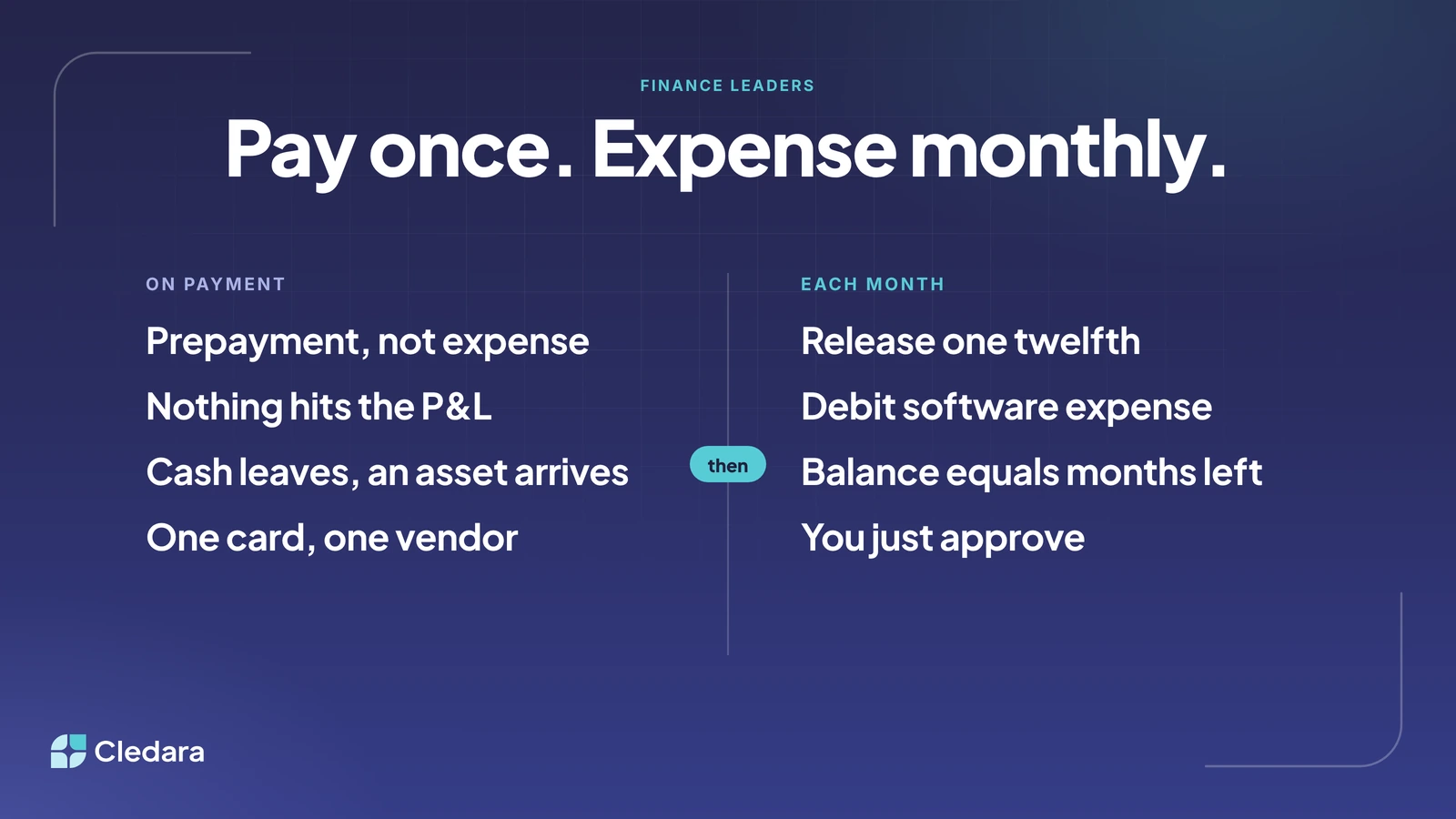
Account for SaaS subscriptions by treating monthly plans as expenses in the month they cover and annual plans paid up front as prepayments, released to software expense one twelfth at a time through a repeating journal. Accrue usage-billed tools such as AI APIs in the month you used them and reverse the accrual when the invoice arrives. Xero, QuickBooks Online and NetSuite all support a prepayment account and a scheduled release; NetSuite adds amortisation templates. Give every subscription its own virtual card so each card line matches exactly one vendor and invoice, and run a short month-end checklist so the close becomes a review rather than a hunt.
How to allocate shared software spend between departments: three chargeback models with a worked example
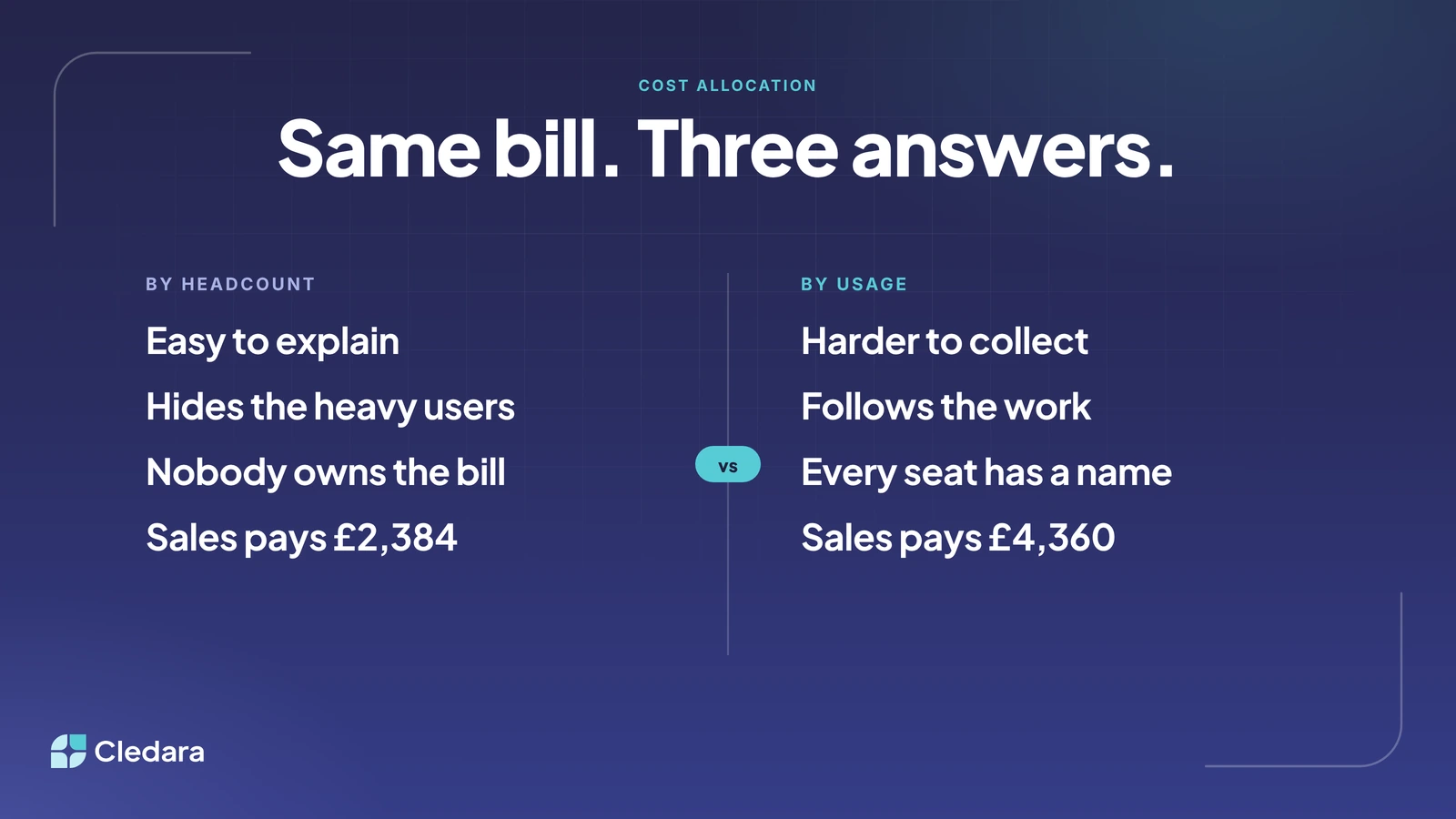
To allocate shared expenses between departments, pick one of three methods for each shared cost: by headcount (fair for platform costs nobody controls), by usage or seats (fair for costs teams can reduce), or by direct attribution with a card or cost centre per subscription (fair for costs a team chose to buy). Write the rule next to each tool, give every tool an owner, and run the same routine monthly. In a worked example for a 150-person company, the same £11,920 of Google Workspace, AI usage and travel bills gives Sales £2,384 under headcount and £4,360 under usage. Allocation arguments are ownership arguments, and a card and owner per subscription settles most of them at the moment of purchase.
The software subscription register: owners, renewal dates and costs in one list (template)
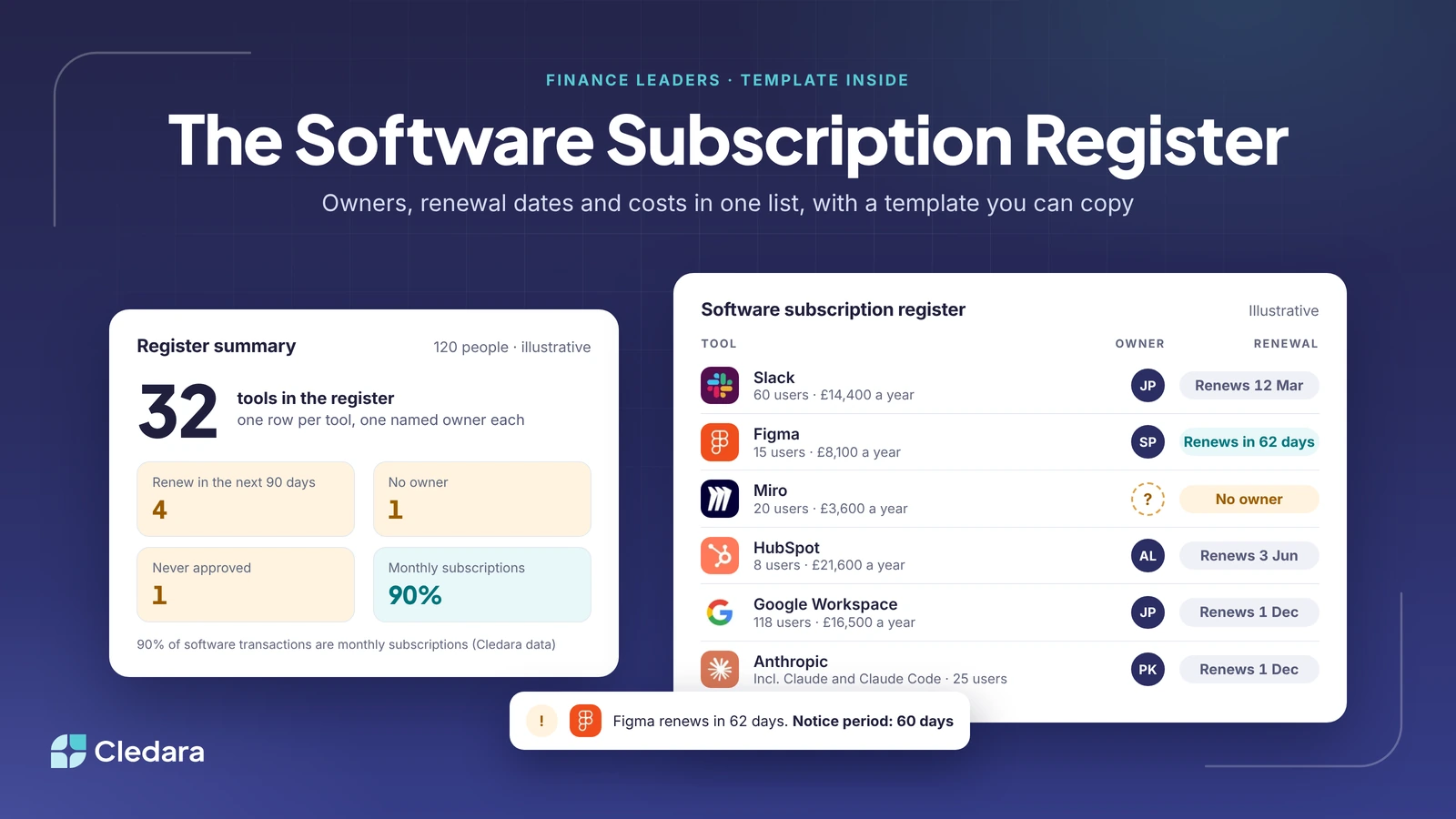
A software subscription register is one list of every software and AI tool a company pays for, with the owner, users, cost, billing cycle, renewal date, notice period and contract term next to each one. Build it from 12 months of payments rather than memory, keep one row per tool, sort it by renewal date and update it on the same day each month. The median company on Cledara pays for 32 tools and 90% of software transactions are monthly, so most renewals happen every 30 days whether you track them or not. This post gives you the 12 fields that matter, a copyable template and the point where a platform should take over.
How to Build a Business Case for SaaS Management Software Ahead of a Renewal (Template)
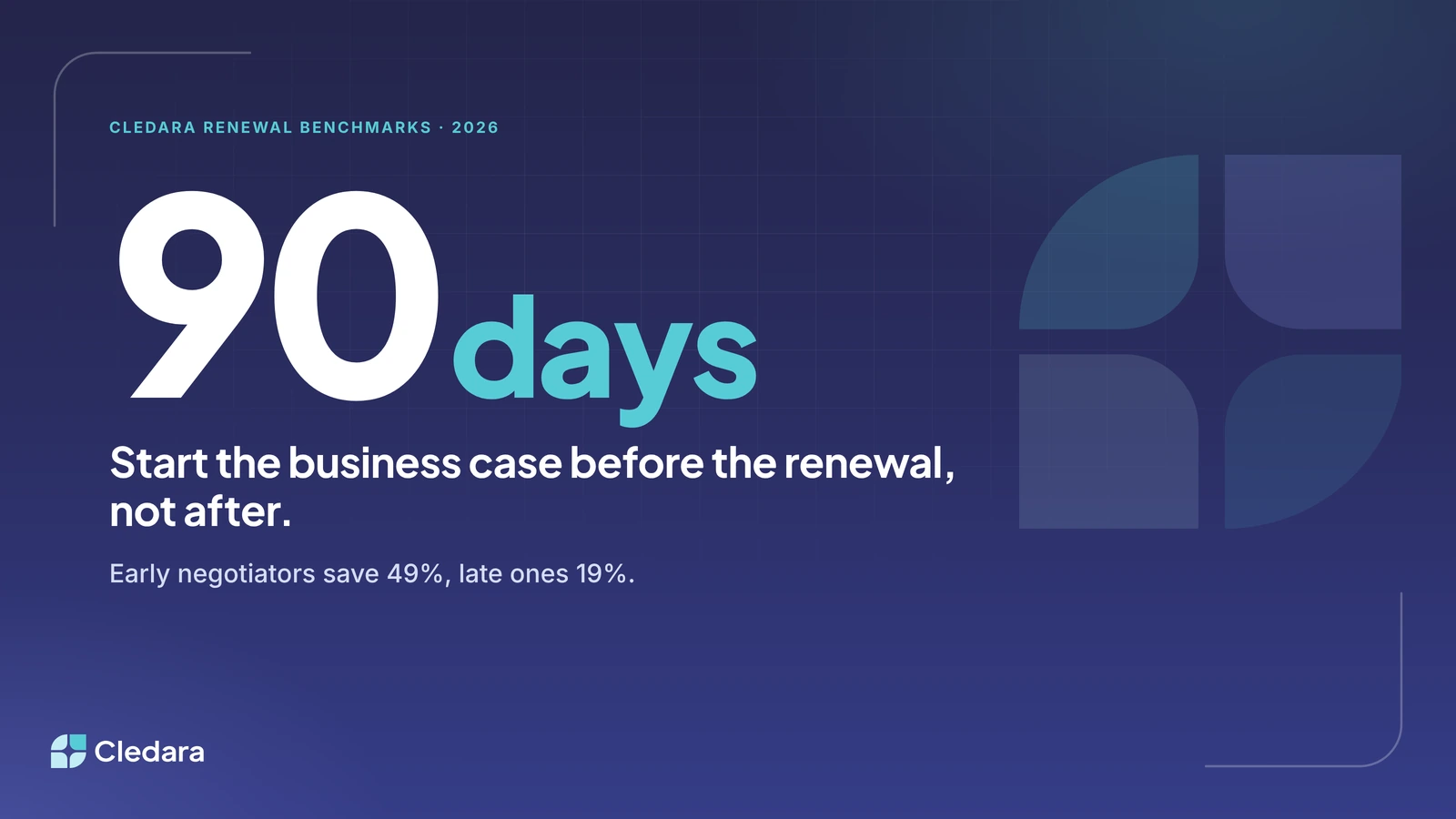
The easiest business case for SaaS management software is the one tied to a specific renewal, because the saving becomes a line on an invoice rather than a forecast. Start 90 days before the renewal: companies that negotiate that early average 49% savings against 19% for those that start later. Use a one-page table with nine rows (problem, cost of doing nothing, options, recommended option, benefits, costs, risks, timeline and the ask), fill it in with your own card statements and the free benchmarks at data.cledara.com, and let the renewal prove the case at the 90-day review.
Startup CFO vs Corporate CFO: What's Actually Different, and When to Hire One
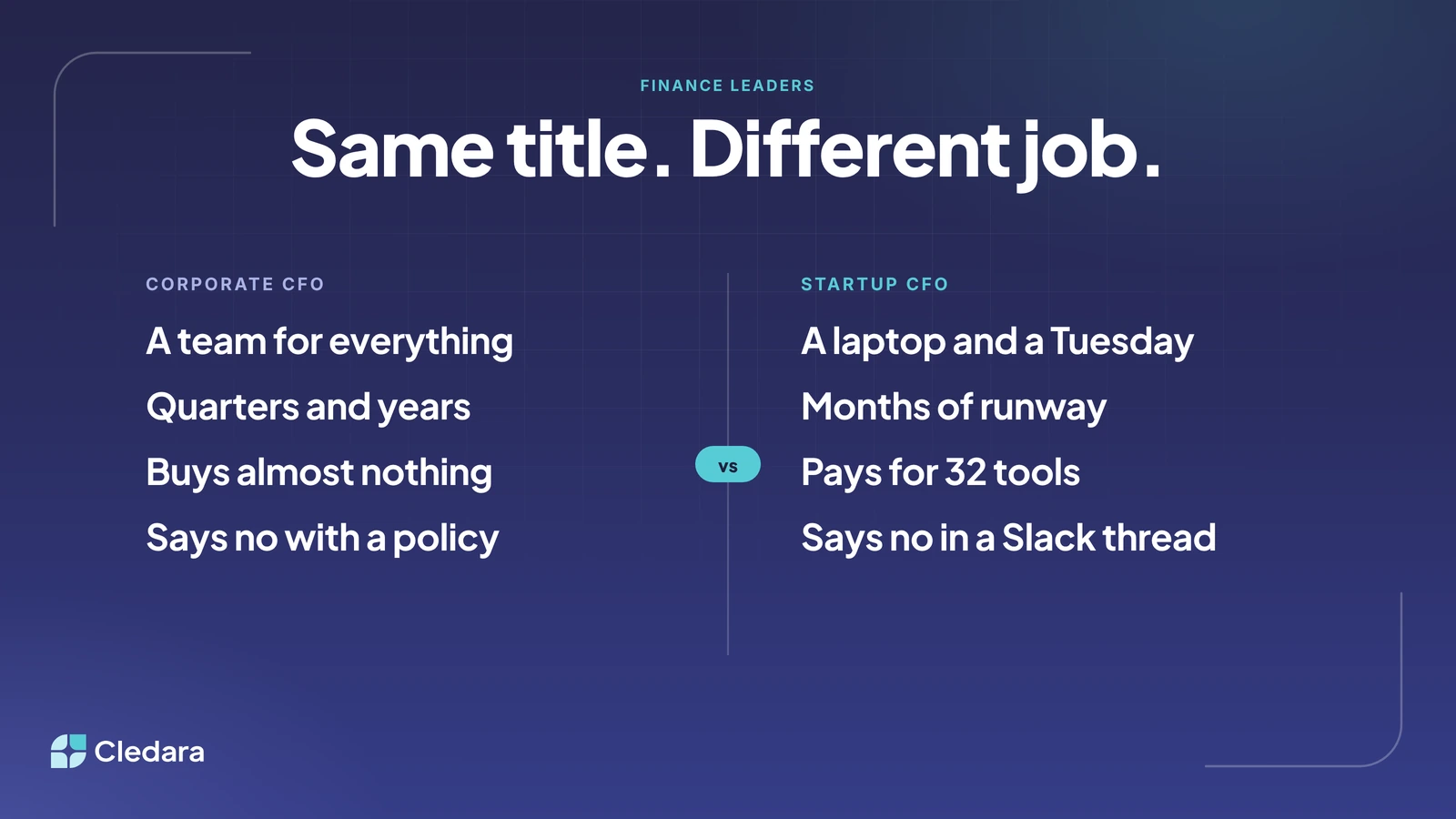
A startup CFO is an operator who happens to be good with numbers: they own cash and runway, the model, the board pack and the fundraise, plus the admin a corporate CFO has a team for, from contracts to the software bill. A corporate CFO is a steward of reporting, governance and capital allocation. Most startups need an experienced finance leader around $3 to 5 million ARR, fractional earlier if fundraising demands it, and a full-time CFO by Series C. Cledara, software subscription management for finance teams, takes the software admin off the startup CFO's desk: invoices, renewals, approvals, new starters and leavers.
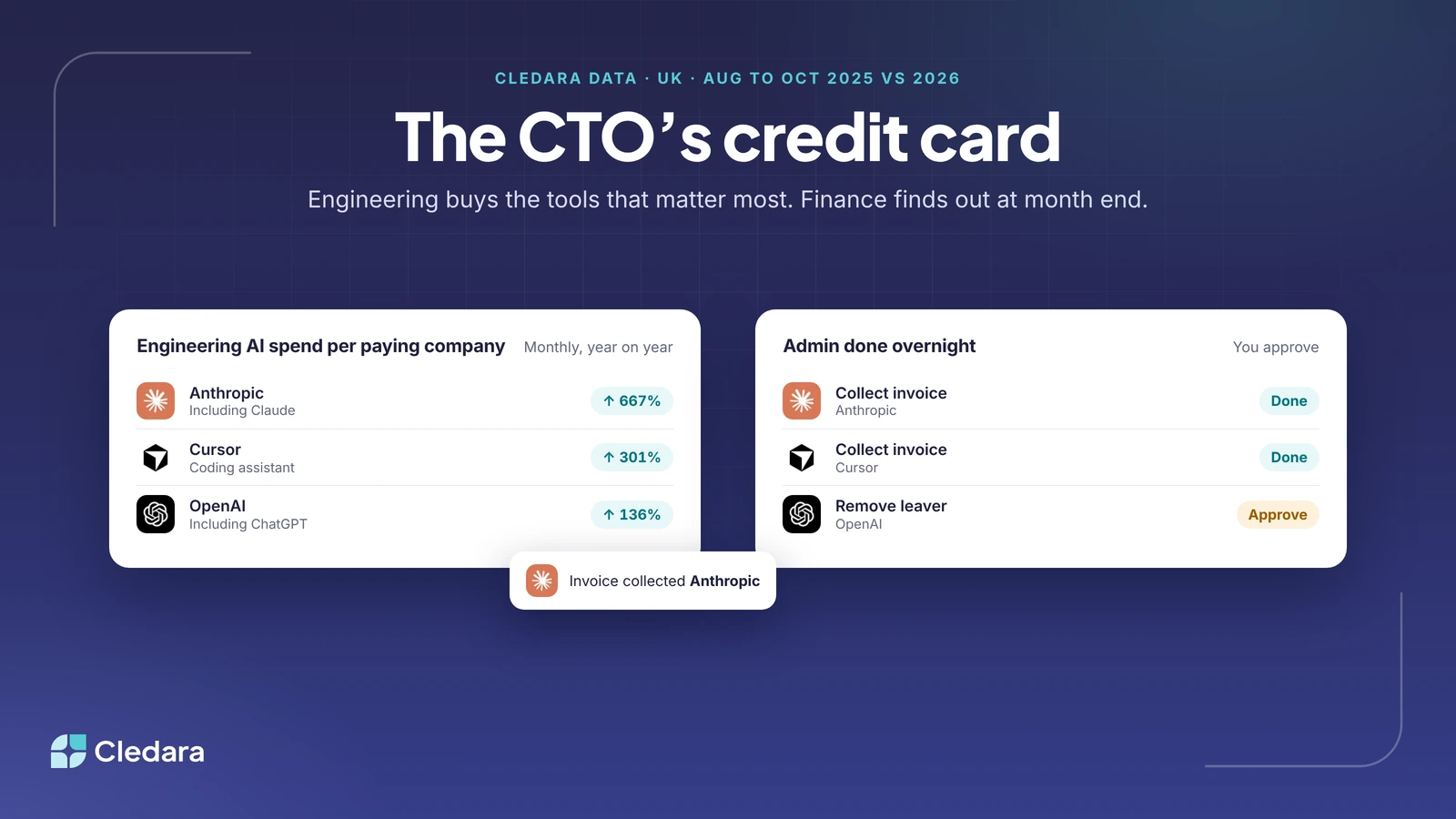
The CTO's Credit Card: Why Engineering Buys the Software That Matters Most, and Finance Finds Out at Month End
Engineering software spend is the biggest and least predictable line in most software budgets, and it usually starts life on the CTO's card rather than in finance's process. That made sense when developer tools were cheap to start, and it still does, but AI has changed the scale: Cledara data shows spend per paying UK company rose 667% on Anthropic, 301% on Cursor and 136% on OpenAI in a year, and engineering's share of software spend climbed from 15.5% to 17%. The cost is admin, not tool choice: CTOs downloading invoices, finance reconstructing budgets from statements. The fix is a card, an owner and a budget per tool, with an agent doing the chasing.
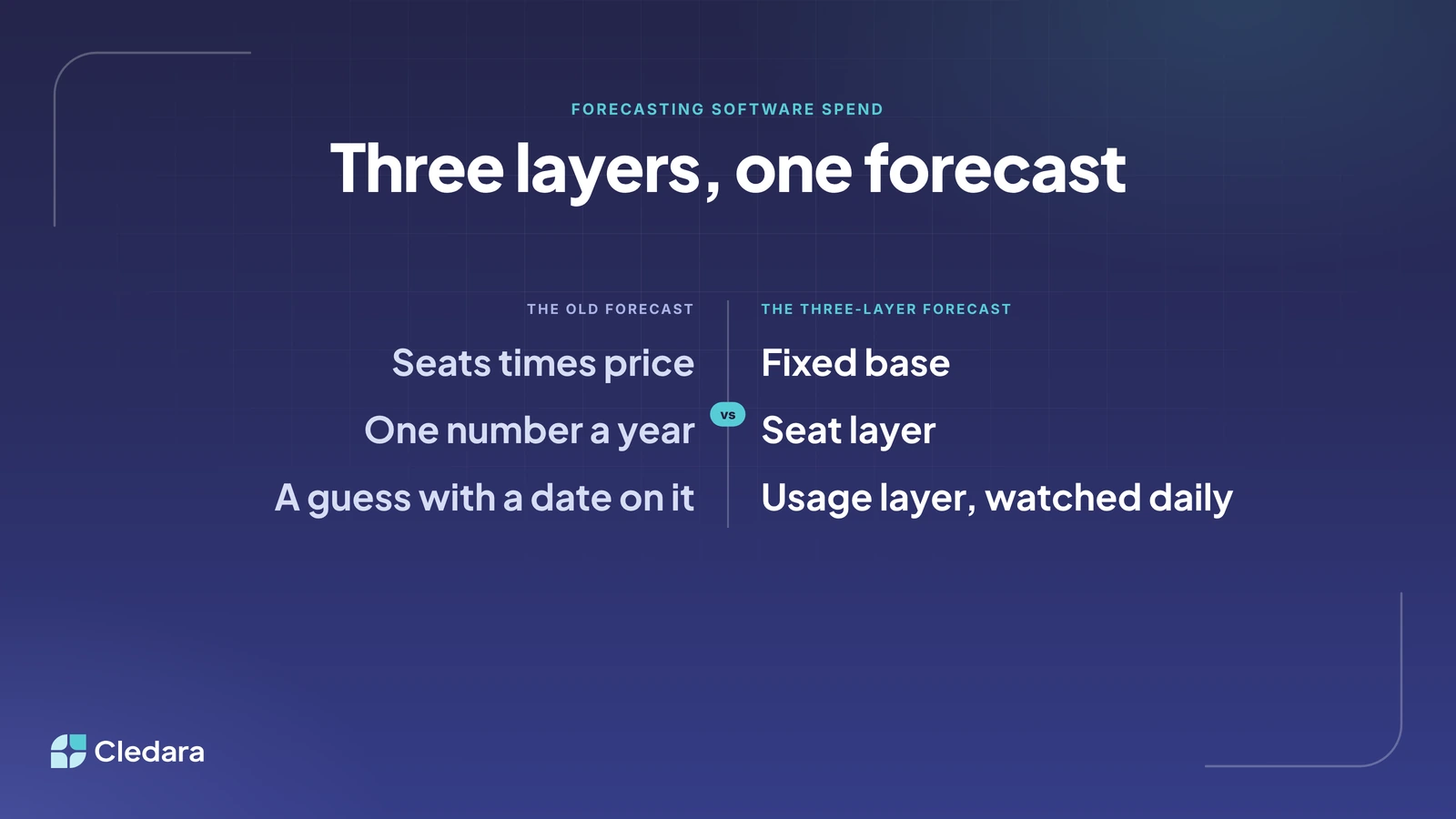
How to Forecast Software Spend When More of It Bills by Usage
Seats times price no longer forecasts software spend, because AI, data and messaging tools charge for usage. Cledara data shows 83% of UK software subscription spend was billed monthly over the last year and that AI-native usage-style tools pay every 5.6 days on average. The fix is a three-layer software spend forecast: a fixed base of annual contracts forecast by renewal month, a seat layer driven by headcount, and a usage layer forecast as a trailing run rate with a ceiling per account, watched daily with alerts. Re-forecast monthly and log variance by layer, so the forecast tells you what to do rather than just that you are over.
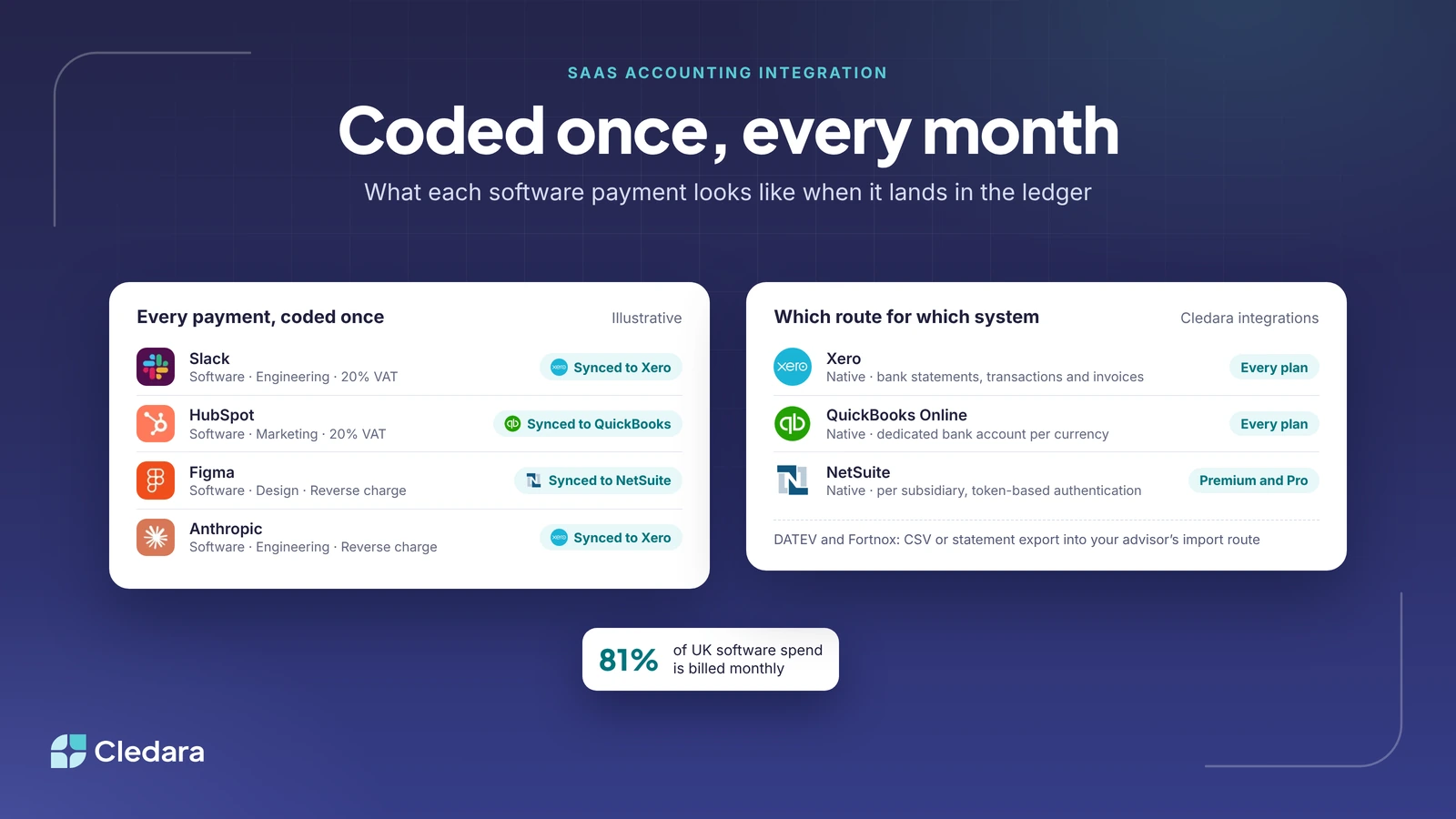
Getting Software Spend Into the Ledger: Xero, QuickBooks, NetSuite, DATEV and Fortnox
A SaaS accounting integration is judged by what lands in the ledger rather than by whether it connects. For every software payment you want the vendor, expense account, department or cost centre, tax treatment, period and invoice right, and Cledara data shows about 81% of UK software spend is billed monthly, so that coding repeats every month. Xero and QuickBooks Online connect natively on every Cledara plan and NetSuite from Premium, each with a one-time mapping per application. DATEV and Fortnox work through CSV or statement exports taken into your advisor's DATEV service or converted to SIE4. Invoices behind vendor logins remain the gap, which Cledara Agent closes by collecting them overnight.
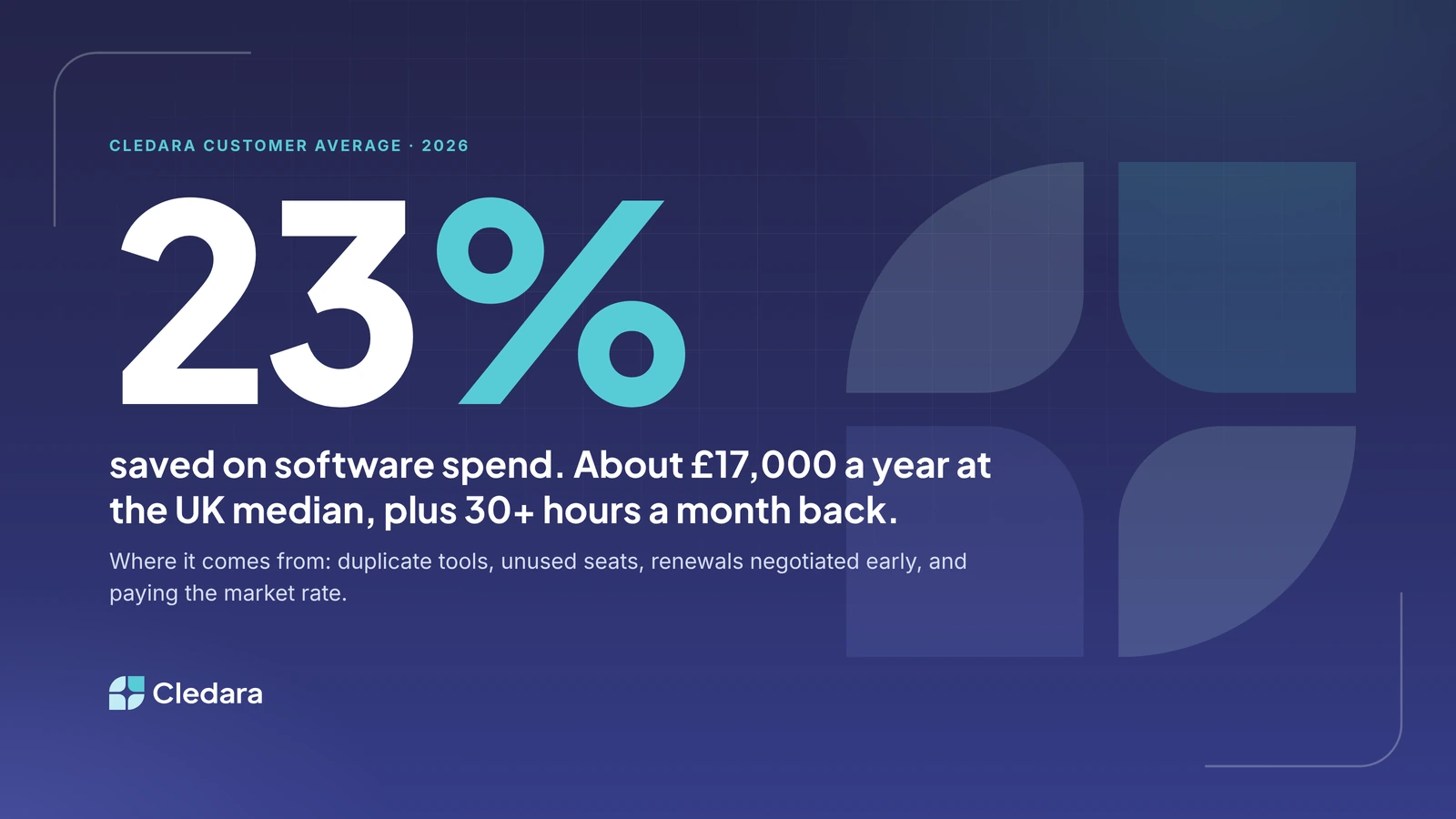
How Cledara Pays for Itself: The Maths
Cledara customers save 23% of their software spend on average and get 30+ hours a month back. On the median UK company's software bill (about £75,000 a year, from Cledara data for the year to October 2026) the saving alone is roughly £17,000, before the hours and before first-year cashback. This post shows where the 23% comes from (duplicate tools, unused seats, renewals handled 90 days early, and paying the market rate), works the maths at the UK, European and US medians, and gives a five-step method for estimating your own return. Prices live on the pricing page; the maths lives here.
Reclaimable VAT You're Leaving on the Table: The Missing Software Invoice Problem
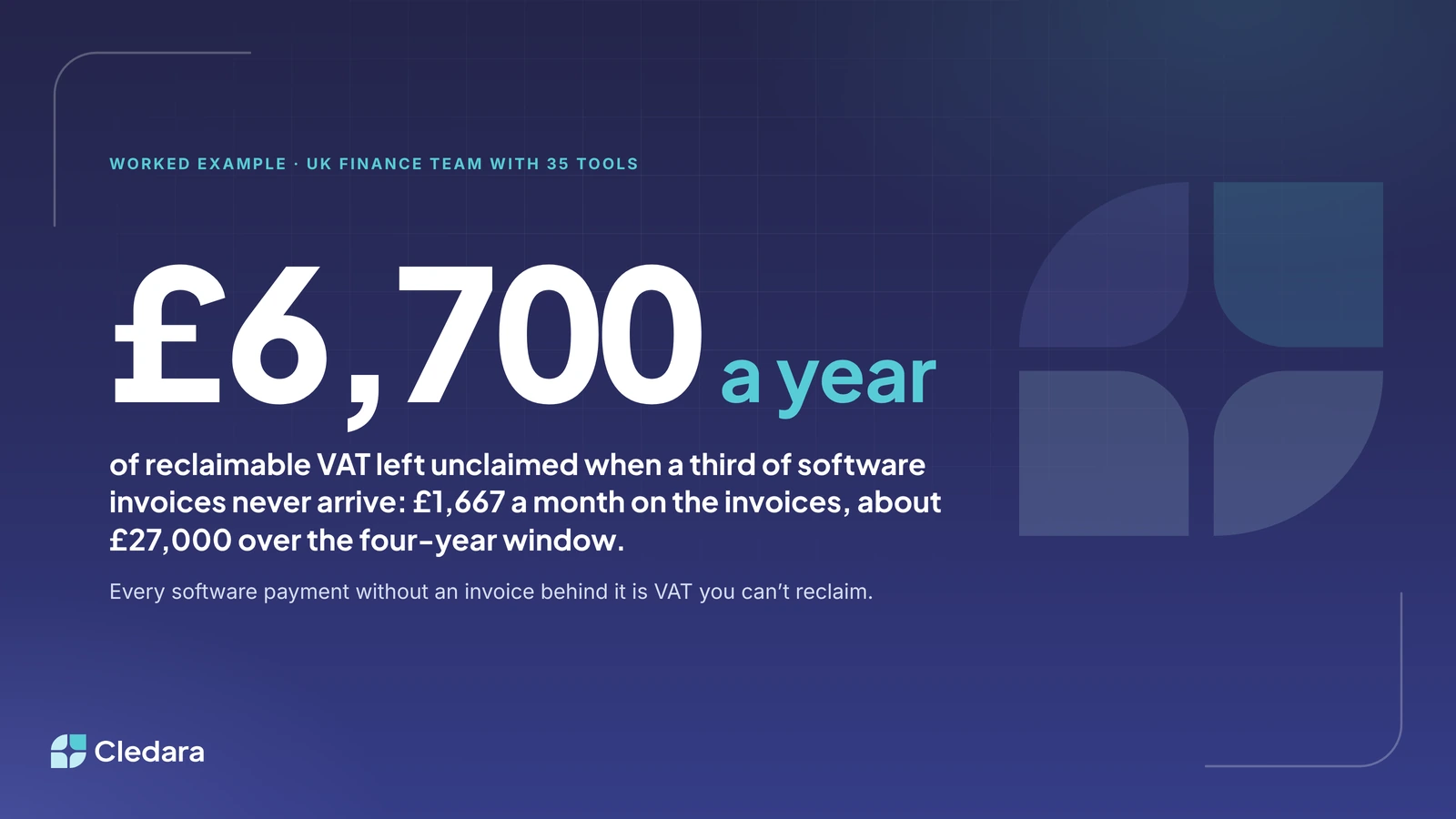
Every software payment without an invoice behind it is VAT you can't reclaim. HMRC expects a valid VAT invoice (or a simplified one at £250 or less including VAT) as evidence, and software is where invoices go missing most, because they sit behind logins owned by the people who bought the tools. Overseas vendors that aren't UK VAT registered fall under the reverse charge, but you still need the invoice. A worked example with 12 UK-VAT vendors and £10,000 a month of spend puts the unclaimed VAT at about £6,700 a year if a third of invoices are never collected, and late claims can go back four years. The fix is collecting every invoice automatically, including from vendor billing pages.
Switching to Cledara From a Spend Tool: What Migration Actually Involves
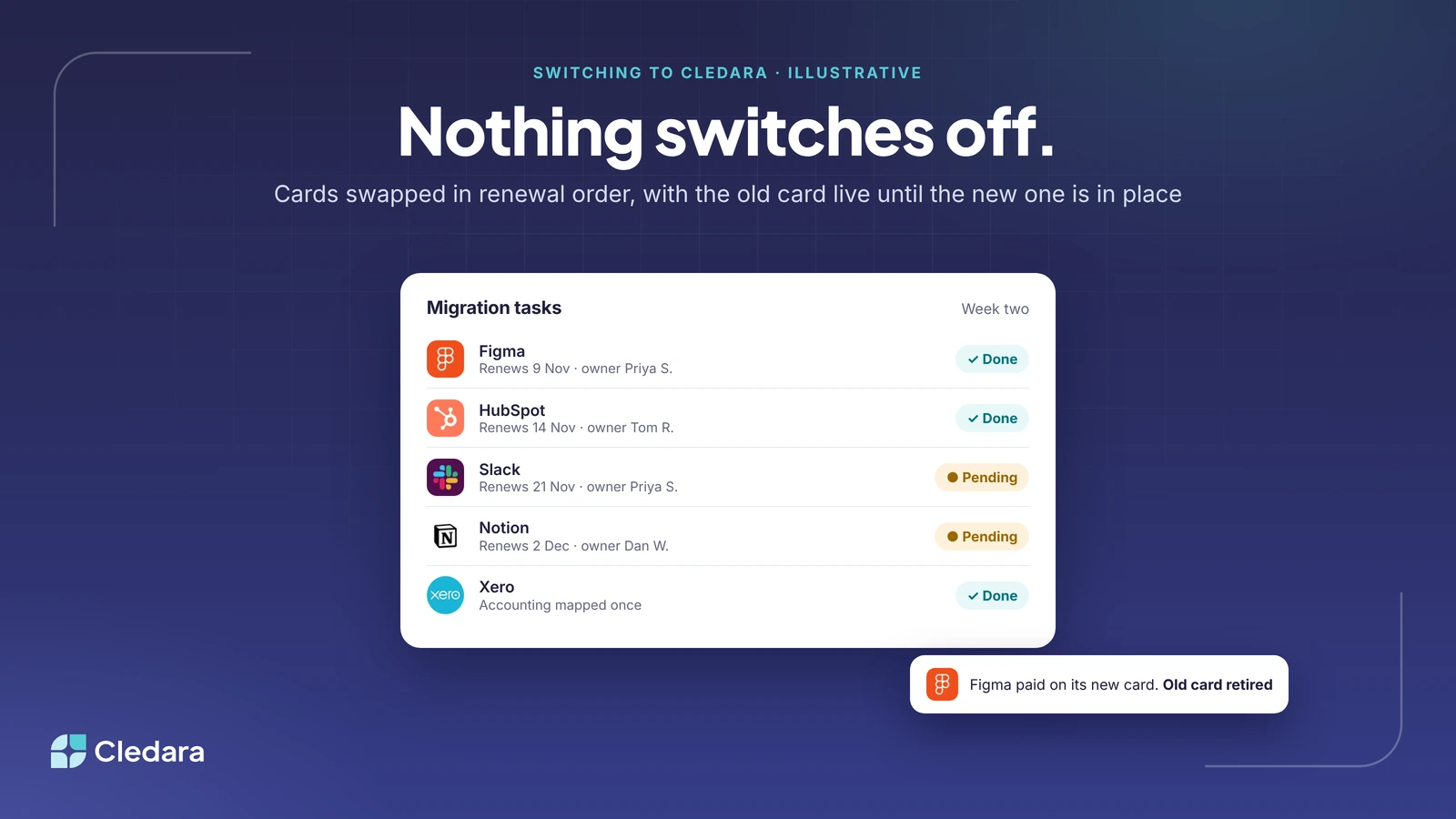
Switching to Cledara from a spend tool is a card change per subscription, done in renewal order, so nothing switches off. You bring your tool list in bulk, issue a free virtual card per subscription, swap the payment method in each tool starting with whatever renews soonest, map the accounting once, and switch on invoice capture, approvals and Cledara Agent. Your spend tool can stay for travel, expenses and supplier invoices. Set-up is measured in days with help on every plan, and the work lands on the tool owners rather than on finance.
The "I Didn't Know We Had That Subscription" Problem
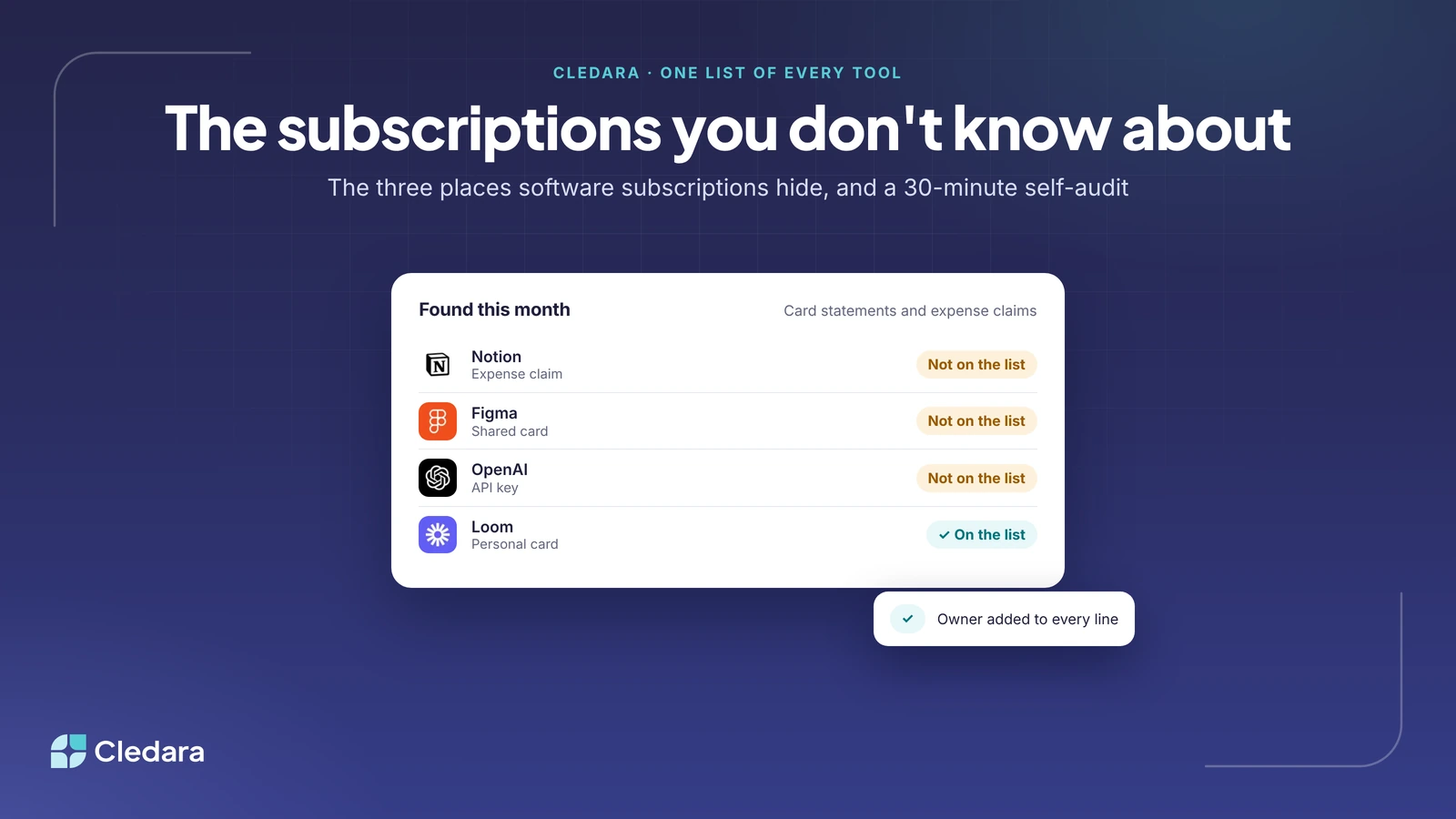
Finance teams discover software subscriptions by invoice because buying is distributed and nobody holds the whole list. Cledara data shows the median company paid for 27 software tools between May and October 2026, and a quarter paid for 40 or more. Unknown subscriptions hide in three places: personal cards and expense claims, shared or legacy company cards, and API keys on usage-based accounts. A 30-minute audit of card statements, expense claims, API accounts and the leavers list finds most of them. The lasting fix is an owner and a payment method per subscription, so every new tool is on the list the day it is bought.
Department Software Budgets That Survive Contact With Real Billing Dates
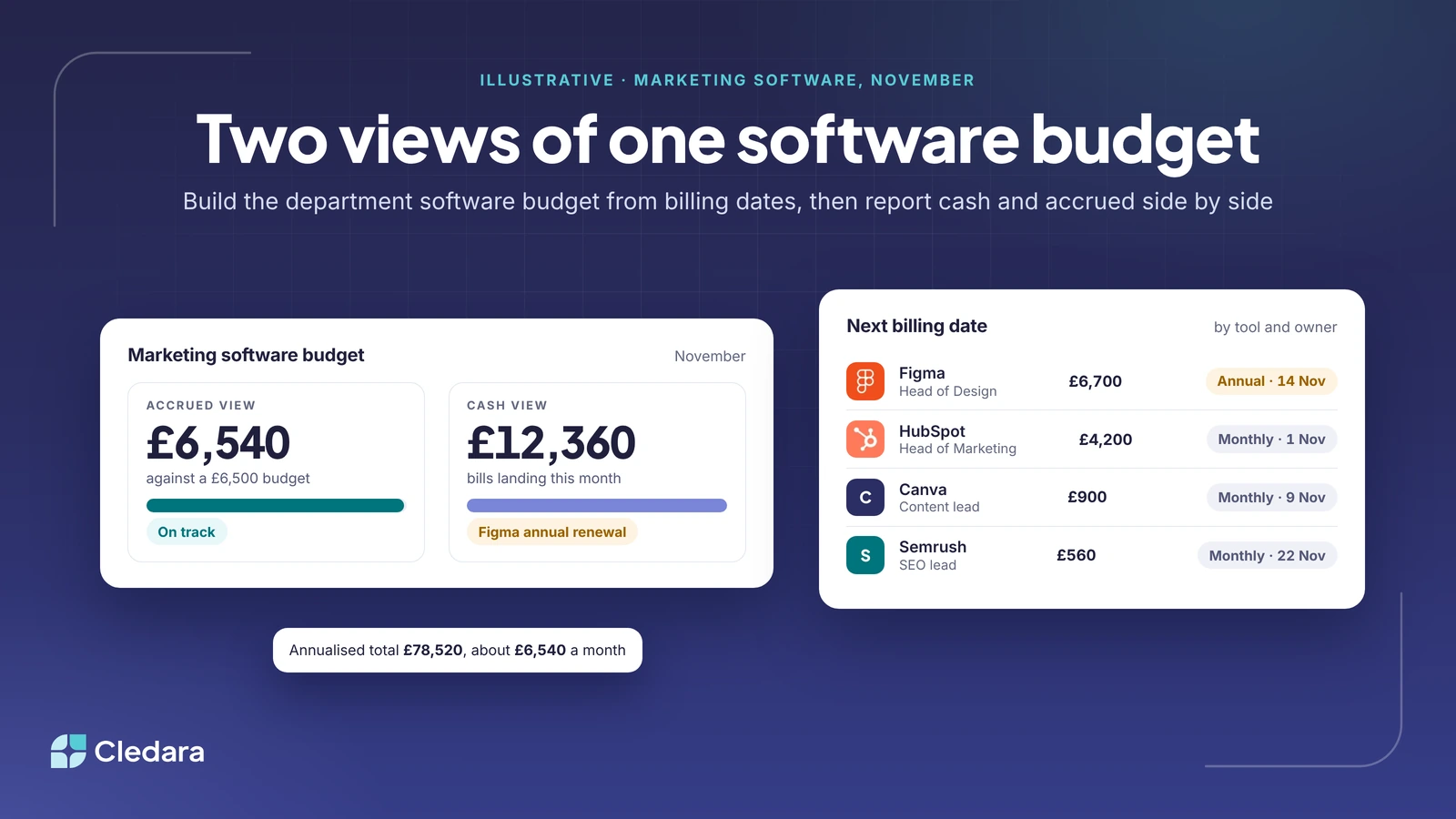
A department software budget usually fails in its second month because it was built from averages, and annual renewals, usage-based tools and mid-month starts don't arrive in averages. This guide shows how to build each team's budget from a list of tools with their billing cycle and next payment date, report two views of the same numbers (cash for the CFO, accrued for team leads), put budgets and alerts on each subscription rather than the department, and run a 20-minute monthly review. It includes a copyable template and the mistakes that quietly undo the whole thing.
Why Your AI Bill Is a Black Box (and the Five Numbers That Open It)
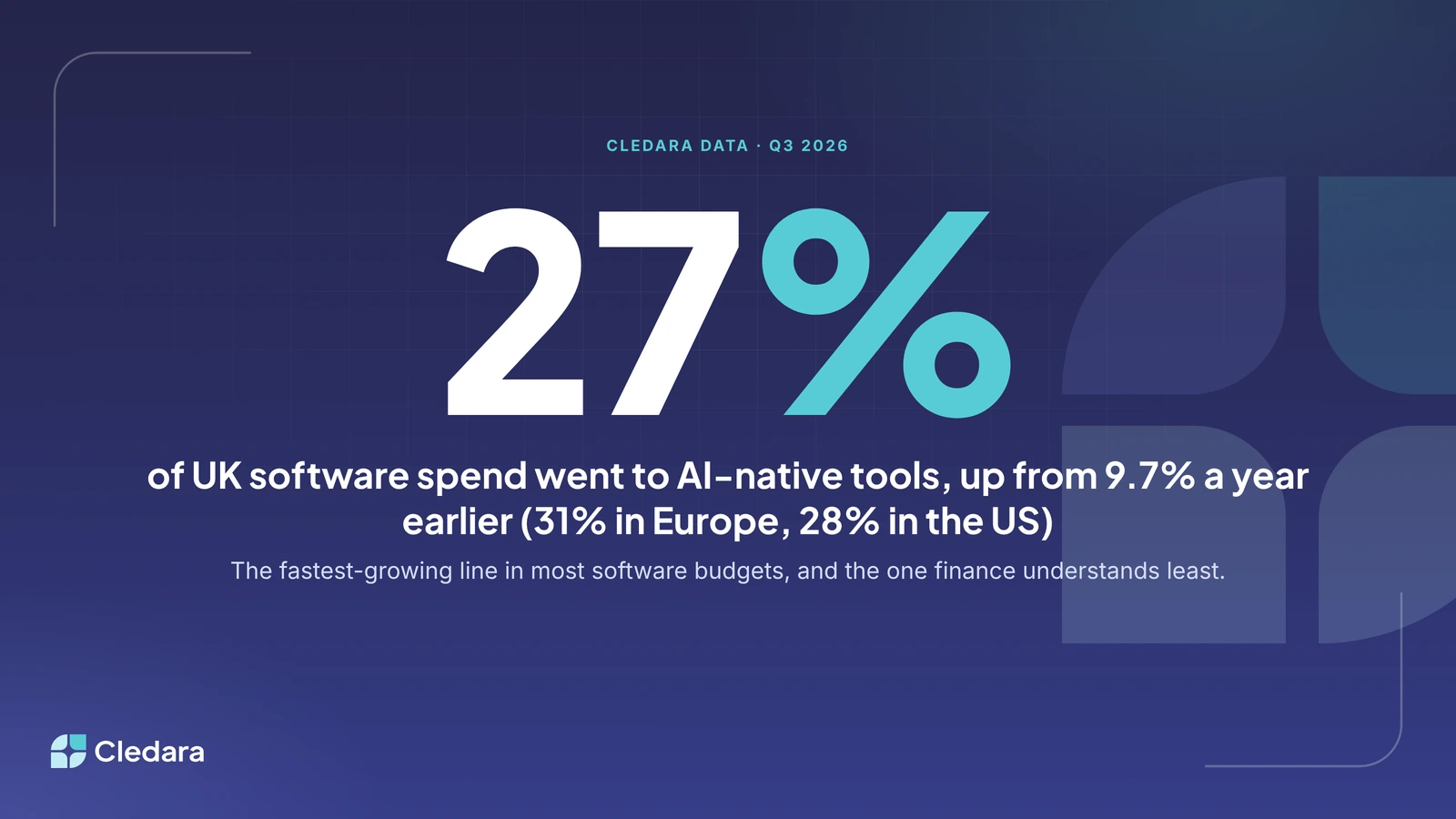
AI spend is a black box because it is metered rather than seat-based, bought by engineers on API keys, and reported monthly by dashboards built for developers. Cledara data shows AI-native tools took 27% of UK software spend in Q3 2026, up from 9.7% a year earlier, and that they pay every 5.6 days on average. Five numbers make it readable: spend by model, by project or key, by person, by day, and against budget. Start with one API key per project, an owner and a budget for each, and a daily view that warns before the money runs out.
How to Make the Business Case for Cledara to Your CEO (Email Template Included)
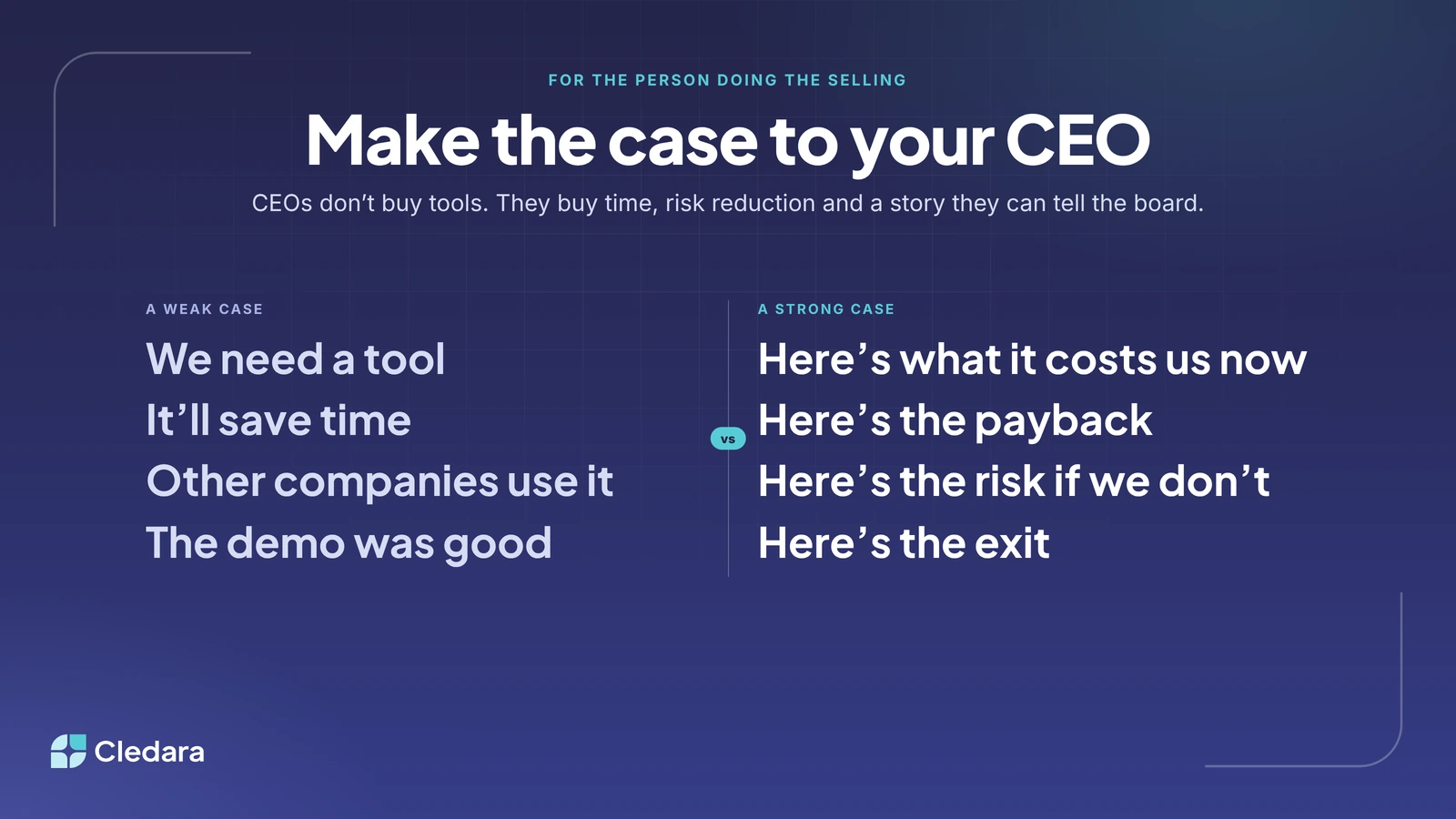
CEOs don't buy tools; they buy time, risk reduction and a story for the board. A strong business case for software subscription management fits on one page: the problem in numbers, the cost of doing nothing, what changes, the payback, the risk and exit, and a clear ask. You can collect every number in an afternoon from the bank feed and HR. Cledara customers save 23% of software spend on average and get 30+ hours a month back; put your own numbers next to those, answer the "too small" and "spreadsheet" objections in advance, and send a short email with a specific ask. The template is in the post.
Who Actually Owns Your Software? Fixing the Ownership Gap Behind Missed Renewals and Missing Invoices
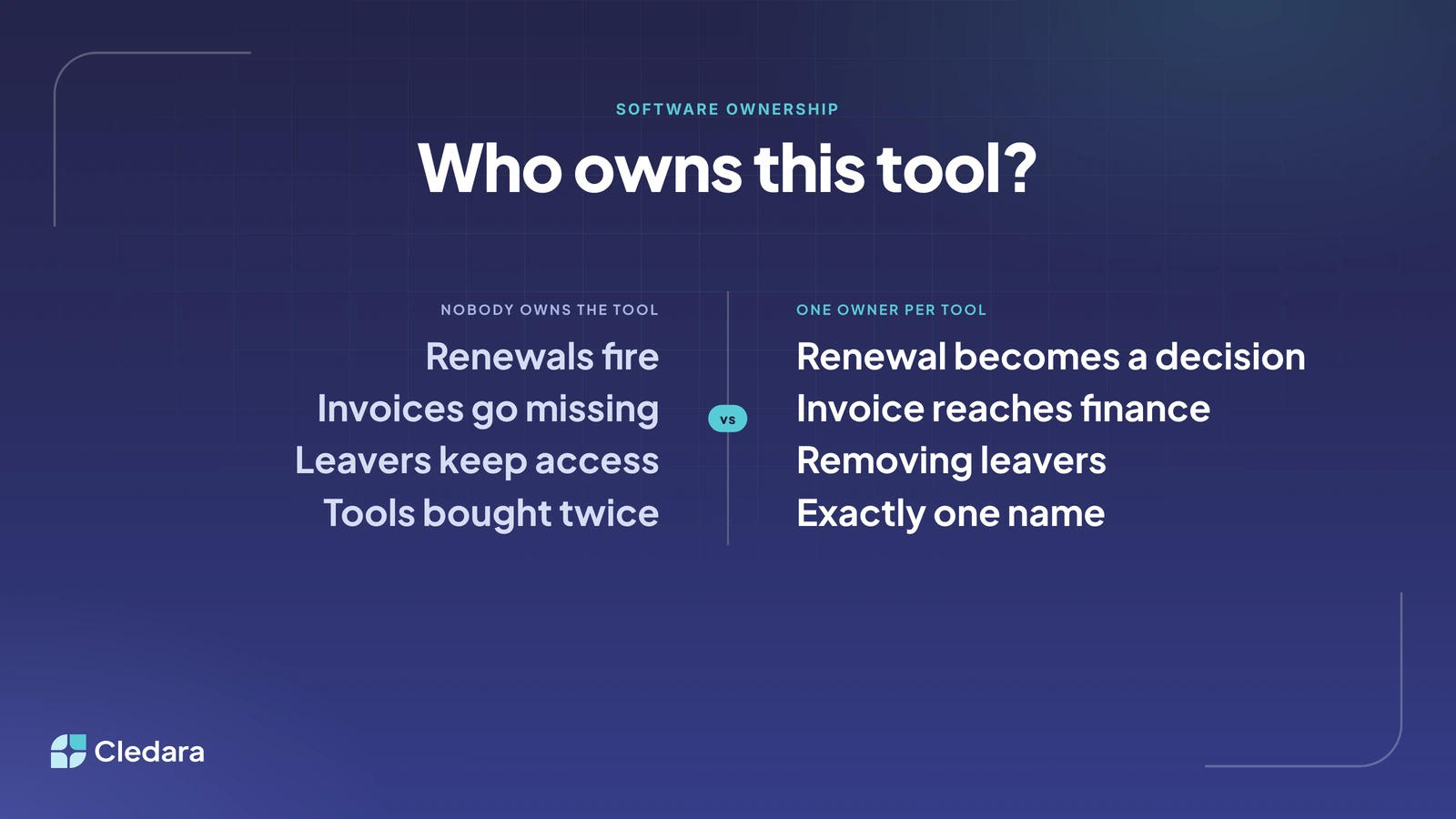
Software ownership means one named person is accountable for each tool: its users, cost, renewal and invoice. In most growing companies nobody has that job, because software moved from IT to every team while the idea of an owner stayed behind. The result is renewals that fire without a decision, invoices stuck behind someone's login, leavers who keep access and tools bought twice. The fix is a short ownership model: the budget holder owns the tool, finance owns the list and the process, IT owns security and access. Cledara data shows the median company pays for 32 software tools, so assign owners from the payment data, give them a 90-day renewal reminder, and reassign tools the week someone moves on.
Should You Outsource Your SaaS Negotiations? Negotiate for Me or Keep the Relationship
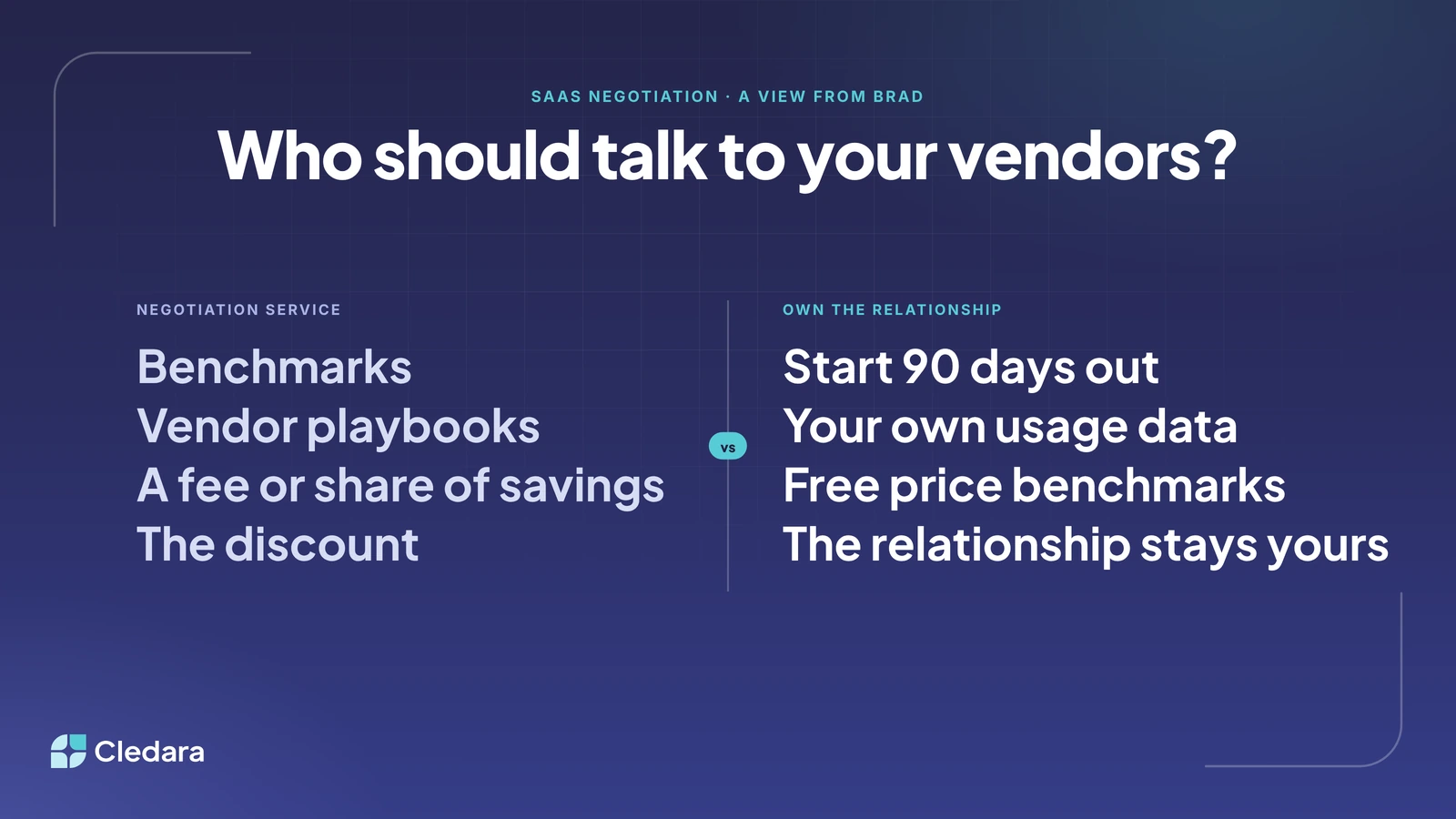
A SaaS negotiation service can win real discounts on large enterprise contracts, but the negotiation is a one-day event and the vendor relationship runs all year. For most growing companies the better answer is to keep the conversation yourself and hand the preparation to software. Cledara data shows timing matters more than skill: companies that start renewals 90 days out save about 49% on average, against 19% for those that start later. Free price benchmarks at data.cledara.com and a copilot that drafts the renewal email give finance most of what a service offers, without giving up the relationship.
SaaS Management Pricing: Flat Fee, Per User or Per Transaction?
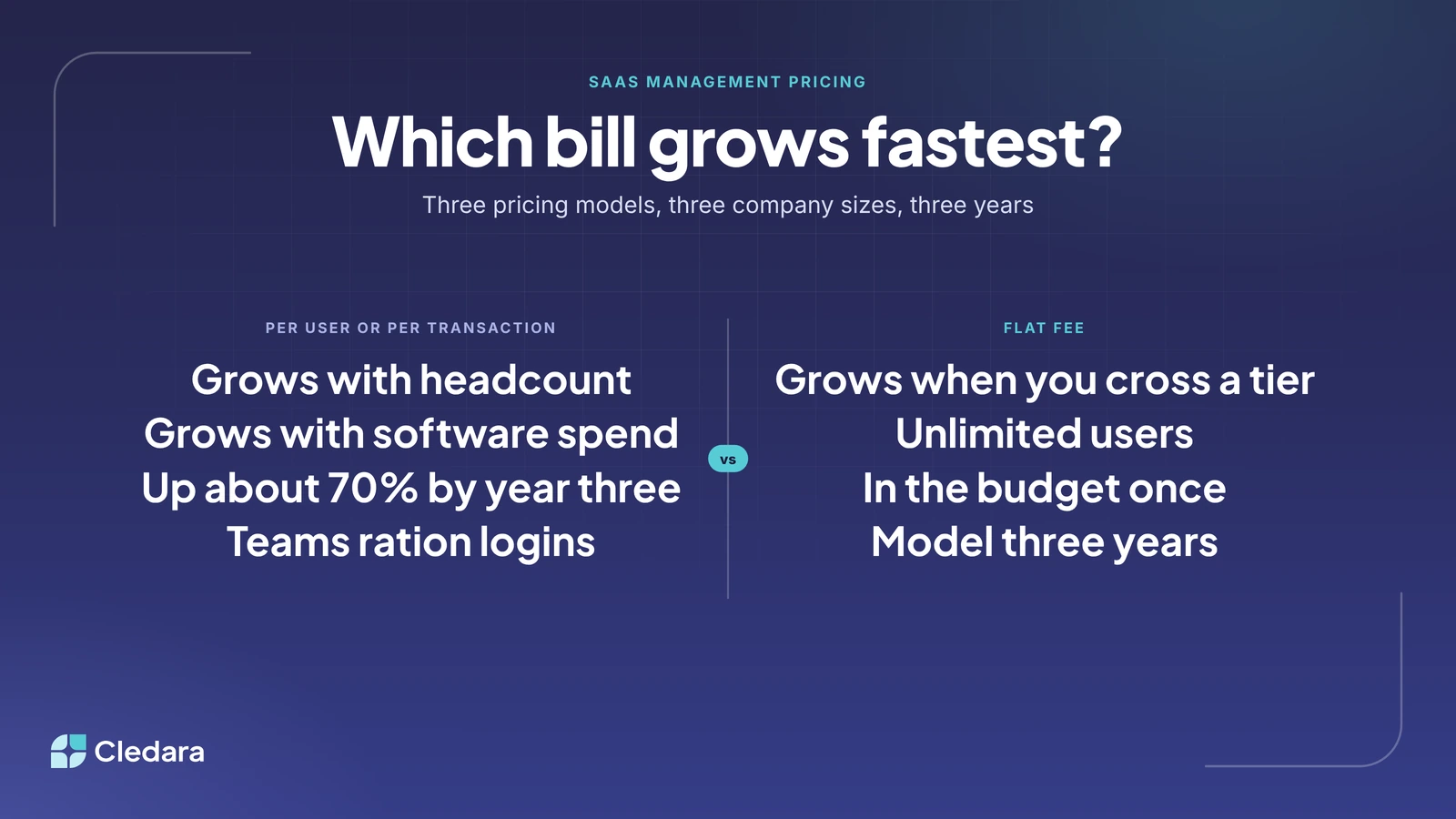
SaaS management pricing comes in three shapes. Per-user pricing grows with headcount, per-transaction or percentage-of-spend pricing grows with software spend, and a flat fee grows only when you cross an application tier. In an illustrative three-year model, the smallest company pays least on a percentage model while the largest pays less than half as much on a flat fee as on per-user pricing. The right model is the one indexed to whatever grows slowest in your business, which for most scaling companies is the number of applications. Add implementation, card, FX and module fees before comparing quotes.
One Card Per Subscription: Virtual Cards for Subscriptions and When a Hard Limit Bites
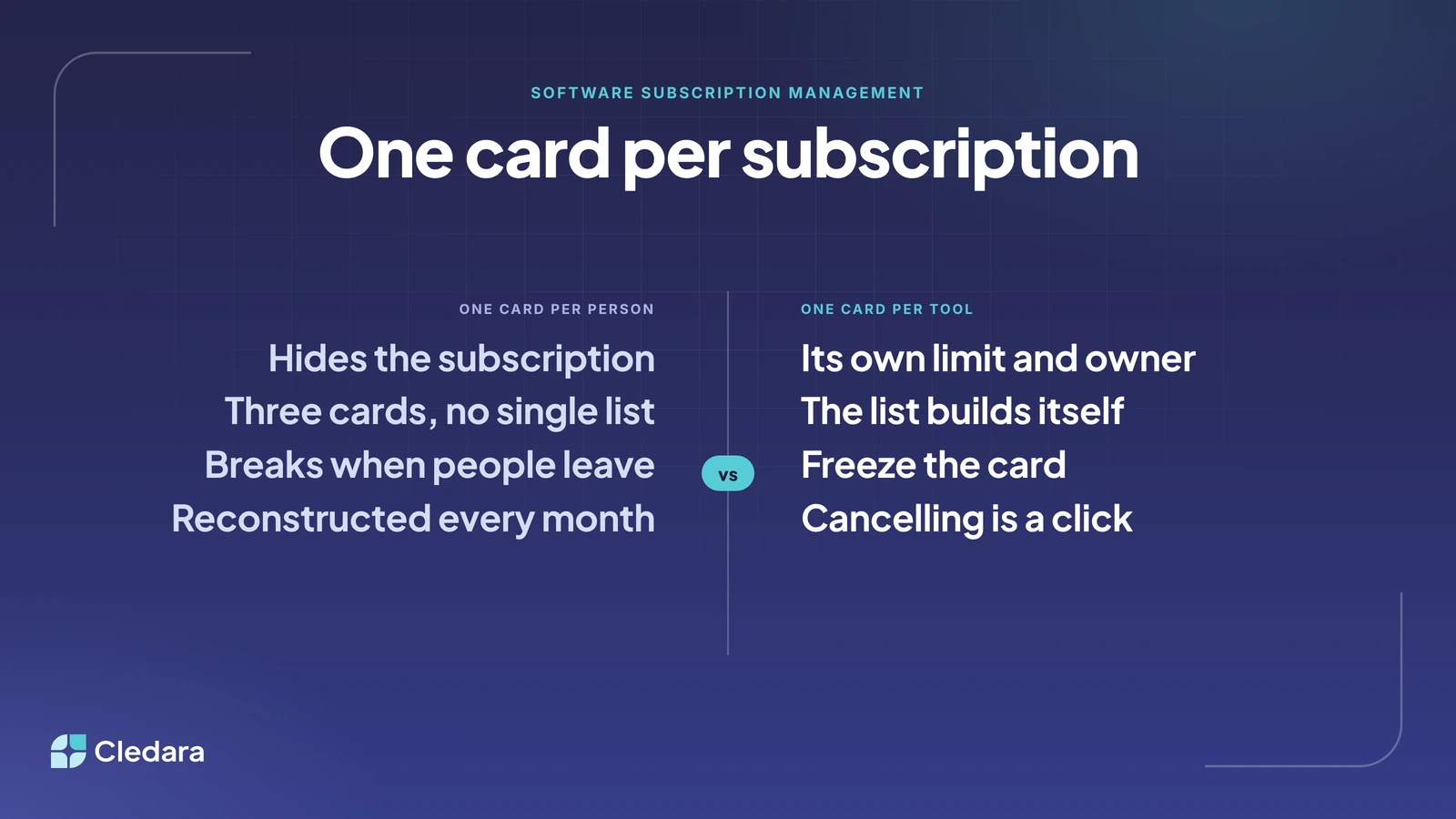
Giving every software subscription its own virtual card, with its own limit and owner, turns a pile of statement lines into a live list of what you pay for. It stops tools failing when a cardholder leaves and makes cancelling a click. The one judgement call is the limit: fixed limits suit seat-based tools with predictable bills, while cloud, advertising and AI tools that charge as usage builds need soft limits with alerts, because a declined payment there is an outage rather than a saving. Cledara data shows about 77% of UK software spend runs on soft limits, and AI-native usage subscriptions pay on average every 5.6 days.
Offboarding Is a Finance Problem: What Leavers Cost in Unused Software Seats
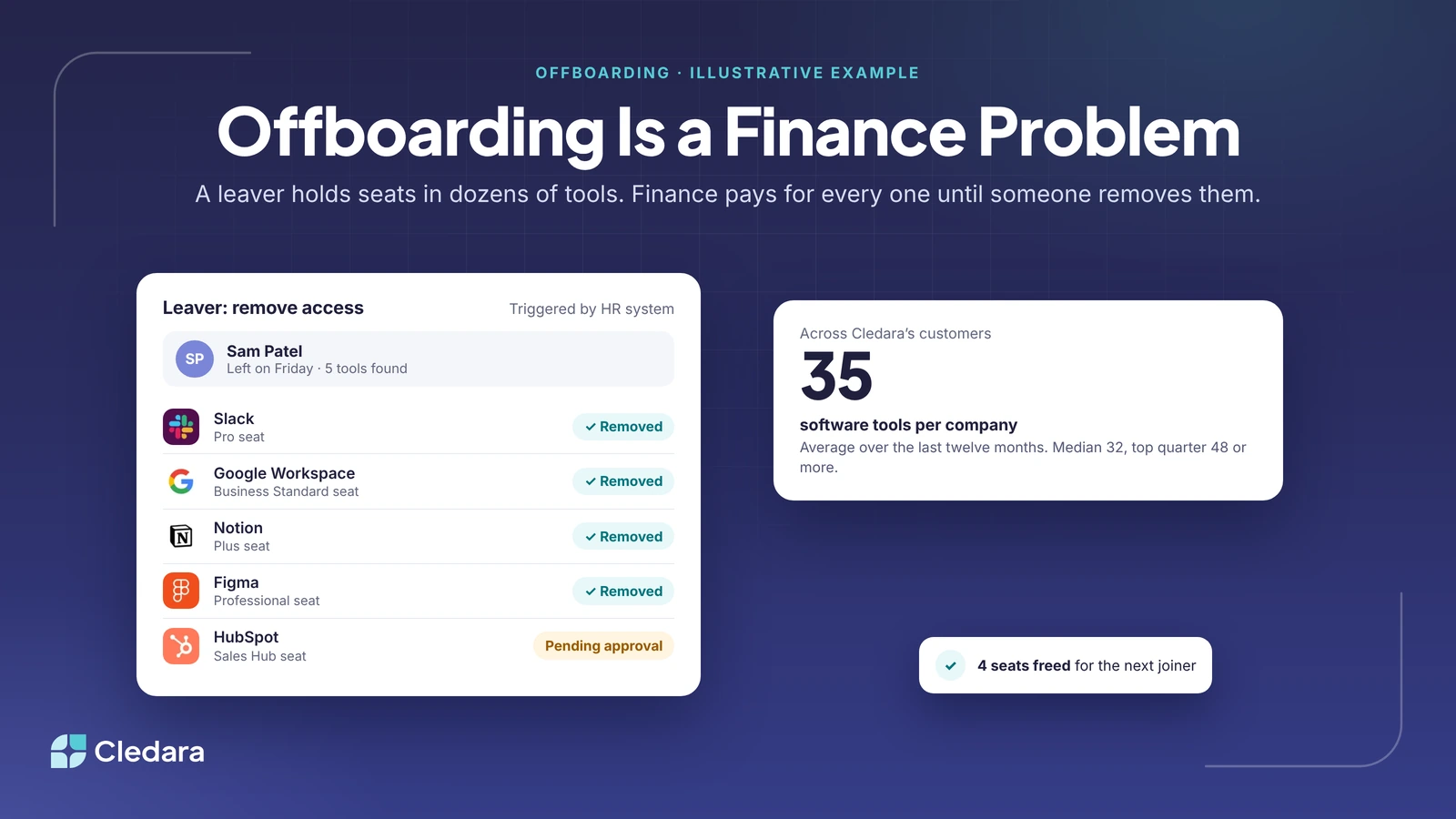
Offboarding software licences has become a finance problem because finance is the team that sees the invoice. The average company on Cledara pays for about 35 software tools, so a leaver typically holds seats in dozens of them, and a June 2026 survey found 48% of former employees still had SaaS access months after leaving. The fix is a five-step leaver checklist that finance owns alongside IT: make the HR system the trigger, keep one list of who has access to what, never tie a subscription to a person's card, reclaim seats on day one and reconcile paid seats against headcount every month. Automated, a leaver becomes a budget event rather than a scramble.
How to Reduce Software Costs: 14 Ways That Work in 2026
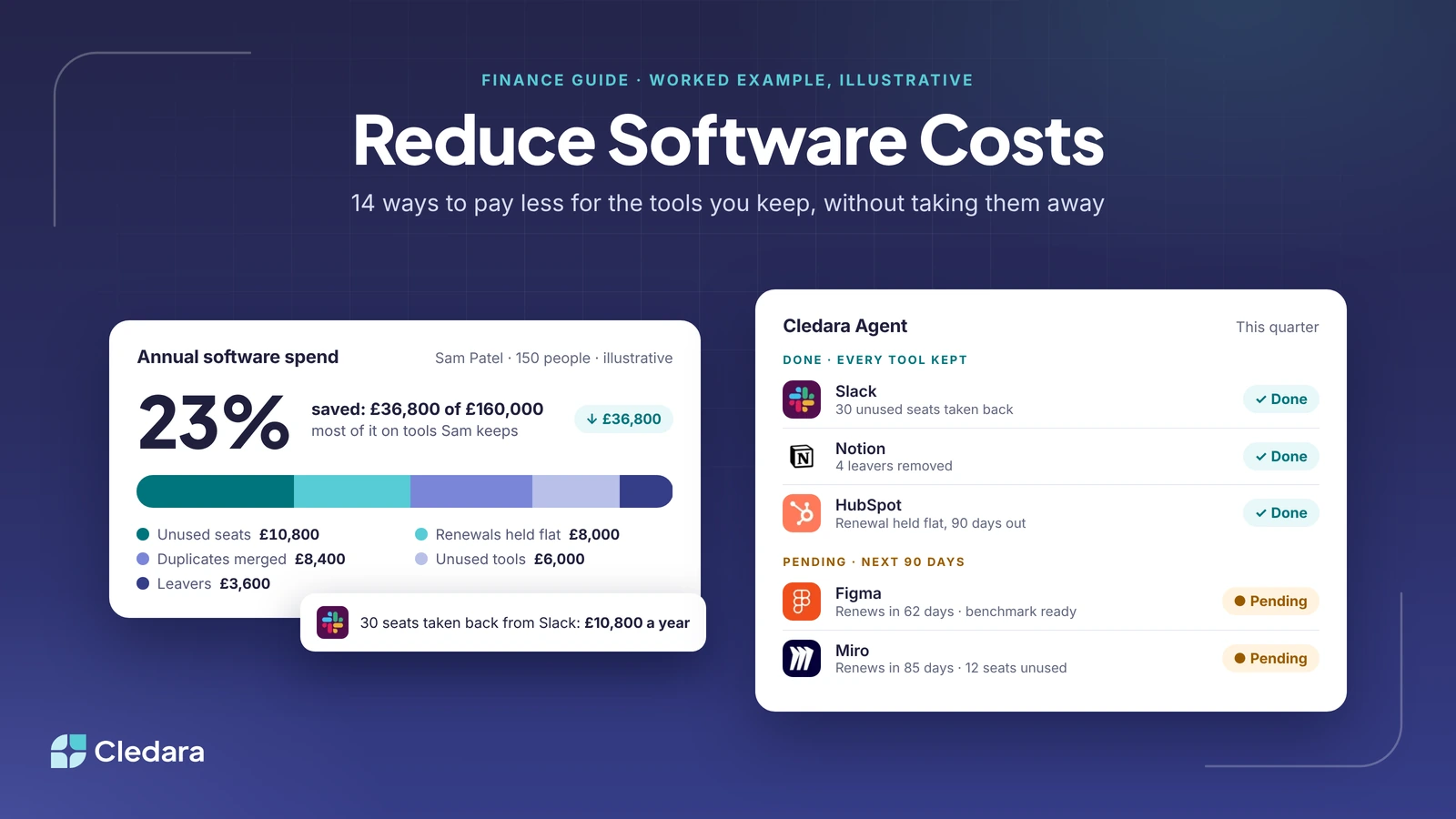
To reduce software costs, put every tool on one list with an owner, then pay less for what you keep: take back unused seats, remove leavers from every tool and renegotiate renewals 90 days out with price benchmarks. Cancel tools nobody uses and merge duplicates. Most of the saving sits in the tools you keep, so you can reduce software costs without cutting the tools people rely on. Cledara, software subscription management for finance teams, does this in one place: it flags duplicates, unused seats and price increases, alerts owners before every renewal, takes back seats with Cledara Agent and cancels a tool in one click by freezing its card. Cledara customers save 23% on software spend on average.
How to Benchmark SaaS Spend: A CFO's Guide With 2026 Data
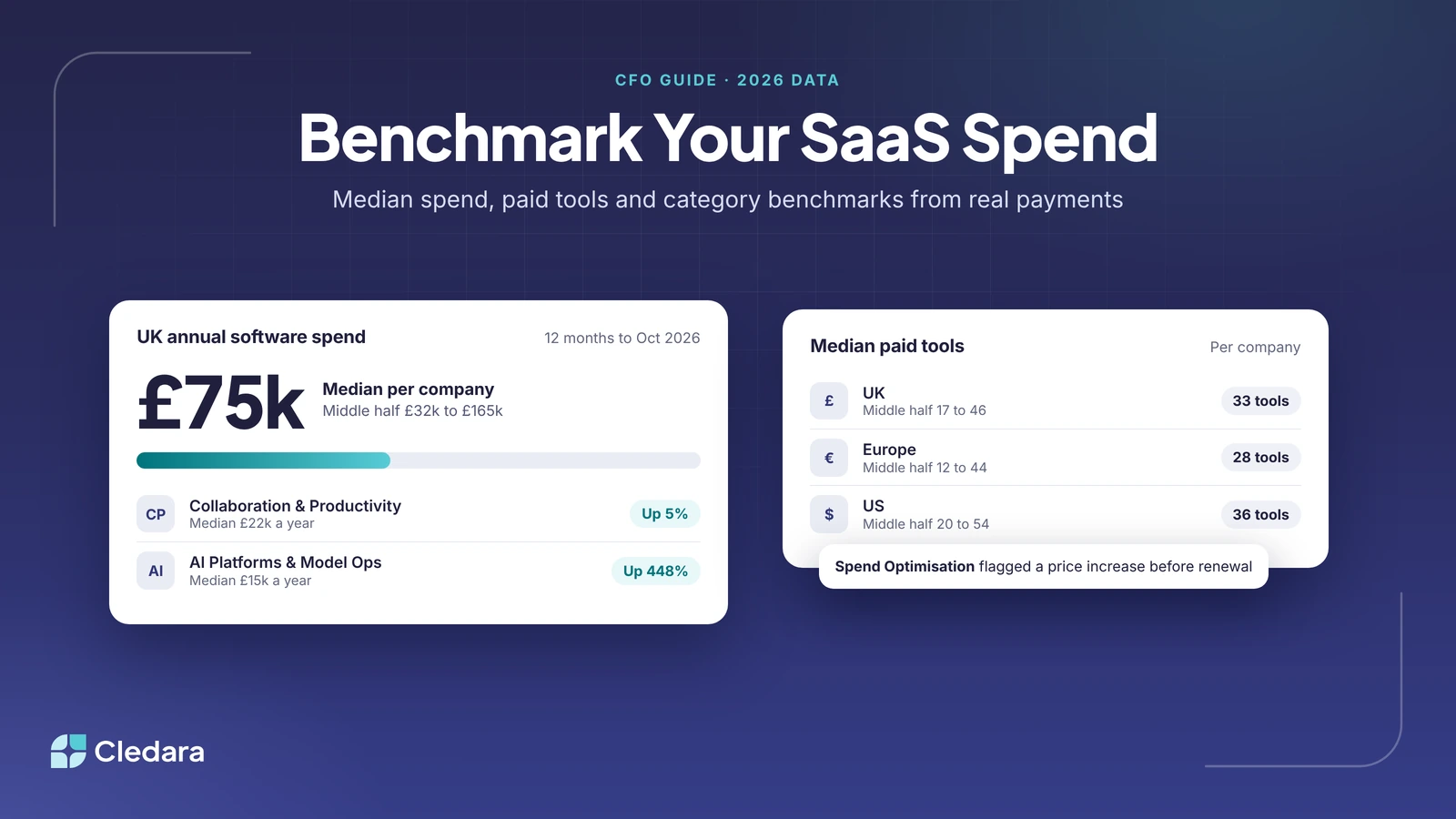
To benchmark SaaS spend, compare four numbers with similar companies: total software spend (and spend per employee), paid tools, spend by category and the price you pay for each tool. Cledara's Spend Optimisation add-on benchmarks what you pay for each tool against what similar companies pay, and data.cledara.com publishes free spend benchmarks from real payments. In the 12 months to October 2026, the median UK company spent £75k on software subscriptions (middle half £32k to £165k) and paid for 33 tools. The median was €64k and 28 tools in Europe, and $162k and 36 tools in the US.
Multi-Entity SaaS Management for Agency Groups and Holding Companies
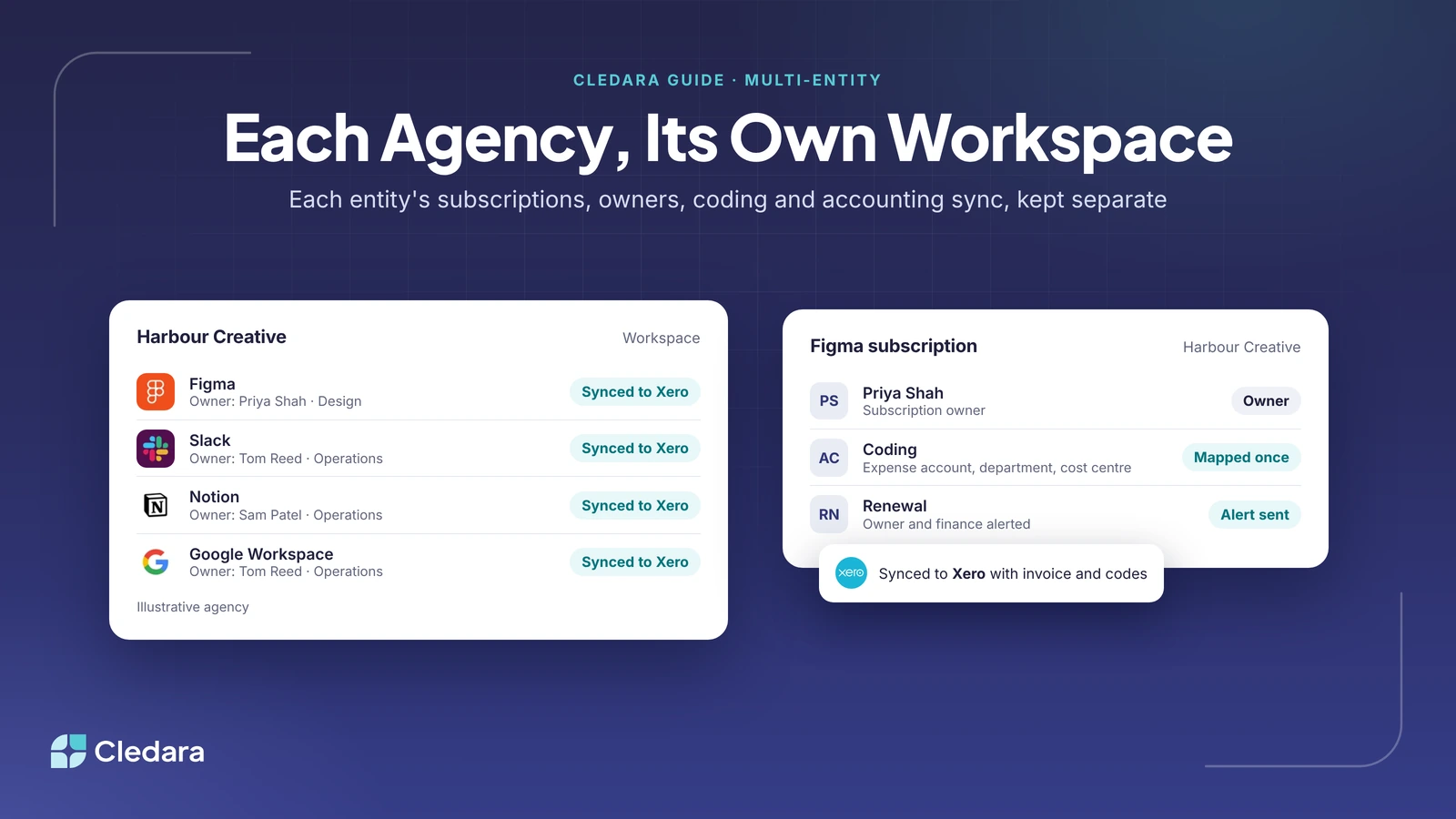
Cledara manages software subscriptions across several companies, agencies or entities. Each entity has its own workspace in Cledara, with its own spend, owners, coding and accounting sync, and one login reaches them all. Because every workspace has the same fields, an agency group or holding company can compare what each agency pays for, spot the same tool bought in several agencies, plan group-wide deals before renewals, and code client-specific tools so they are ready to recharge. Multi-entity set-up is agreed with Cledara's team, so talk to Cledara about your structure.

How to Reconcile Card Transactions With Your Accounting Software
To reconcile card transactions with your accounting software, match every card payment to its invoice, code it to the right account, department and cost centre, and confirm it against the card statement. For software, Cledara automates the whole job: each subscription is paid with its own virtual card, invoices are captured from email, a forwarding inbox or vendor billing pages by Cledara Agent, and every payment syncs to Xero, QuickBooks Online, NetSuite or Tripletex with its invoice attached and its codes already on. Finance reviews the exceptions instead of matching hundreds of lines by hand.
Cashback vs Spend Control: Which Saves Finance Teams More?
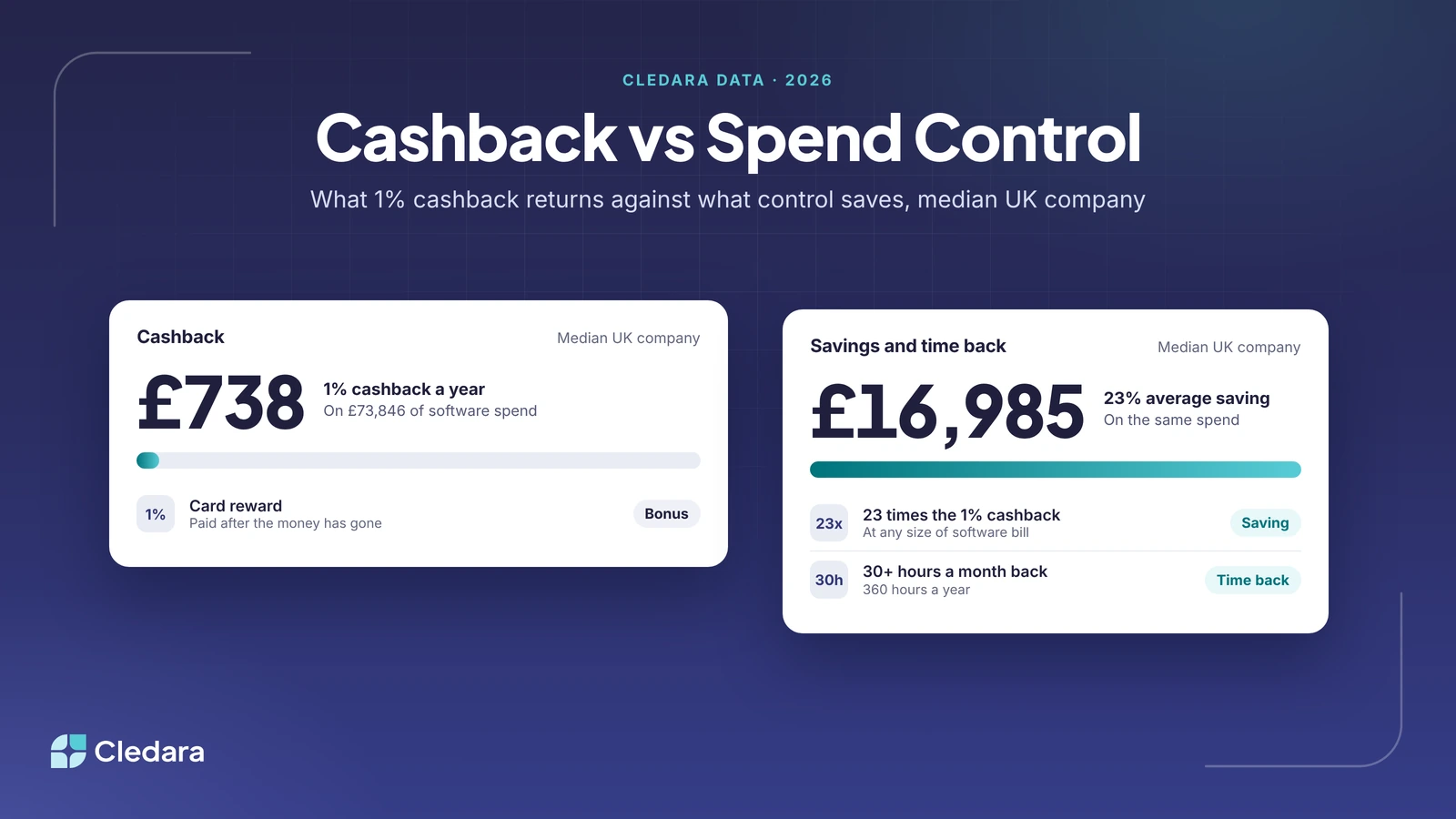
Spend control is better for almost every finance team: card cashback on software spend usually returns 1 to 2% of what you pay, while Cledara customers, who control each subscription with approvals, owners and renewal alerts, save far more. On the median UK company's annual software spend of £73,846, 1% cashback is £738; the 23% that Cledara customers save on average is £16,985, and a typical customer also gets 30+ hours a month back. Cashback only matters for the smallest companies, and even then as a tiebreaker. Cledara, software subscription management for finance teams, puts control and automation first.
How to Collect SaaS Invoices From Every Tool (Without Chasing)
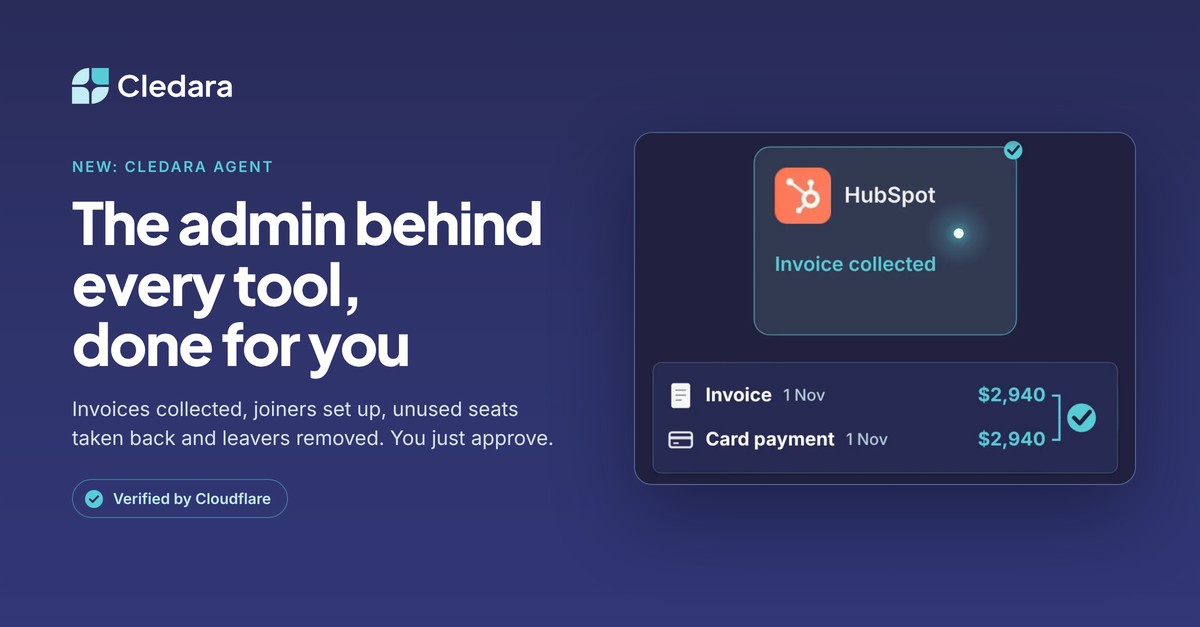
To collect SaaS invoices from every tool, send them all to a shared billing mailbox, change the billing email in each tool, give every tool an owner and do a monthly round of vendor billing pages for the invoices that are never emailed. Then match each invoice to its payment and the right entity before month-end. A card statement isn't enough for UK VAT: HMRC treats the VAT invoices you receive as the primary evidence for reclaiming VAT, and says statements from ordinary purchasing, charge and credit cards are not acceptable for VAT purposes. Automation can capture emailed invoices and collect the rest from billing pages.

Spend Management Software vs Subscription Management: 8 Tools
Spend management software, such as Pleo, Spendesk, Payhawk, Ramp, Brex, Soldo, Moss and Airwallex, controls company spending: cards, expenses, reimbursements, bills and purchase approvals. Software subscription management controls every SaaS and AI tool as a subscription: its owner, users, seats, renewal date and invoices, plus joiners and leavers. For software, Cledara keeps every SaaS and AI tool on one list with its owner, renewal alerts and invoices; it is rated 4.6 from 251 G2 reviews and is a G2 Leader for mid-market SaaS spend management. Spend tools do the spend stuff; Cledara does the subscription stuff, and many finance teams use both.

Software Tail Spend: Why It Matters and How to Manage It
Software tail spend is the long tail of small, low-cost subscriptions that people across a company buy on cards and expenses. Each tool is too small to need approval, but together they make up a real share of software spend and much of the admin: duplicates, renewals nobody owns, invoices behind vendor logins and access that outlives leavers. Across UK companies on Cledara, the 2,781 vendors outside the top 50 shared 34% of software spend between October 2025 and September 2026. To manage it, build one list of every subscription, give each an owner and its own card with a limit, set renewal alerts and automate invoice capture.

SaaS Budget: How to Forecast Software Costs for 2027
A SaaS budget lists every software subscription with its owner, billing type, renewal date, current annual cost, expected price uplift and planned seats, then adds them up into next year's forecast. Build it in five steps: list every subscription, price each line and find its renewal date, decide what stays, forecast each line, then set owners and a monthly review. Budget renewals 8 to 12% above today's price and forecast usage-based AI costs separately. For context, the median company pays for 32 tools and spends £73,846 a year on software in the UK, €60,444 in Europe and $146,344 in the US.

CFO Report Examples: 3 Free Templates for Monthly and Board Reports
A CFO report tells the leadership team, board or investors how the business performed against plan, why, and what happens next. It should include an executive summary, results against budget and the prior period, cash and runway, the KPIs that matter, variance commentary, an updated forecast, and the risks and decisions ahead. Most finance leaders need three versions: a monthly management report, a board pack for directors and a one-page investor update. This post gives you a copyable template for each, a one-page template for software and AI spend, and a worked example of variance commentary.

CFO Performance Metrics: 20 KPIs to Measure a Finance Leader
CFO performance metrics work on two levels. The first is the company KPIs a CFO owns: cash runway, operating cash flow, margins, growth, burn multiple, forecast accuracy and days to close. The second is the quality of their leadership: reporting, strategic input, team management and risk control. To measure CFO performance fairly, agree goals and baselines at the start of the year, score the numeric KPIs each quarter, and gather structured feedback from the CEO, board and finance team. Most CFOs should track 8 to 12 core KPIs in depth, drawn from six groups: liquidity, profitability, growth, efficiency, forecasting accuracy and finance operations.

Budget Reporting: How to Build a Budget Report (Free Template)
A budget report compares what you planned to spend and earn with what actually happened in a period, usually a month or a quarter. For each line it shows the budget, the actual, the variance in money and as a percentage, a short commentary on the cause and the owner who will act. Good budget reports explain only the variances that pass a set threshold, separate timing from permanent changes and end with an updated forecast. Software subscriptions and AI tools deserve their own lines, because monthly billing, renewal price rises and fast-growing AI usage make them drift from budget faster than most costs.

The 13 Best FP&A Software Tools for 2026
The best FP&A software in 2026 depends on your size and how your team works. Enterprises planning across functions should shortlist Anaplan, Workday Adaptive Planning, Pigment or Jedox. Mid-market teams that want planning, close and reporting in one suite should look at Planful, Prophix One or, on NetSuite, NetSuite Planning and Budgeting. Excel-first teams suit Vena, Datarails or Cube, and scaling companies replacing spreadsheets should try Abacum, Aleph or Drivetrain. None of them showed list prices when we checked, so test each tool on your own numbers and make sure the data you feed it, including software subscriptions, is accurate.

Shadow AI: The Finance Leader's Guide to Managing Unsanctioned AI Spend
Shadow AI is one of the fastest-growing categories of unmanaged software spend. This guide breaks down why shadow AI is primarily a finance problem (not just a security concern) and provides a practical 4-step framework for discovering, quantifying, governing, and optimising AI spend.
AI Spend Benchmarks: How Much Are Companies Spending on AI in 2026?
How much should your company be spending on AI tools? This data-driven analysis combines Cledara platform data with industry research from Gartner, IDC, and Zylo to deliver practical AI spend benchmarks for mid-market companies. Key findings: 79% of companies on the Cledara platform pay for at least one AI tool, with the average adopter spending $15,300 per year across 3.7 subscriptions. General-purpose AI (OpenAI, Claude) accounts for 72% of AI budgets, while AI coding tools like Cursor represent the fastest-growing category at 18%. AI now represents 5.6% of total SaaS spend, growing at over 100% year-over-year compared to 19% for overall SaaS. The post covers benchmarks by company size, category breakdowns, warning signs of overspending, and how to bring AI costs under control.
The CFO's Guide to AI Investment: Measuring ROI on AI Tools
Only 29% of executives can confidently measure their AI tool ROI, yet AI spending continues to accelerate across companies of every size. This guide gives finance leaders at 30 to 500 employee companies a practical four-step framework for measuring AI investment returns. Learn how to categorise AI tools by business function, define measurable outcomes for coding tools, content tools, analytics platforms, and general-purpose assistants, calculate true total cost of ownership beyond licence fees, and build the per-tool scorecard and board reporting your investors expect. Includes real pricing benchmarks, ROI calculation examples by tool category, red flags that signal wasted spend, and a quarterly review cadence for ongoing AI portfolio management.
SaaS Management for Finance Teams: A CFO's Complete Guide
SaaS management for finance teams goes beyond IT visibility. This guide covers the four core finance use cases, from budget forecasting and cost allocation to renewal management and audit readiness, with practical guidance on what CFOs should look for in a platform. Based on Cledara platform data showing companies manage an average of 35.8 software vendors, and industry research indicating 51% of SaaS licences go unused, the post makes the case that finance teams need purpose-built tools, not repurposed IT solutions. Includes specific evaluation criteria for accounting integrations, spend controls, benchmark pricing, and approval workflows, plus a detailed breakdown of how Cledara addresses each finance use case.

The Controller’s Guide to SaaS Expenses: Amortization, Accruals, and the End of the Spreadsheet
Struggling with SaaS accruals and prepaid amortization? This guide covers the accounting rules for software subscriptions (ASC 606/350-40), the risks of spreadsheet schedules, and how to automate your month-end close.

How To Calculate Revenue Growth
Revenue growth is the cornerstone of business success, serving as a crucial indicator for investors and a key metric for measuring sustainable performance over time.

Tech CFOs in 2025: Balancing Innovation and Resilience
As CFOs step into 2025, they are no longer just financial stewards but strategic leaders navigating a rapidly evolving landscape of AI-driven automation, economic volatility, and growing ESG responsibilities

Statement of Retained Earnings: How to Gain Insight into Invested Profit
A statement of retained earnings is a crucial financial document that reveals how much profit your company keeps for reinvestment after paying dividends.

What Is Annual Revenue? The Founder’s Guide to Financial Literacy
In this article, we break down annual revenue, what it is, why it matters, and how to calculate it, to help you assess your company's financial health with confidence.

Planning, Budgeting, and Forecasting: How CFOs Can Set, Strategize, and Forecast the Future
Master the differences between planning, budgeting and forecasting, and discover how they drive financial success.

How to Calculate Opportunity Cost for Your SMB + Real-Life Examples
Understand opportunity cost, how to calculate it, and why it matters. Plus, discover how Cledara can complement your financial decision-making toolkit.

How to Outsource a CPA for Your Startup: 5 Key Criteria
Outsourcing your accounting to a CPA can save time and resources—here’s how to find the best fit for your startup.

Win Customers in Competitive Markets with Penetration Pricing
Penetration pricing is a powerful strategy to attract customers and dominate new markets by launching products at competitive, low prices—learn how it works and why it could be your next big move.

The What, Why, and How of Unit Economics
Is your business truly profitable at the unit level? In this post, we’ll unpack how unit economics provides the insights you need to make smarter financial decisions and drive sustainable growth.

CFO Dashboard: What it is and Why You Need One
Spreadsheets can only take you so far—discover how a CFO dashboard can transform the way you manage financial metrics, automate tasks, and optimize decision-making.

A Guide to Virtual Debit Cards: All You Need to Know
If your business is tired of dealing with the hassle and risks of physical cards, virtual debit cards offer a secure, efficient solution for managing spending online and in-person.

Revenue Multiples: The Pros, the Cons, and How to Calculate Yours
Discover revenue multiples as a key valuation method for early-stage companies, what they are, their pros and cons, how to calculate them, and the factors that impact their effectiveness in startup valuation and funding.

How to Identify and Prevent Expense Reimbursement Fraud
We explore the various types of expense reimbursement fraud, their potential cost to organizations, and provide practical strategies for identifying and preventing such fraudulent activities in the workplace.

How to Become a CFO in Tech: An Analysis of 100+ Careers
A comprehensive analysis that examines the career paths of over 100 CFOs in the technology sector, providing valuable insights into education, experience, and skills required to reach this pivotal leadership role in today's fast-paced tech industry.

A Thorough Guide to Automated Invoice Processing
Automated invoice processing can revolutionize your business's financial operations by streamlining workflows, reducing errors, and saving valuable time and resources.

Venture Debt: Raising Funds for Your Early Stage Startup
A financing option for startups and small businesses that allows them to access funds without diluting equity, providing a valuable tool for growth, cash flow management, and runway extension.

OTE (On-Target Earning): What It Is and How It Works
OTE (on-target earning) is a payment model consisting of base salary and commissions. Here's how to calculate it and present it to your employees.

Month End Without the Headache: How to Automate Your Accounting
As companies grapple with the overwhelming increase in SaaS subscriptions—from eight in 2015 to an average of 130 in 2022—effective management tools like Cledara are becoming essential for streamlining software spend and enhancing financial efficiency.

The Rise of Finance AI Tools: Transforming CFO Operations
AI tools are revolutionizing financial operations by enhancing efficiency, accuracy, and strategic decision-making for CFOs across various domains such as financial planning, compliance, sales forecasting, and more.

A Guide For Your First 90 Days as CFO
Your first 90 days as CFO at a new company set the trajectory of this chapter of your career. Here’s a checklist of how to play these valuable initial weeks for maximum impact.

The 15 Top Podcasts for CFOs in 2024
Level up your knowledge as a finance professional with these 15 leading podcasts for CFOs.

A CFO’s Guide to SaaS Contracts
Here’s what to look for when you sign a SaaS contract—which clauses to read carefully, which to insist upon, and how to come away with a great deal.

What does a great CEO-CFO relationship look like? 10 Tips
As a CFO, you’re the CEO’s right hand person. The company hinges on your working relationship—so here’s how to strengthen it.

The Best Cap Table Management Software: 5 Options for 2024
Essential information on the 5 best cap management software tools for 2024, and why each one could be a great fit for your business.

The Top Subscription Analytics Software for 2024: ChartMogul vs Baremetrics
If you’re a CFO for a tech company, subscription analytics software will make your job a lot easier. Here’s a rundown of two of the best.

The Top Accounts Receivable Software for 2024: Upflow vs Chaser
Here’s everything you need to know if you’re in the market for accounts receivable software and want to make the best choice, with a focus on Upflow and Chaser, two leading options.

How Scaleups Can Maximize Software ROI in 2024
Wondering how to improve software ROI for your company? In this post, you’ll learn everything you need to know to drive maximum ROI from software investments.

A Comprehensive Guide to Key Performance Indicators for CFOs
Here’s 23 KPIs CFOs should track in order to gain a full overview of their business’ financial health.

10 Must-Have Software Tools for CFOs
According to Cledara’s data, these software tools for CFOs are absolutely invaluable. Save time, reduce errors and increase compliance with these programs.

Ramp vs Brex: A Comprehensive Analysis
Which is best for your business, Ramp vs Brex? Our ultimate rundown can help you decide.

Why Treasury and Cash Management Software Is Essential in 2023 [+ Best Tools]
Treasury and cash management are crucial to financial planning. Discover key tools and strategies to optimize your cash management in 2023's unique landscape.

9 Ways Financial Reporting Software Can Help Companies Save More Money
Discover how financial reporting software can help startups save money and streamline operations. With features like expense tracking, account reconciliation, cash flow management, and more, businesses can become more efficient and profitable. Invest in financial reporting software to secure your startup's future.

How to Hire Fractional CFO Services in 2023
Considering outsourcing CFO services? In this guide, you'll learn everything you need to know to hire a great fractional CFO.

Digital Transformation Frameworks for CFOs
We share best in class digital transformation frameworks and the benefits of using one. Make sure you include these 4 things in yours!

Change Management Planning: a Guide for CFOs
Are you implementing a change management plan? Here’s your full guide on where to start and what to include.

How SaaS Management Can Help Startup CFOs During a Downturn
Ensure you have the right software to sustain a downturn.

5 Steps for CFOs Evaluating Payments Software
Turn payment processing from a burden into an advantage.


How to Buy Software? 4 Secrets CFOs Need to Know
The tools you buy as a CFO impact almost everyone in the business. Here are some tips to make the right decision.

5 Signs It’s Time for Startup CFOs to Invest in New Software
How can CFOs identify when it’s the right moment to upgrade their software stack? Let's take a look at some of the signs that can help you decide

What Finance Leaders Need to Look Out for in 2022 {Free eBook}
As we come to the end of the year, find out the five key predictions for finance leaders to stay ahead of the curve in 2022.

The 5 must-have tools for startup and scaleup CFOs
The startup CFO relies on the delicate balance of skill, processes and - the subject of this blog - great SaaS tools.

How Rob Collings, Head of Finance at Flux, manages SaaS subscriptions
How does a Head of Finance keep control of SaaS subscriptions at a skyrocketing Fintech startup? We talked to Rob Collings to find out.

How Lapis Kim, the Head of Finance at Bond, balances SaaS management and business scalability
What’s it really like for a Head of Finance managing SaaS subscriptions day-to-day at a growing company? We talked to Lapis Kim to find out.

The Ever-Evolving Role of Today’s Startup CFO
We’ve taken a look at the evolving role of the startup CFO and the pressing challenges you face today.

Monthly Management Reporting for Startup CFOs
Great startups are powered by great monthly management reporting. Find out what the best startup CFOs include in their reporting.

Meet the Actor That Pivoted Into CFO of a Hot VR Startup
Empathy, infrastructure for scale and the future of virtual reality. What can we learn from someone that began their career as an actor and is now CFO of a hot VR startup?

The Ideal Startup CFO with Xavier Sansó
We talk to Xavier Sansó, founding Partner at Metrix Partners, a boutique advisory firm which provides fractional CFO and financial services to the startup community.

6 Tips for COVID-Era Tech CFOs
We dig into the 6 top things that startup CFOs can do to create value today.