


What are the best AI coding tools by team size? The short answer
Here's a funny thing about AI coding tools. Two years ago they were a line on an engineer's personal card. Now they're one of the biggest software bills in the company, and the best AI coding tools by team size are not the same list at every size. A 50-person engineering team buys differently from a 1,000-person one, and both buy differently from the Fortune 500.
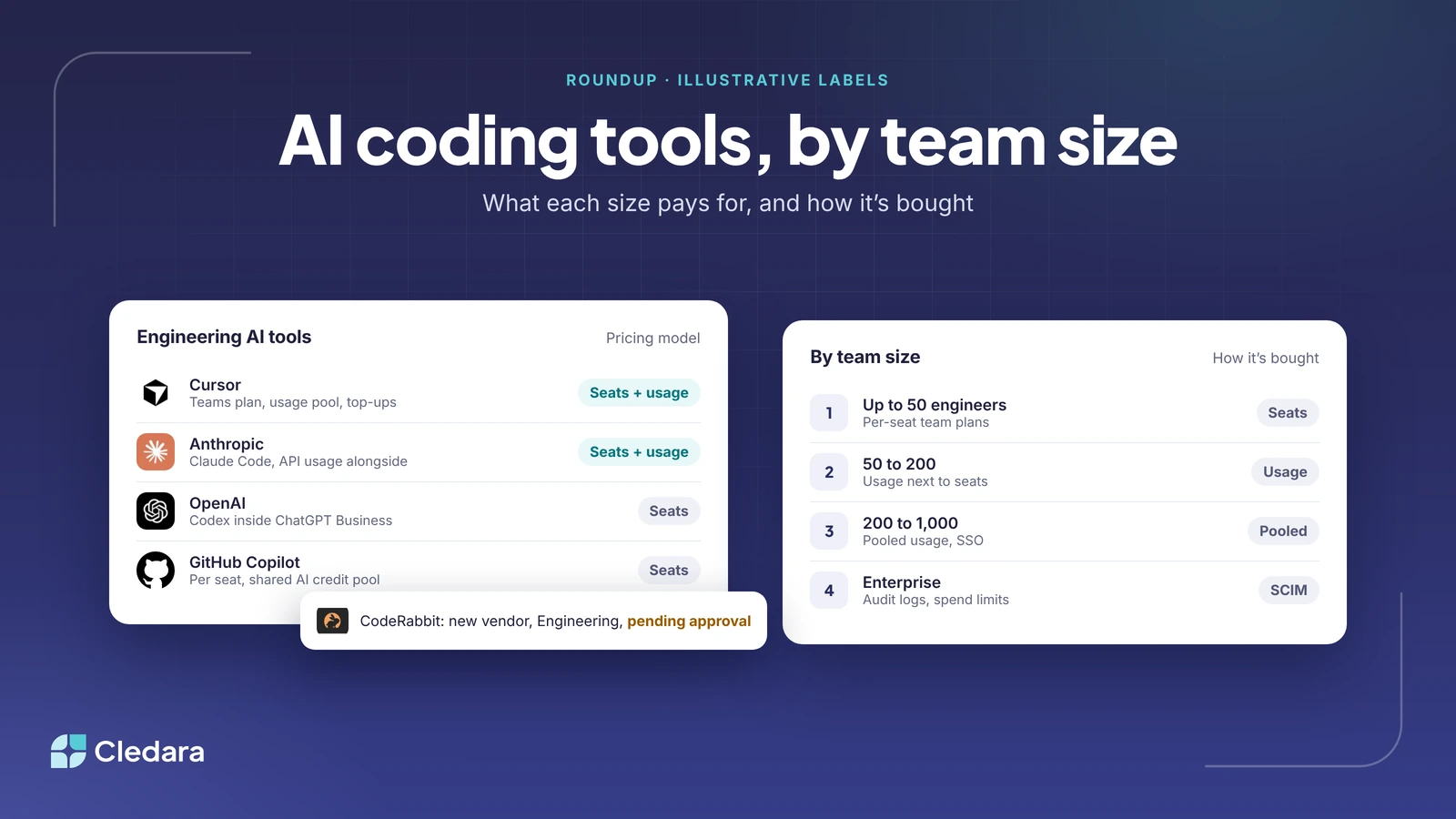
The short version: at every size we see the same four names in the payment data (Cursor, Anthropic's Claude Code, OpenAI's Codex and GitHub Copilot). What changes by team size is how they're bought. Fixed seat plans at the small end, seats plus pooled usage in the middle, and enterprise agreements with SSO, audit logs and spend limits at the top. This post goes tier by tier, using what companies on Cledara actually pay for.
Key takeaways
- Engineering and DevOps tools are about one in five of the software subscriptions held by companies on Cledara, and about 15% of their software spend (data.cledara.com, October 2026).
- Cursor is the fifth most popular software product across companies on Cledara and GitHub (where Copilot is billed) is seventh. Anthropic and OpenAI took 75% of UK AI-native spend from August to October 2026.
- Up to 50 engineers: per-seat team plans, one subscription per tool, one owner each.
- 50 to 200 engineers: seats plus usage. The budget per tool and the usage alert matter more than the plan name.
- 200 to 1,000 engineers: pooled usage, SSO and a company standard. AI code review arrives (CodeRabbit grew 198% in paying companies, August to October 2026 against May to July).
- Fortune 500: enterprise agreements with SCIM, audit logs and admin spend limits. The risk moves from the bill to the tools outside the agreement.
- At every size, the bill is controlled at the payment, not in the vendor's dashboard.
How we got here: AI coding tools became a budget line
Software used to be bought by IT. Then it was bought by everyone. AI coding tools skipped straight to the second stage: an engineer put Cursor on a personal card, it worked, and three months later half the team had done the same. 27% of software spend on Cledara now goes to AI-native tools, up from about 3% two years ago, and engineering teams did a lot of that spending.
The ranks tell the story. Cursor is the fifth most popular software product across companies on Cledara and seventh by spend, with GitHub seventh by popularity and eighth by spend (data.cledara.com, October 2026). On 22 November 2026, the five vendors with the most payment activity on Cledara were Anthropic, Atlassian, Microsoft, Cursor and OpenAI. Coding tools now sit alongside the suite.
One thing before the tiers. We see payments, not org charts. So the tiers below are built from the way payments change as companies grow (more cards for the same vendor, usage charges next to seat charges, an invoice replacing the card) and from what each vendor sells at each level. Treat the engineer counts as a guide.
What are the best AI coding tools for a 50-person engineering team?
For a team of up to 50 engineers, the best AI coding tools are the ones your engineers already use on their own cards: Cursor, Claude Code (sold inside Anthropic's Team plan), Codex (inside OpenAI's ChatGPT Business plan) and GitHub Copilot. Buy them on team plans, one subscription per tool, and keep the usage add-ons in view from the first month.
At this size the plan name matters less than the owner. Each tool gets an engineering lead who owns the seats, and finance gets one card per tool with a limit. Cursor and Anthropic both let a team admin see usage. What they can't see is the second Cursor plan a new starter bought on expenses, or the Lovable account the founders opened for a prototype (Lovable is the 27th most popular software product across companies on Cledara, which is a lot of prototypes).
Tip: at this end, the best AI coding tools by team size question is really a question about habits. Start the one-subscription-per-tool rule at 20 engineers and you never have to clean up at 200.
Which AI coding tools do fast-growing engineering teams pay for? (50 to 200 engineers)
Fast-growing engineering teams pay for the same four tools, plus an AI code review layer, plus usually one app-builder for the non-engineers. The difference from the first tier is that usage charges start to show up next to seat charges, and the bill stops being predictable. This is the tier where most finance teams first ask what Cursor actually costs.
The data point I'd watch here is CodeRabbit. It grew 198% in paying companies on Cledara (August to October 2026 against May to July) and climbed from the 159th most popular software product in October 2025 to the 71st in October 2026. AI code review is what you buy when AI-written code arrives faster than humans can read it, which is exactly what happens at 100 engineers. Cursor lost 14% of paying companies over the same three months. I think that's teams tidying three plans into one rather than a loss of interest, because Cursor's rank didn't move. Either way, the list of the best AI coding tools by team size keeps changing underneath you, which is an argument for short contracts.
The best AI coding tools for a 200 to 1,000-person engineering org
At 200 to 1,000 engineers the best AI coding tools are the ones you can run on pooled usage with SSO, a usage dashboard and a spend limit per group: Cursor Enterprise, Anthropic Enterprise with Claude Code, GitHub Copilot Enterprise and OpenAI's business plans. The choice is less about which model writes better code this quarter and more about the controls around it.
This is where security review, SSO and procurement arrive, and the enterprise tiers are built for them. Cursor's Enterprise plan adds SCIM, group-level spend limits and audit logs. Anthropic's adds role-based access, SCIM, audit logs and admin-set user and org spend limits. GitHub's Business and Enterprise plans have organisation-wide policy management and audit logs. The pricing model shifts too: seats plus pooled usage, invoiced, with the overage decided by an admin rather than an engineer.
Two things catch finance out at this size. One: the usage part of the bill (API calls from agents, CI jobs, internal tools) grows faster than the seat part, and it's usually on a different account. Two: one enterprise agreement doesn't stop the long tail. Windsurf is still the 92nd most popular software product across companies on Cledara, and its spend rank climbed from 253rd to 166th in the year to October 2026. Engineers keep buying the tool they like, whatever procurement signed.
What are the best AI coding tools for Fortune 500 companies?
For Fortune 500 companies the best AI coding tools are the same vendors on enterprise agreements: GitHub Copilot Enterprise, Cursor Enterprise, Anthropic Enterprise with Claude Code and OpenAI Enterprise with Codex, chosen for SCIM, audit logs, data retention controls and IP terms as much as for the code they write. The question changes from "which tool" to "which tools are outside the agreement".
I'll be straight about our data here. Most companies on Cledara are growing companies rather than the Fortune 500, so what we see at this end is the enterprise tiers themselves and the largest companies on the platform. The pattern is consistent, though. An enterprise agreement covers the standard tool, and the rest sits on team cards: a Lovable account in marketing, Replit in a data team, a second Cursor plan in an acquired subsidiary. That's where the money leaks, because none of it went through the review.
The Fortune 500 habit worth copying is negotiating the renewal from the usage data. Renewal prices rise 8 to 12% a year on average, and companies that start negotiating 90 days before renewal average 49% savings, against 19% for those that start later (our renewal benchmarks). The enterprise contract gives you the usage report. Read it before the renewal, not after.
Should an engineering team standardise on one AI coding tool?
Mostly no, but standardise on one way of buying them. Engineering teams run two or three (Copilot in the IDE, Claude Code or Codex for agents, a review tool on the pull requests), and the vendors have built for that with mix-and-match seat types. What a company should standardise is the rule: one subscription per tool, one owner, one budget, and a renewal date everyone can see. Our Cursor vs GitHub Copilot post makes the case for running both, and the engineering spend post has the longer trend.
There's a good reason not to force one tool. The models leapfrog each other every few months, and the switching cost for an engineer is an afternoon. If you've signed a three-year agreement for the wrong one, that afternoon costs a lot more. Keep contracts short at the small end, keep pooled usage flexible at the large end, and let the best AI coding tools by team size sort themselves out under a rule that doesn't change.
How do companies control AI coding tool spend across a large engineering org?
They control it at the payment and at the budget, not in each vendor's dashboard. Every AI coding tool gets its own subscription with its own limit, an owner, and a usage budget with an alert before it runs over. The vendor controls (Cursor's spending cap, Anthropic's org spend limit, GitHub's switch for extra paid usage) are the second line. The card limit is the first, because it works on every vendor, including the ones nobody approved. We wrote up the mechanics in how to set AI spending limits by team.
The order to do it in:
- List every AI coding tool anyone is paying for, including the ones on expenses. The median company on Cledara pays for 32 software tools and 90% of software transactions are monthly subscriptions, so the list moves faster than you think.
- Give each tool one subscription, one owner and one limit. Move the personal-card plans onto it.
- Split the seat bill from the usage bill (top-ups, credits, API) and budget them separately.
- Set the vendor-side caps to match, and the alert at 80% so the owner hears before finance does.
- Put the renewal dates in one place and start each negotiation 90 days out.
The checklist for a large engineering org:
- ✓ One subscription per AI coding tool, with its own card and limit, so a Cursor top-up can't land on the Google Workspace card
- ✓ An owner per tool who sees the usage, not just the invoice
- ✓ Seat spend and usage spend budgeted separately, with a soft cap that warns before it runs over
- ✓ Vendor-side caps set to match: Cursor's spending cap, GitHub's extra-usage switch, Anthropic's org spend limit
- ✓ Engineering's seats tagged inside company-wide plans (ChatGPT, Claude) so coding spend is countable
- ✓ Usage reviewed 90 days before each renewal, with the seats nobody has used in 30 days listed
- ✓ Leavers removed from Cursor, GitHub, Anthropic and OpenAI on their last day, not at the next invoice (see orphaned AI subscriptions)
- ✓ The same check run on the tools outside the agreement: Lovable, Replit, Windsurf, the second Cursor plan
What is the best AI spend management software for engineering teams?
The best AI spend management software for engineering teams is the one that sees every AI coding tool at the payment, puts a budget on each one, and does the admin when people join and leave. Cledara is one example. It's software subscription management for finance teams, and it treats a Cursor seat, an Anthropic API bill and a GitHub Copilot pool the same way: as subscriptions with an owner, a cost and a renewal date. We compared the options in AI spend management tools and by size in AI spend management by team and company size.
In practice it works like this. Every tool gets its own virtual card with its own limit (cards are free on every plan). Cledara connects to OpenAI, Anthropic and Cursor and tracks usage every day against the budget you set. Each AI budget can be a hard cap or a soft cap: a soft cap warns finance and the subscription owner before spend runs over, and a hard cap stops spend at the limit. Cledara Engage, our browser extension, shows which of 8,000+ tools engineers actually use, including the ones nobody approved, and collects only the username and a timestamp. Requests route to the manager, finance or IT based on rules you set, so a new vendor (CodeRabbit, say) shows up as pending approval rather than as a surprise on the statement. The Spend Optimisation module benchmarks what you pay against similar companies and flags duplicates, unused seats and price increases.
And then the admin. Cledara Agent, an add-on for any plan, takes back the paid seats nobody uses and removes leavers from every tool they had, with your approval. When someone leaves the business, their Cursor, GitHub and Anthropic seats go the same day. You just approve. Customers save 23% on software spend on average, and a typical customer gets 30+ hours a month back. Plans are on the pricing page.
Why managing AI coding tools by team size will seem obvious soon
Not that long ago, engineering tools were a line in the IT budget nobody looked at twice. Then, in about two years, they became a big slice of the software bill, bought by forty different people on forty different cards. Soon the idea that AI coding spend was managed in eight vendor dashboards and a spreadsheet will sound like typing bank statements into the accounts by hand.
The engineering orgs that win won't be the ones with the fewest tools. They'll be the ones where every tool has an owner and a budget, the admin runs itself, and the engineers spend their time on the thing the tools were bought for. That's a better place to work, honestly, for finance and engineering both.
If you want to see what that looks like for your team, book a demo. And if you just want the numbers, the benchmarks are free at data.cledara.com.
Cheers,
Brad