


What customer support tools do fast-growing SaaS companies use?
Here's a funny thing about customer support tools. It's the one category where every SaaS company has an opinion, and almost nobody has data. Ask a founder what they use and you'll get a confident answer. Ask them what the company next door pays for, and you get a shrug. So I pulled the customer support tools fast-growing SaaS companies actually pay for, from Cledara's payment data, and the picture is clearer than I expected.
Quick context. Cledara is software subscription management for finance teams, and the data below comes from what more than 1,000 companies in 32 countries pay for through it, published at data.cledara.com. The figures are for October 2026. "Customer support spend" means spend on tools in Cledara's Customer Success & Support category (347 tools: helpdesks, live chat, feedback, onboarding and community platforms). No absolute totals, just shares and ranks.
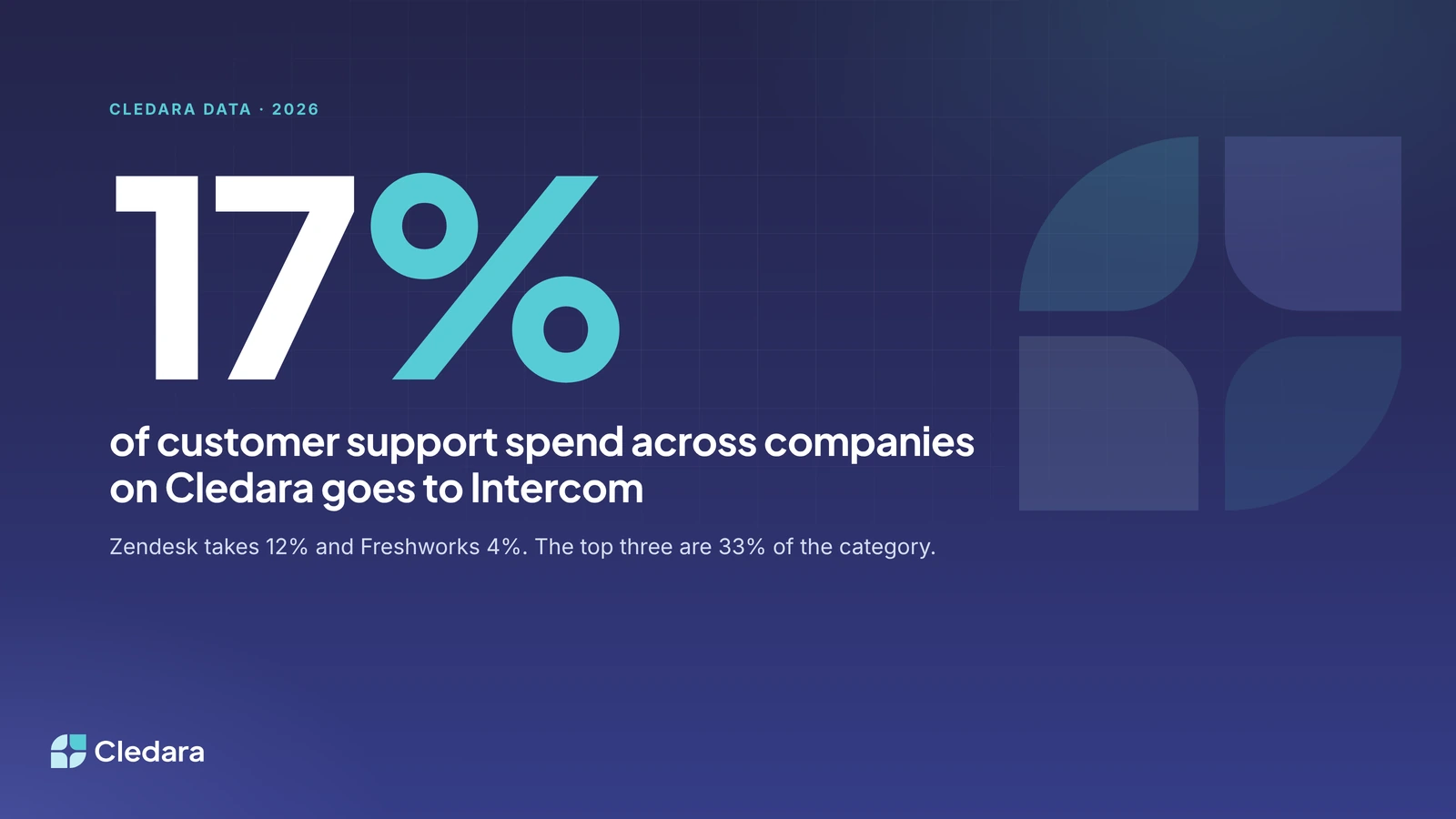
The short answer: Intercom and Zendesk. Intercom takes 17% of customer support spend across companies on Cledara (16.7% to be exact), Zendesk 12%. Freshworks is a distant third at 4%, so the top three are 33% of the category. (Cledara’s category also holds review platforms such as Trustpilot; they are not support tools, so I have left them out of the ranks.) Narrow it to the Support subcategory (the 28 helpdesk and messaging platforms proper) and Intercom is 45% of spend, Zendesk 32% and Freshworks 11%. Two vendors, three quarters of the money.
Key takeaways
- Intercom (16.7%) and Zendesk (11.9%) together take 29% of customer support spend across companies on Cledara; Freshworks (4.0%) is a distant third.
- Customer support tools are 5.7% of software spend across companies on Cledara, down from about 10% in early 2022 as AI tools took a bigger share of the budget.
- The incumbents are slipping in the popularity rankings (Intercom 32nd to 45th in a year) while cheaper chat tools like Crisp and Wati climb fast.
- Cledara's data does not break support tools out by headcount yet, so the ranks here are across all companies. I say so where it matters.
- 24% of the tools in the category are AI tools, and both leaders now sell AI agents priced per resolution on top of seats. That's the new cost line to watch.
- Finance controls support costs the same way as any other subscription: one list, one owner, one card per tool, and a renewal date you see coming.
Here is the full table of customer support tools. "Share of customer support spend" is each tool's share of spend in the category. "Popularity rank" is its rank among all software by the number of companies paying for it. The move is from November 2025 to October 2026.
Source: Cledara data, Customer Success & Support category, October 2026, via data.cledara.com. Spend shares are within the category; popularity ranks are across all software.
Notice the gap between popularity and money. Ringover is 74th across all software by popularity but takes under 1% of the spend; Wati, a WhatsApp tool, is 109th and 0.3%. Lots of companies, small bills. Intercom and Zendesk are the reverse: fewer companies, much bigger cheques.
How much of a SaaS company's software budget goes on customer support tools?
About 5.7% of software spend across companies on Cledara goes to customer support tools, and the category is 3.4% of all the tool-company relationships we see (Cledara data, October 2026). That makes it the eighth of twelve software categories by spend, and the tenth by popularity. It used to be bigger: in January 2022 the same category was about 10% of software spend.
I don't think support got cheaper. I think everything else got more expensive, and AI in particular. 27% of software spend on Cledara now goes to AI-native tools, up from about 3% two years ago, and that share had to come from somewhere. By team, the Customer Success and Support team's share of software spend fell from 5.0% in November 2025 to 3.8% in October 2026. Same tools, smaller slice.
So if your finance team is wondering whether customer support tools are the problem in the software budget, the data says probably not. The median company on Cledara pays for 32 tools, and the support stack is a handful of them. The bigger question is what those lines do at renewal, which I'll come to.
Which customer support software is most popular with startups?
By popularity (the number of companies paying), the most popular customer support tools across all companies on Cledara are Intercom (45th of all software), Zendesk (49th), Freshworks (68th), Ringover (74th) and Wati (109th). One honest caveat: Cledara's data does not yet break customer support tools out by company size or stage. Its company-size view falls back to a stack-size proxy (how many tools a company pays for), and that proxy does not split by category. So I can't give you a startup-only ranking, and I'd be suspicious of anyone who claims to.
What the data does show is movement, and the movement tells a startup story. The big three all fell down the popularity rankings over the year: Intercom from 32nd to 45th, Zendesk from 41st to 49th, Freshworks from 51st to 68th. Meanwhile the cheap, fast-to-set-up chat tools climbed: Crisp from 571st to 324th (flagged as a rising star in the data), Wati from 211th to 109th, tawk.to from 396th to 371st. Pylon, a support tool built around Slack Connect for B2B SaaS, moved from outside the top 1,500 to inside the top 700 between November 2025 and November 2026. Tidio, an AI-native chat tool, is another rising star.
Part of this is AI tools crowding the top of the rankings. But part of it is real: a seed-stage company in 2026 has more good customer support tools under the two big names than it did three years ago, and plenty are choosing them.
What is the best support platform for a 200-person SaaS company?
At 200 people you're almost always on Intercom or Zendesk for the helpdesk, and the data backs that up: between them they take 29% of customer support spend and sit 45th and 49th of all software by popularity. Which one is a product question I'll leave to your support lead. The finance question is what sits around it, because the helpdesk is rarely the only customer support tool on the bill.
Looking at the top products bought by Customer Success and Support teams on Cledara, the typical set of customer support tools at this size has four or five layers. Here's what they look like and what each one does to the bill.
Source: top products for the Customer Success / Support team in Cledara data, October 2026. Pricing models are the vendors' published models; I've left the numbers out on purpose because they change.
One more thing the data shows about this stack: 81.3% of companies paying for Intercom also pay for OpenAI, and 78% of Zendesk's do (Intercom vs Zendesk on data.cledara.com). Support teams are early AI adopters. The team's AI adoption rate is 28%, fifth of the twelve teams we track, behind Data and AI (55%) and Marketing (38%) but well ahead of Finance (16%). And 24% of the 347 customer support tools in the category are AI tools. If you run finance at a SaaS company, expect your support lead to ask for an AI budget soon. Our guide to AI spend management tools covers how to say yes safely.
Intercom vs Zendesk for a growing SaaS company
On Cledara's data, Intercom is the more popular of the two and the bigger spend line: 16.7% of customer support spend against Zendesk's 11.9%, and 45th against 49th by popularity. Both are classified as AI-embedded tools. Both lost ground over the year, Intercom from 0.48% to 0.32% of all software purchases and Zendesk from 0.38% to 0.27%, and the data shows no strong switching pattern between them (head to head on data.cledara.com). Companies pick one and stay.
What's changed for finance is how they charge. Both now sell an AI agent on top of the seats, and both price it per resolution: you pay when the AI closes a conversation on its own (Intercom's own pricing comparison sets out the models). Freshworks prices its AI per session. I think this is a good thing, honestly. A machine answering "where's my invoice?" at 3am is a better world for everyone, and paying for outcomes is fairer than paying for idle seats. But it means your support bill now has a usage component that moves with customer volume, not headcount, and the budget needs to know that.
Tip: when you compare the two, ask each vendor for the seat count, the AI resolution volume and the renewal uplift as three separate lines. The quote that looks cheaper on seats is often the one with the bigger usage line.
Customer support tools: the cost lines that surprise finance
Three things catch finance teams out with customer support tools, and none of them show up in the demo.
Seat creep comes first. Support hires in bursts, and every new starter needs a helpdesk seat on day one. Nobody removes the seat when someone leaves, because the person who left was the one who knew the admin. Our post on offboarding covers why; support is one of the worst categories for it because seats are expensive and turnover is high.
AI resolutions come second. A per-resolution line is a usage line, and usage lines don't ask permission before they grow. A good product launch doubles your conversations and the AI quietly handles half of them. Great for customers, surprising for whoever reads the statement.
Renewals come third, and this one is boring but expensive. Renewal prices rise 8 to 12% a year on average, and 15 to 25% with aggressive vendors. Companies that start negotiating 90 days before renewal average 49% savings, against 19% for those who start 30 to 90 days out. Support platforms are mostly annual contracts with auto-renewal, so the date matters. Our post on renewal price increases and cancellation terms has the detail.
How do finance teams control customer support software costs?
The same way they control every other subscription. Customer support tools aren't special; they're just a category where the seats, the usage and the renewal all move at once. Here's the checklist I'd give a finance manager at a fast-growing SaaS company.
- ✓ Put every support tool in one list with its owner, users, cost and renewal date. If you don't have one, start with our software subscription register template.
- ✓ Give each tool its own virtual card with its own limit. A per-resolution AI line can't run past a card limit it doesn't know about.
- ✓ Check seats against the HR system every month, and take back the ones nobody uses. Cledara Agent does this for you, with your approval, in 8,000+ tools.
- ✓ Benchmark what you pay against similar companies before renewal, not after. Cledara's Spend Optimisation module does this and flags price increases and duplicate tools.
- ✓ Check for duplicates: a chat tool running alongside the helpdesk's own chat is one of the most common ones we see. Our guide to finding unused and duplicate subscriptions has the method.
- ✓ Set a budget for the AI resolution line, hard cap or soft cap, and track usage against it daily rather than finding out at month end.
- ✓ Start the renewal conversation 90 days out. Put the date in the list and let the system remind you.
Key takeaway: Cledara customers save 23% on software spend on average, and a typical customer gets 30+ hours a month back. The support stack is a small part of the budget, but it's a good place to start because the owner is obvious and the renewal date is fixed.
Here's where I think this is going. The companies that win over the next few years will have machines answering the easy support questions and people handling the hard ones, with finance seeing the whole bill for customer support tools in one place and approving changes rather than discovering them. That's a happier support team, a better experience for customers, and a finance team that spends its time on finance. We built Cledara Agent to do the admin in between.
If you'd like to see what your own support stack looks like next to similar companies, the benchmarks are free at data.cledara.com, or book a demo and we'll walk you through it.
Cheers,
Brad