


What tools does a fractional CFO implement for spend management?
Here's something I've noticed about the fractional CFOs who last. They don't start with the budget. They start with a list.
A fractional CFO spend management stack is the set of tools a part-time finance leader puts in place at a new client so that money can be seen, approved, paid and reported without them being in the building. It has five layers: bank and cards, accounting, software subscription management (Cledara is an example of that layer), approvals and reporting. This post is about what goes in each, the order you set them up in, and why the order matters more than the brands.
If you're still deciding whether to hire one at all, start with our guide on how to hire fractional CFO services. This post is for the other side of the table: the fractional CFO who has just said yes to client number five and has to be useful by Friday.
Key takeaways
- A fractional CFO spend management stack has five layers: bank and cards, accounting, subscription management, approvals and reporting. Set them up in that order.
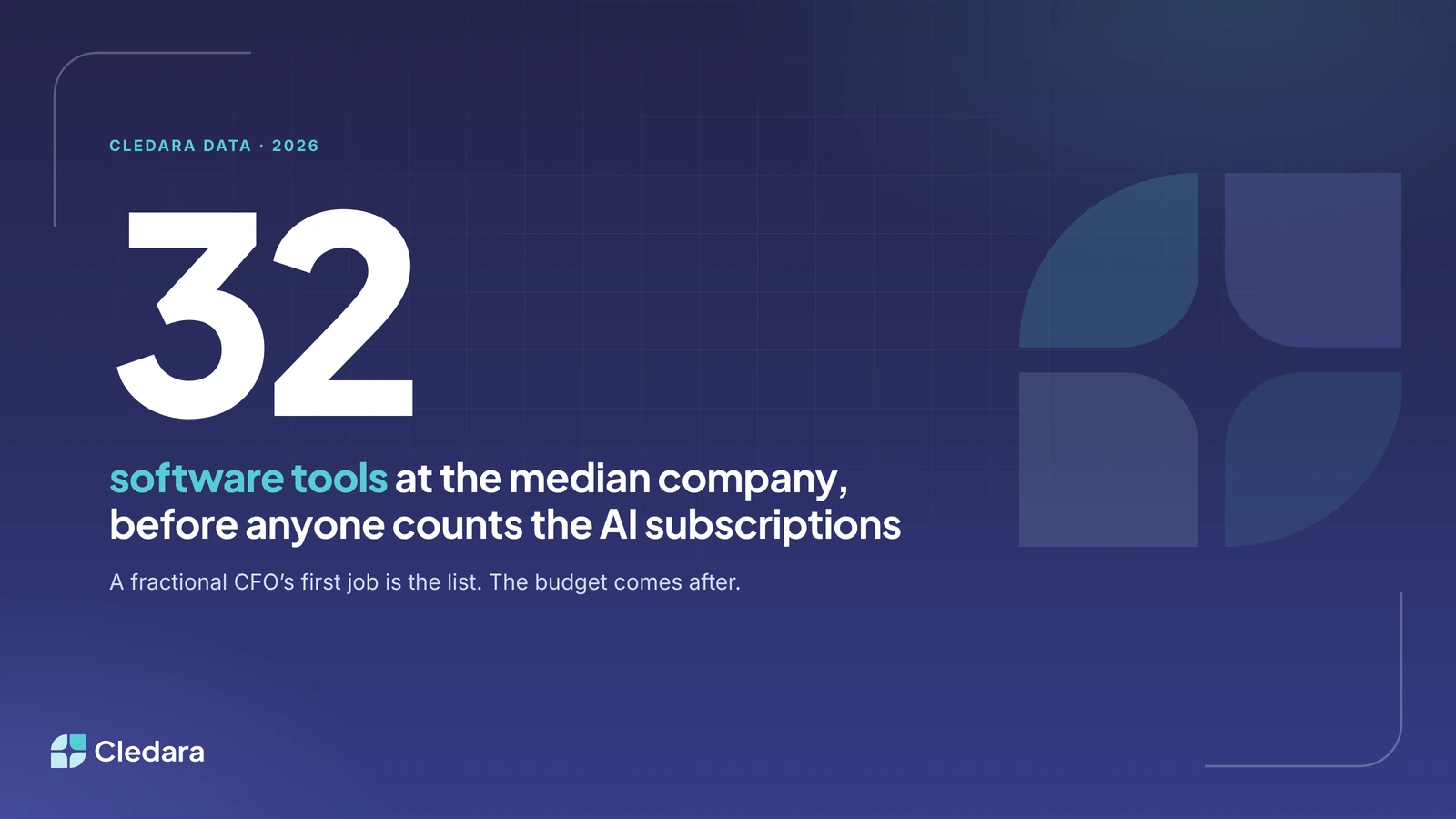
- Subscription management comes before the budget. The median company pays for 32 software tools (middle half 16 to 48) and 90% of software transactions are monthly, so the budget is wrong until the list is right.
- Renewal prices rise 8 to 12% a year on average, 15 to 25% with aggressive vendors. Starting negotiations 90 days out saves 49% on average, against 19% for 30 to 90 days out.
- The fastest way to see every subscription a client pays for is to pay each one from its own virtual card, so the list builds itself from the payments.
- The handover pack to an in-house team is the list, the renewal calendar, the approval rules and the coding map, not a spreadsheet and a prayer.
How we got here: why a fractional CFO inherits a mess
Software used to be bought by IT. One person signed one contract and finance saw one invoice a year. Now anyone with a card can start a subscription in about 90 seconds, so the admin of any tool could be anyone, and usually it's whoever signed up first and then changed jobs.
That's the client a fractional CFO walks into. The founder thinks the company has about ten tools. Cledara's data says the median company pays for 32, and the middle half pay for 16 to 48. That's 32 software tools at the median company, before anyone counts the AI subscriptions: AI-native tools now take 27% of software spend on Cledara, up from about 3% two years ago, and they're the ones most likely to be on someone's personal card.
The pain is human before it's financial. Someone is chasing people for invoices, and the people being chased hate the admin. VAT goes unreclaimed because the invoice is behind a login nobody has. A leaver still has access to the CRM, and the company is still paying for the seat (true story, more than once). Month-end closes late, and the fractional CFO, paid by the day, spends that day on it.
What should a fractional CFO set up in the first month at a startup?
In week one, set up the five layers of the fractional CFO spend management stack, one a day, in the order below. In weeks two to four, run the first month-end close through it, build the renewal calendar and send the first board pack. Do the five days properly and the rest of the month is mostly reading what the stack tells you.
Then the rest of the month, in order:
- Run the first month-end close through the stack. Every software payment should arrive with its invoice and codes in Xero or QuickBooks. Anything that doesn't is a gap in day 3: fix the list, not the journal.
- Build the renewal calendar from the list. Flag every renewal in the next 90 days and decide now which ones you'll renegotiate, downgrade or cancel. Our renewal tracking guide covers the 90, 60 and 30 day rhythm.
- Send the first board pack with a software line the founders can argue with: what we pay for, who owns it, what renews next quarter. Then write down the rules (thresholds, owners, how a leaver is removed). That's the start of the handover pack.
Tip: for a seed-stage startup, day 1 and day 2 can be the same day. Keep day 3 on its own. The list takes longer than anyone expects, and it's the part that pays back.
Why a fractional CFO sets up subscription management before the budget
You can't forecast what you can't see. A budget built on last year's software expense account is a budget built on a number that is wrong in three ways: it misses the tools paid on personal cards, it misses the renewals that will go up in price, and it misses the seats nobody uses. A fractional CFO's first job is the list. The budget comes after.
The price rises alone are worth the day. Renewal prices rise 8 to 12% a year on average, and 15 to 25% with aggressive vendors. Companies that start negotiating 90 days before renewal save 49% on average, against 19% for those that start 30 to 90 days out (our 2026 renewal benchmarks have the detail). You can only start 90 days out if you know the date, and you only know the date if it's on the list.
Then there's the scale. UK companies on Cledara spend a median of £73,846 a year on software, and the middle half spend between £29,549 and £161,780. Cledara customers save 23% on software spend on average once every subscription is on one list with an owner and a renewal date. I'll let you do the maths on what that means against the retainer.
Key takeaway: the list is the forecast. Everything else in the fractional CFO spend management stack exists to keep the list true without anyone maintaining it by hand.
How does a fractional CFO get visibility of every software subscription a client pays for?
Four sources, in order of how much they'll find: 12 months of bank and card transactions, the software expense accounts, a ten-minute conversation with each team lead, and the browser. Then one change so you never do it again: pay each subscription from its own virtual card, and the list builds itself from the payments.
The bank statement finds the recurring merchants. The ledger finds what someone remembered to code as software. The team leads find the tools on personal cards and the ones that were "free" until the trial ended. The browser finds the rest: Cledara Engage, our browser extension, shows which of 8,000+ tools people actually use, including ones nobody approved, and collects only a username and a timestamp. Never browsing history, content or passwords.
Expect the list to be longer than the client thinks. Jiminny's finance team found an extra 15% of subscriptions it didn't know it was paying for once everything was in one place (their story). Expect duplicates too: 69% of companies on Cledara paying for Zoom also pay for Google Workspace. Our guide to finding unused and duplicate subscriptions has the method.
Once the list exists, the job is keeping it true. That's where paying each tool from its own virtual card earns its place in the fractional CFO spend management stack. Every payment adds its tool to the list with an owner, a cost and a renewal date. Invoices are collected automatically (by email capture, a forwarding inbox, or Cledara Agent signing in to the tools whose invoices are never emailed) and synced with their codes to Xero, QuickBooks, NetSuite or Tripletex. Freezing a card cancels a tool in one click. The Spend Optimisation module benchmarks what the client pays against similar companies and flags duplicates, unused seats and price increases. If you'd rather start in a spreadsheet, our software subscription register template has the columns.
What is the best fractional CFO tool to manage multiple clients' consolidated reporting in one place?
Honest answer: for consolidated reporting across clients, the accounting system is the reporting tool, and you'll have one per client (Xero is the most used finance tool across Cledara customers). What you want from the rest of the fractional CFO spend management stack is that each layer feeds that accounting system cleanly, and that the tool for the software line can handle several entities without mixing them up.
Cledara supports multi-entity set-ups, so a fractional CFO can manage the software subscriptions of more than one client or group company, each as its own entity. The set-up is arranged with our team, so talk to us about how your clients are structured. Our guide to multi-entity SaaS management goes through the options for groups.
For the reporting itself, every plan gives you real-time software spend, budgets and forecasting (plan details are on our pricing page). The API is included on every plan, and transactions and invoices export as CSV, so if you already run your own CFO dashboard across clients, the software line can feed it without anyone retyping it.
How do fractional CFOs hand over to an in-house finance team?
By handing over a system, not a spreadsheet. The best fractional CFO handovers take an afternoon, because the new Head of Finance inherits the list, the renewal calendar, the approval rules and the coding map, all already running. The worst take a quarter, because everything lived in the fractional CFO's head and a workbook called final_v7.
Here's the per-client ✓ checklist I'd want to tick before the handover meeting:
- ✓ Every software and AI tool is on one list with an owner, users, cost, renewal date and card, and the owner still works there.
- ✓ Every renewal in the next 90 days has a decision against it: renew, renegotiate, downgrade or cancel.
- ✓ Every tool is mapped once to its expense account, department and cost centre, so payments code themselves.
- ✓ Approval rules are written down and running: thresholds, approvers, where the request lands.
- ✓ Three months of invoices are collected and matched to payments, with nothing outstanding.
- ✓ The HR system is connected (Cledara works with BambooHR, HiBob, Personio, Workday, Gusto and others), so leavers lose their tools. Our offboarding guide covers that side.
- ✓ Your own access is listed, dated and ready to be removed on the day.
This is the bit I find genuinely exciting about where finance is going. A typical Cledara customer gets 30+ hours a month back from software admin, and with Cledara Agent the repetitive parts (collecting the invoices nobody emails you, setting up new joiners, taking back unused seats, removing leavers) wait for an approval and then get done. So the in-house hire inherits a system that runs, not a pile of admin, and spends their time on the finance questions that made them want the job. If you're writing the case for that, our business case guide has the numbers.
What does a fractional CFO cost a startup?
In the UK, a fractional CFO typically costs £600 to £1,200 a day, with most engagements landing between £700 and £900 a day, according to FD Capital's 2026 pricing guide. On a retainer, the same source puts one day a week at about £2,800 to £4,300 a month and two days a week at £5,600 to £8,700 a month. Fractionus (April 2026) gives a wider retainer range of £5,000 to £14,000 a month, with two days a week at £8,000 to £10,000 a month, against a full-time CFO base salary of £190,000 to £300,000 a year.
Those ranges are the sources' own, and they move. The point is simpler. At £700 to £900 a day, every day a fractional CFO spends rebuilding a subscription list from bank statements is a day the client pays senior rates for data entry. The stack above exists so that day happens once, in week one, and never again.
Why this will seem obvious soon
Not that long ago, plenty of finance teams typed bank statements into the accounts by hand. Then bank feeds arrived, and within a few years nobody could remember doing it any other way. Software subscriptions are at the same point. A lot of fractional CFOs still build the list by hand at every new client. Soon the list will build itself from the payments, the invoices will collect themselves, and the handover will be an afternoon.
If you look after more than one client and want to see how the subscription management layer works across them, book a demo and we'll walk through it with your set-up in mind. And if you have a week-one routine that beats this one, I'd honestly like to hear it.
Cheers,
Brad