
Cledara's transaction data reveals the moment Anthropic overtook OpenAI in enterprise spend, and what the Pentagon controversy means for how companies are choosing their AI providers.
For the past two years, every company has been answering the same question: which AI provider do we bet on?
The answer used to be simple. OpenAI had the brand, the head start, and the integrations. ChatGPT was synonymous with AI itself. But our data, drawn from hundreds of thousands of real SaaS purchases across companies in the UK, Europe, and the US, tells a different story. One that shifted dramatically in the last 90 days.
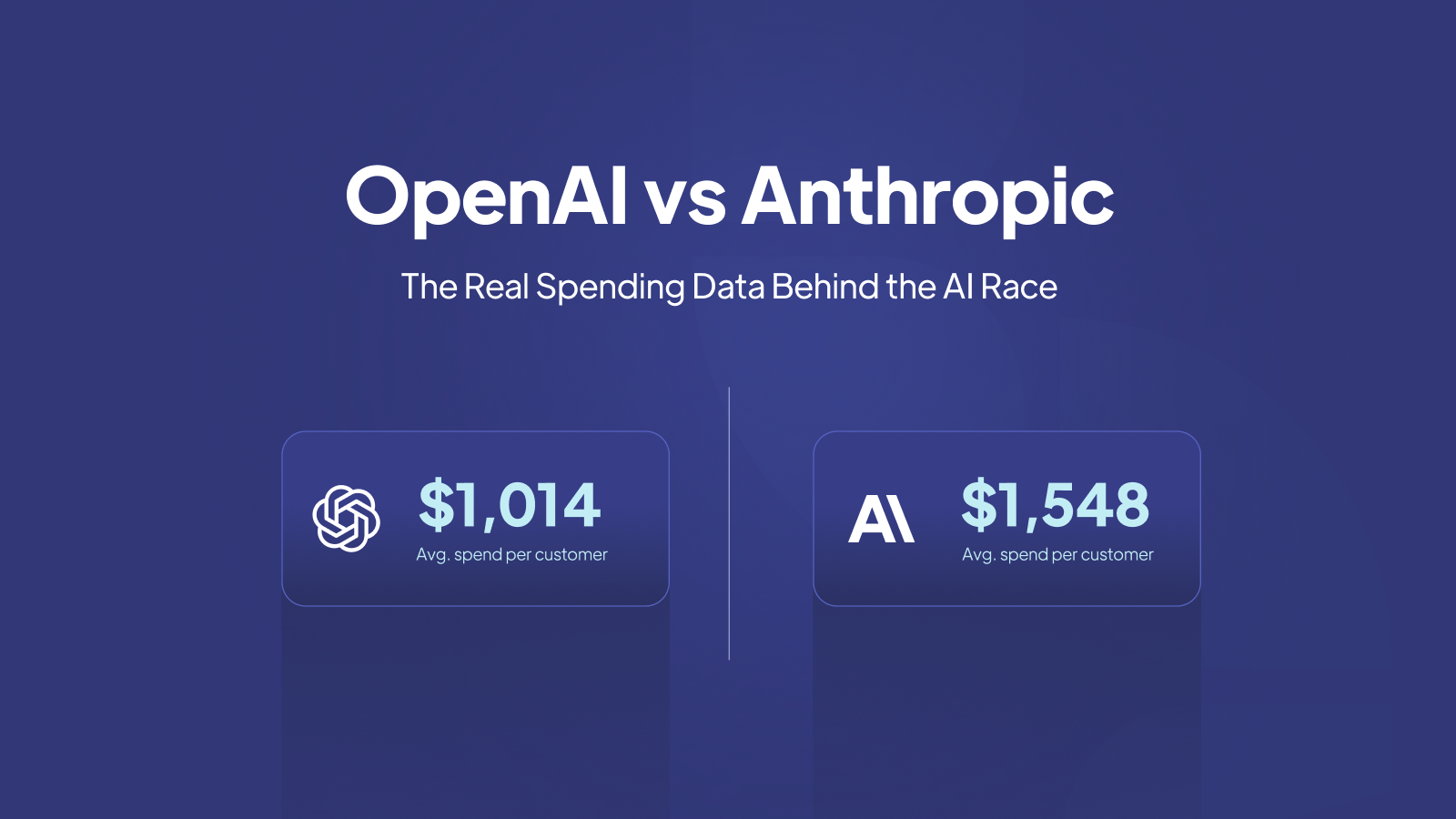
In March 2026, Anthropic overtook OpenAI in average spend per customer for the first time. And it wasn't close.
The Crossover: When Claude Caught ChatGPT
Twelve months ago, Anthropic's average spend per customer was less than a third of OpenAI's. By January 2026, the two were neck and neck. By March, Anthropic had pulled ahead decisively.
The trajectory tells the story: in April 2025, OpenAI customers averaged $543/month while Anthropic customers averaged just $163. By July it was $663 vs $332. October: $818 vs $642. Then in January 2026, the two nearly converged at $1,050 vs $1,049, almost to the dollar. February saw Anthropic pull ahead ($1,351 vs $1,172), and by March the gap widened to $1,548 vs $1,014.
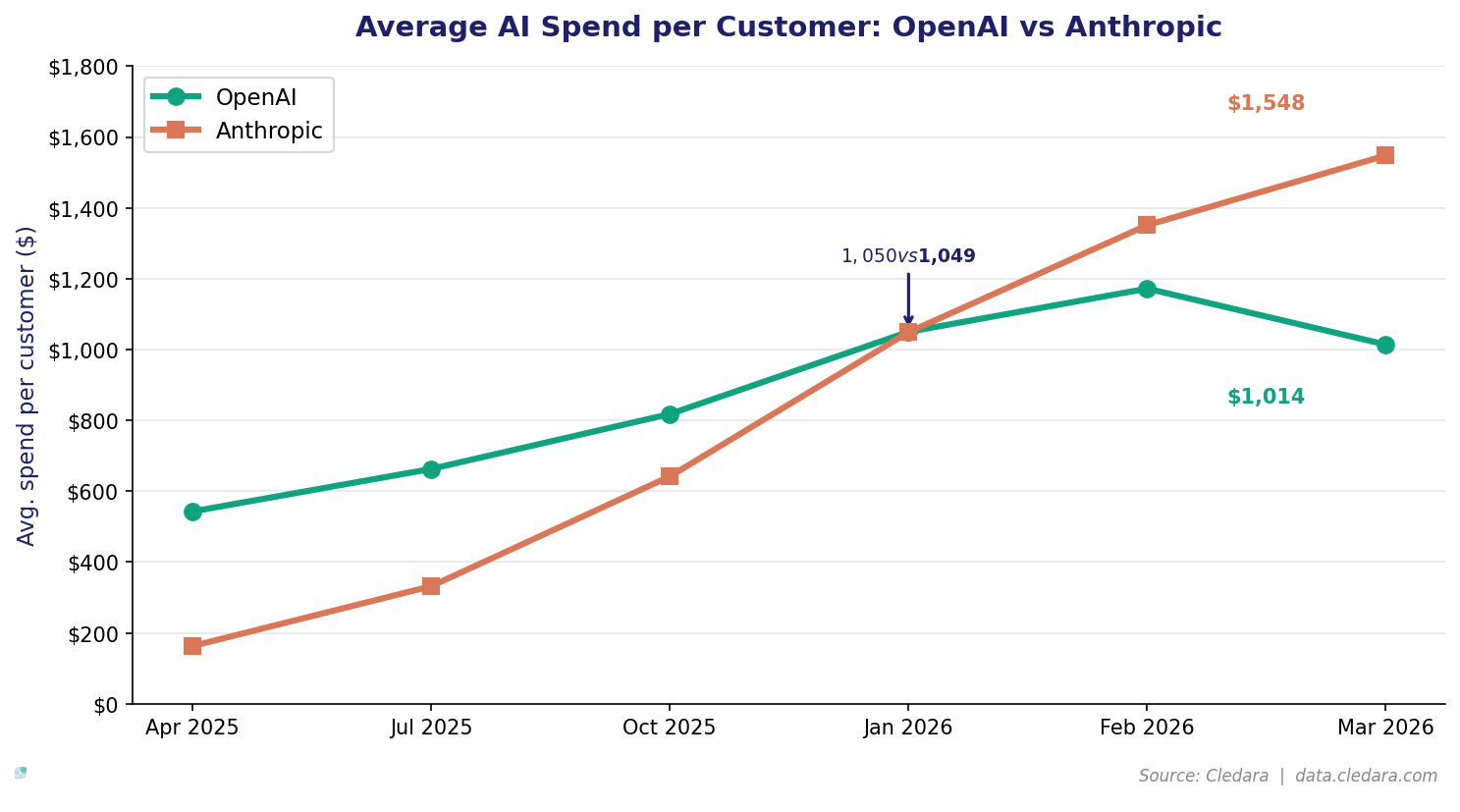
That January 2026 near-tie is remarkable. Then February and March pulled apart sharply: Anthropic customers now spend 53% more per company than OpenAI customers.
The divergence is driven by two forces: Anthropic's product momentum and OpenAI's political controversy.
The Product Race: Claude Opus 4.6 vs GPT-5.4
Both companies shipped aggressively in early 2026. Anthropic released Claude Opus 4.6 on February 5 and Claude Sonnet 4.6 on February 17, with significant improvements in coding, long-context reasoning, and agentic workflows. OpenAI followed with GPT-5.4 on March 5, featuring a 1 million token context window and a 33% reduction in factual errors.
On paper, the models are competitive. But our data suggests the market has started to differentiate between the two in a way it hadn't before. Anthropic is no longer just 'the alternative to ChatGPT.' It's becoming the default for a growing share of companies.
The Adoption Gap is Closing Fast
In January 2025, 55.8% of companies in our dataset had active OpenAI subscriptions. Just 9.2% had Anthropic subscriptions. Fourteen months later, the picture looks completely different.
As of March 2026, 56.1% of companies have active OpenAI subscriptions and 51.0% have Anthropic subscriptions. Anthropic now accounts for 15.4% of all SaaS transactions (up from 1.2% a year earlier), while OpenAI sits at 5.0%. Median transaction sizes are comparable ($45 for OpenAI, $39 for Anthropic), though OpenAI's mean transaction size ($299) remains higher than Anthropic's ($143), reflecting a wider spread of contract sizes.
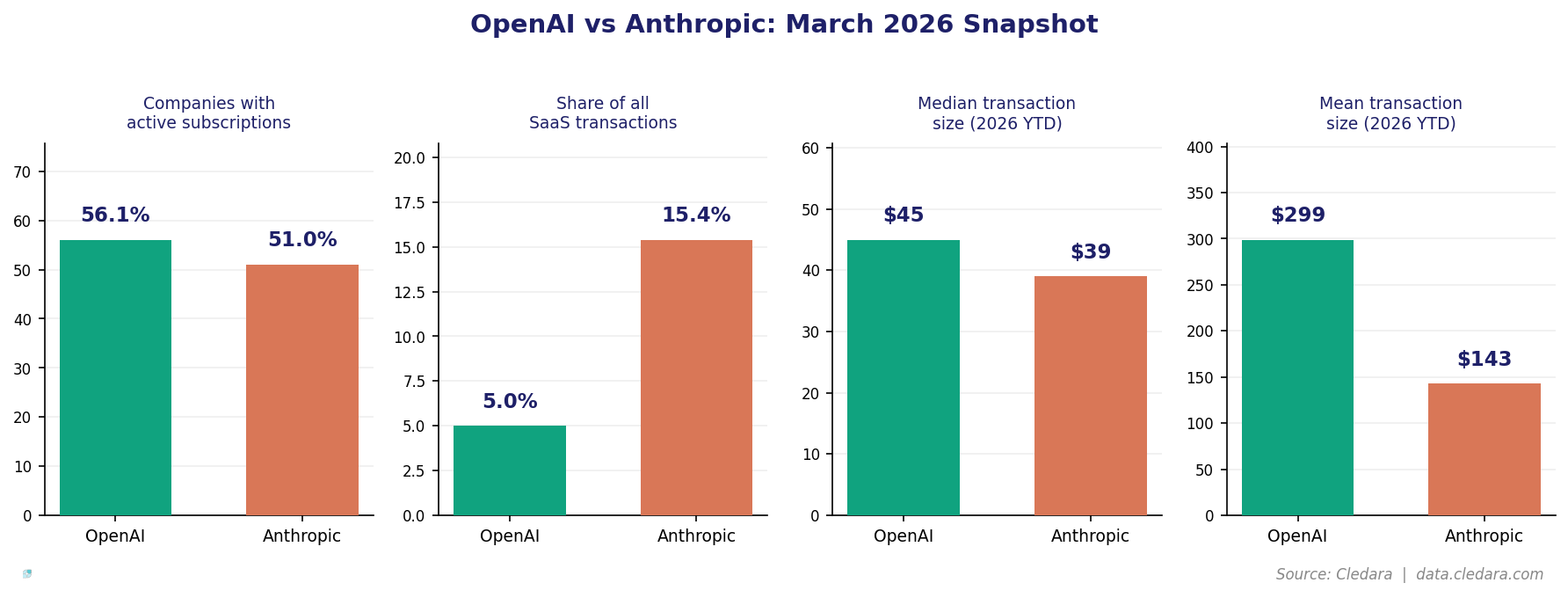
More than half of all companies now pay for both Claude and ChatGPT. In fact, 36.2% of active companies have subscriptions to both providers simultaneously. The era of picking one AI provider is over. Companies are hedging.
But look at the transaction share: Anthropic accounts for 15.4% of all SaaS transactions in March 2026, up from 1.2% in April 2025. That's a 12x increase in under a year. OpenAI, meanwhile, has dropped from 6.3% to 5.0% in the same period.
The Pentagon Effect
It's impossible to tell this story without addressing the elephant in the room.
On February 24, 2026, US Defense Secretary Pete Hegseth gave Anthropic CEO Dario Amodei a deadline: allow unrestricted military use of Claude, or face consequences. Anthropic refused. On February 27, President Trump directed federal agencies to stop using Anthropic's products, and the Pentagon designated the company a supply chain risk, a classification historically reserved for foreign adversaries like Huawei.
The same day, OpenAI signed a deal with the Pentagon for use of its models in classified systems.
The backlash was swift. The #CancelChatGPT movement surged, with the QuitGPT campaign claiming 2.5 million users canceled or pledged to cancel their subscriptions. US uninstalls of ChatGPT's mobile app jumped 295% the day after the deal was announced, and Sam Altman himself admitted the deal was 'opportunistic and sloppy.'
On March 9, Anthropic sued the federal government, arguing the blacklisting was unprecedented and unconstitutional. The case was heard yesterday, March 24, in San Francisco.
What the Data Shows: The Pentagon's Impact on Enterprise Spend
Our transaction data captures what happened to actual purchasing behavior. The weekly numbers from February and March 2026 are striking:
In the week of February 23, the week of Hegseth's ultimatum, Anthropic transactions already exceeded OpenAI's by more than 2:1. By the first week of March, after the Pentagon deal and the boycott, Anthropic transactions were running at nearly 3:1.
The share of companies actively paying OpenAI fell roughly 15% between January and mid-March. Meanwhile, the percentage of companies paying Anthropic climbed steadily, gaining several points over the same period.
These aren't consumer boycotts. These are corporate procurement decisions. When a company's finance team sees their AI vendor on the front page for a military surveillance contract, it triggers a review. And in many cases, that review is accelerating a shift that was already underway.
What This Means for Your AI Budget
If you're a finance or IT leader trying to make sense of AI spend, here's what we'd take away from the data:
1. Plan for multi-provider AI spend. The era of choosing one AI provider is over. More than a third of companies now pay for both OpenAI and Anthropic simultaneously. Your budgeting needs to account for this.
2. AI costs are climbing fast. Average spend per customer on these tools has roughly tripled in the past year for OpenAI and grown nearly 10x for Anthropic. This is not a line item you can set and forget.
3. Values are now a procurement factor. The Pentagon controversy has shown that a vendor's political and ethical positioning can directly impact purchasing decisions, even at the enterprise level. Whether you agree with the boycott or not, it's a variable your procurement process should account for.
4. Watch the transaction patterns, not just the headlines. The shift toward Anthropic was well underway before the Pentagon controversy. Claude's share of SaaS transactions grew 12x in under a year. The controversy accelerated an existing trend. It didn't create it.
The Bigger Picture
Across our dataset, AI tools now account for 15.4% of all SaaS transactions, up from around 6% a year ago. The spend is real, it's growing, and it's increasingly split across providers.
What the OpenAI vs Anthropic story really illustrates is that the AI market has matured past the 'there's only one option' phase. Companies are sophisticated buyers now. They're evaluating models on performance, pricing, trust, and increasingly, on the values of the companies behind them.
The question isn't whether AI will dominate the enterprise software stack. It already does. The question is who gets to be the default, and whether being first still matters when being trusted matters more.
This analysis is based on anonymized, aggregated transaction data from Cledara's platform, which tracks SaaS purchases across companies in the UK, Europe, and the US. All figures represent averages, percentages, and ratios. No individual company data is disclosed. Explore the latest SaaS rankings and trends at data.cledara.com.